Question 1
Refer to the exhibit. A customer wants to collect data from 120,000 objects and given the VMware
Aria Operations sizing guide.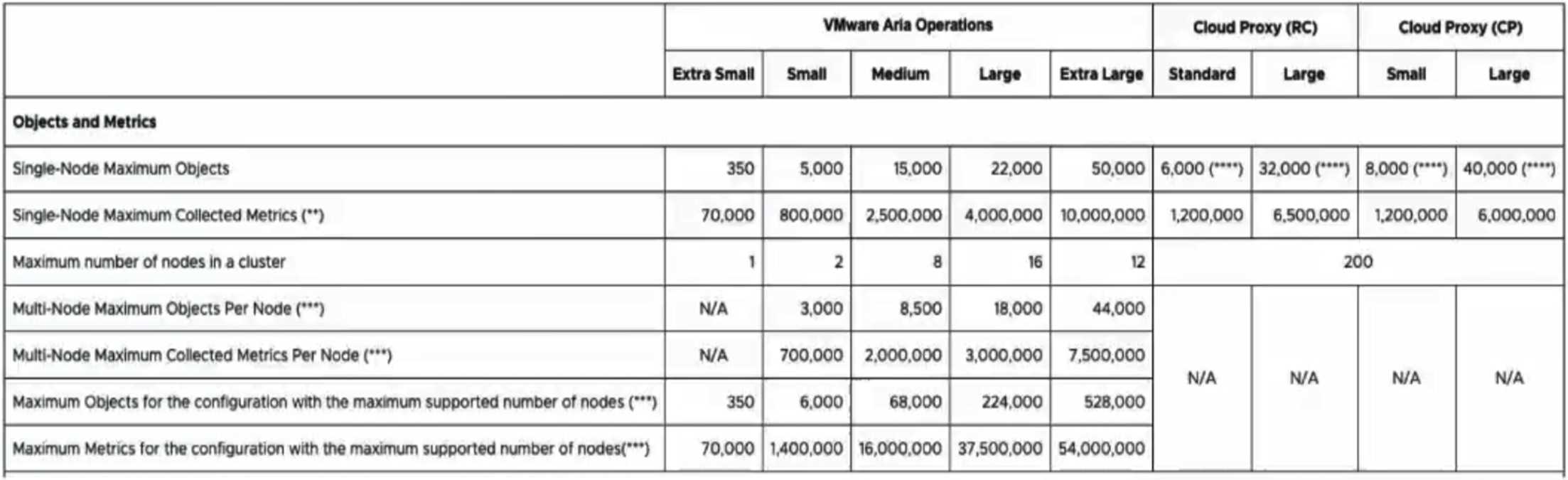
Assuming the customer has no requirements for continuous availability or high availability, what
recommendation for the quantity and type of nodes should the architect provide?
- A. 6 Large Nodes
- B. 12 Large Nodes
- C. 3 Extra Large Nodes
- D. 8 Medium Nodes
Answer:
C
Explanation:
Extra Large nodes support 44,000 objects each; three nodes deliver 132,000-object capacity,
satisfying the 120,000-object requirement with the smallest cluster.
Comments
Question 2
Which three products can be deployed with VMware Aria Suite Lifecycle? (Choose three.)
- A. VMware Aria Operations
- B. VMware Aria Operations for Applications
- C. VMware Aria Operations for Networks
- D. VMware Aria Operations for Logs
- E. VMware Aria Automation for Secure Clouds
- F. VMware Aria Business Insights
Answer:
A, B, D
Explanation:
VMware Aria Suite Lifecycle can deploy and manage VMware Aria Operations, VMware Aria
Operations for Applications, and VMware Aria Operations for Logs as part of the integrated cloud
management platform.
Comments
Question 3
An architect is designing the deployment of VMware Aria Operations for Logs in their data center.
The customer has the following requirements:
VMware Aria Operations for Logs cluster responds to multiple Virtual IP Addresses (VIPs)
Each event message received from a VIP is associated with a tag
Which two design decisions would the architect make to achieve the requirements? (Choose two.)
- A. Configure a list of dynamic tags (key=value) for an integrated load balancer VIP, so that each event message received from a VIP is annotated with a tag.
- B. Each node should have at least one network interface on a different subnet as that of a VIP.
- C. Configure a CSV file to use with VIP tags.
- D. Configure a list of static tags (key=value) for an integrated load balancer VIP, so that each event message received from a VIP is annotated with a tag.
- E. Each node should have at least one network interface on the same subnet as that of a VIP.
Answer:
A, D
Explanation:
To ensure that event messages from different VIPs are associated with specific tags, configure either
dynamic or static tags (key=value) on the integrated load balancer VIP. This allows VMware Aria
Operations for Logs to annotate each incoming event with the correct tag based on the VIP.
Comments
Question 4
An architect is responsible for designing the physical deployment of a four-node VMware Aria
Operations cluster for a healthcare customer. The following requirements must be met:
vSphere management cluster consists of three nodes
Recovery Time Objective (RTO) of less than 2 hours
Use existing customer backup solution
Which recommendation should the architect make to satisfy the requirements?
- A. Deploy VMware Aria Operations with both high availability and continuous availability with customer backup and restore capabilities.
- B. Deploy VMware Aria Operations high availability to address unintended disaster recovery with customer backup and restore capabilities.
- C. Deploy VMware Aria Operations continuous availability to address downtime with customer backup and restore capabilities.
- D. Deploy VMware Aria Operations relying on customer backup solution for backup and restore capabilities.
Answer:
B
Explanation:
High availability in VMware Aria Operations ensures the solution can tolerate node failures and
minimize downtime, supporting a low RTO. Leveraging the existing customer backup solution
provides backup and restore capabilities without the added complexity of continuous availability,
which is not strictly required for an RTO under 2 hours.
Comments
Question 5
An architect is designing a self-service Cloud Management solution environment such that:
It provides a way to calculate the price of each deployed Virtual Machine.
It displays an estimated cost to users when they are requesting a Virtual Machine.
Which two components can help meet these requirements? (Choose two.)
- A. VMware Aria Operations for Networks
- B. VMware Aria Operations for Logs
- C. VMware Aria Automation
- D. VMware Aria Operations
- E. VMware Aria Automation Orchestrator
Answer:
C, D
Explanation:
VMware Aria Automation enables self-service VM deployment and can show estimated costs to
users. VMware Aria Operations integrates with Aria Automation to provide pricing and cost
calculation for deployed resources. Together, they satisfy the requirements for price estimation and
cost display during VM requests.
Comments
Question 6
An architect is creating the design for VMware Aria Operations. The following requirements,
constraints, and recommendations were gathered:
Enable Continuous Availability
Monitor two physical locations
The sizing guide recommends deploying 5 analytics nodes
What are two design considerations for the analytics node deployment? (Choose two.)
- A. A sixth analytics node is needed
- B. High Availability will need to be enabled
- C. Two witness instances are required
- D. Extra Large Nodes must be used
- E. Two fault domains need to be created
Answer:
A, E
Explanation:
Enabling Continuous Availability requires that the number of analytics nodes be doubled (from 5 to
6) to provide node pairing across two fault domains. Creating two fault domains ensures node
redundancy across physical locations for CA functionality.
Comments
Question 7
A customer wants to deploy Workspace ONE Access for VMware Aria Suite users. The customer
wants to achieve the following requirements:
95% availability per month, excluding weekends
The deployment footprint must be minimal
Which design decision should the architect choose?
- A. Deploy a single Workspace ONE Access node and protect it with VMware Fault Tolerance.
- B. Deploy a single Workspace ONE Access node and protect it with vSphere High Availability.
- C. Deploy a Workspace ONE Access cluster and protect it with VMware Fault Tolerance.
- D. Deploy a Workspace ONE Access cluster and protect it with vSphere High Availability.
Answer:
B
Explanation:
A single node with vSphere High Availability meets the minimal deployment footprint requirement
and is sufficient to achieve 95% availability per month (excluding weekends). Clustering or Fault
Tolerance would increase complexity and resource usage beyond what is required by the customer's
availability target.
Comments
Question 8
A customer is deploying VMware Aria Operations for Logs in their data centers. The customer has the
following:
Three data centers in three geographical locations.
Each site has 1,000 logging sources that send events to VMware Aria Operations for Logs.
The customer has the following requirements:
Minimize the resources footprint in the management cluster where VMware Aria Operations for Logs
will be deployed.
VMware Aria Operations for Logs must be highly available with no single points of failure.
Logs collected from any data center must be protected against site failure.
Which three design decisions would the architect choose to achieve the requirements? (Choose
three.)
- A. Deploy four VMware Aria Operations for Logs large nodes in a single cluster in each data center.
- B. Deploy nine VMware Aria Operations for Logs medium nodes in a single cluster in each data center.
- C. Configure logs forwarding from each data center to another one.
- D. Configure filters to eliminate forwarding loops between VMware Aria Operations for Logs clusters.
- E. Configure logs forwarding from all data centers to a specific data center.
- F. Configure filters to forward critical logs to central VMware Aria Operations for Logs cluster.
Answer:
A, C, D
Explanation:
Deploying four large nodes per site ensures high availability without a single point of failure and
meets the resource requirement. Forwarding logs between data centers protects against site failure.
Configuring filters to eliminate forwarding loops is essential for maintaining efficient log flow and
preventing duplicates or cycles in the system.
Comments
Question 9
An architect is designing a VMware Aria Operations for Logs cluster for an organization. The
organization has the following requirements:
No requirement for archival data
Support a log data retention period of 14 days
How will the log data be handled in this VMware Aria Operations for Logs cluster after the 14-day
retention period?
- A. A variable sized chunk of old log messages is deleted to free up space based on the data age basis.
- B. Old log messages are automatically and periodically retired on a first-come-first-retired basis.
- C. The user needs to manually select and delete specific old log messages to free up space.
- D. Old log messages are automatically and periodically retired on least accessed basis.
Answer:
B
Explanation:
VMware Aria Operations for Logs automatically deletes log data older than the defined retention
period (in this case, 14 days) using a first-come-first-retired method, ensuring compliance with the
retention policy without manual intervention.
Comments
Question 10
Which two sources can be integrated with the service catalog in VMware Aria Automation
Consumption to provide content? (Choose two.)
- A. Git Repository
- B. VMware Aria Automation Orchestrator
- C. Azure Resource Management (ARM) Templates
- D. AWS Cloud Formation Templates
- E. IP Address Management (IPAM) Solution
Answer:
B, D
Explanation:
VMware Aria Automation Consumption can integrate with VMware Aria Automation Orchestrator for
workflows and AWS Cloud Formation Templates for provisioning AWS resources, both of which can
be published as catalog items for end users.
Comments
Page 1 out of 8
Viewing questions 1-10 out of 86
page 2