Question 1
Consider the following extract of a model showing relationships between Business Architecture
concepts: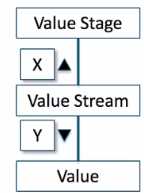
What is the relationship labeled Y?
- A. Consists of
- B. Receives
- C. Enables
- D. Creates
Answer:
C
Explanation:
This answer is based on the definition of the enables relationship in the ArchiMate 3.1
Specification 1
, which states that “An enabling relationship describes how an element (e.g., a node,
device, or system software) enables another element (e.g., a business process, service, or function)
to function.” In this case, the value stream stage enables the business capability to function, as it
provides the necessary inputs, outputs, and resources for the capability to deliver value. The other
options are not correct, as they do not describe the relationship between a value stream stage and a
business capability.
Comments
Question 2
Which of the following is the element of a value stream stage mat describes the end state condition
denoting the completion of the value stream stage?
- A. Exit criteria
- B. Target stale
- C. End point
- D. Completion stage
Answer:
A
Explanation:
This answer is based on the definition of exit criteria in the TOGAF Series Guide: Value Streams 2
,
which states that “Exit criteria are a set of conditions that must be met before proceeding to the next
stage in a value stream. They are used to ensure that the value stream stage has been completed
successfully and that the required outputs have been produced.” Exit criteria describe the end state
condition that denotes the completion of a value stream stage, as they indicate that the stage has
achieved its objectives and can move on to the next stage. The other options are not correct, as they
do not describe the element of a value stream stage that denotes its completion.
Comments
Question 3
Which Input to Phase B is a document that may form the basis of a contractual agreement between
the supplier and consume! of the architecture services?
- A. Architecture Vision
- B. Business principles, goals, and drivers
- C. Statement of Architecture Work
- D. Architecture Road map
Answer:
C
Explanation:
This answer is based on the definition of Statement of Architecture Work in the TOGAF Standard,
Version 9.2 - Phase A: Architecture Vision 3
, which states that “The Statement of Architecture Work is
a document that may form the basis of a contractual agreement between the supplier and consumer
of architecture services. It defines what will be delivered by an architecture project, how it will be
delivered, when it will be delivered, and how much it will cost.” The Statement of Architecture Work
is an input to Phase B, as it provides the scope, approach, constraints, assumptions, risks, and
deliverables of the architecture project. The other options are not correct, as they are not documents
that may form the basis of a contractual agreement between the supplier and consumer of
architecture services.
Comments
Question 4
Consider the following table of techniques used w decompose a business architecture: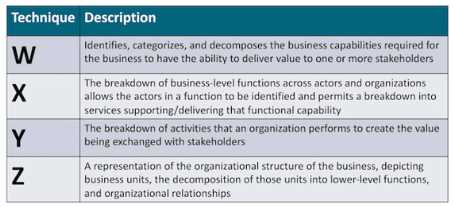
What is the technique marked W?
- A. Value Stream Mapping
- B. Organization Mapping
- C. Process Modeling
- D. Business Capability Mapping
Answer:
D
Explanation:
This answer is based on the definition of business capability mapping as “a technique for the
representation of an organization’s business anchor model, independent of the organization’s
structure, processes, people, or domains” . Business capability mapping identifies, categorizes, and
decomposes the business capabilities required for the business to have the ability to deliver value to
one or more stakeholders. The other options are not correct, as they do not match the description of
the technique marked W.
Comments
Question 5
Compete the sentence. An objective of Phase B is to identify candidate architecture Roadmap
components based upon______________________.
- A. the Architecture Requirements Impact Assessment
- B. the Architecture Vision created in Phase
- C. gaps between the Baseline and Target Business Architectures
- D. a cross-mapping of Value Stream Stages to Business Capabilities
Answer:
C
Explanation:
This answer is based on the TOGAF Standard, Version 9.2 - Phase B: Business Architecture , which
states that “The objective here is to identify candidate Architecture Roadmap components based
upon gaps between the Baseline and Target Business Architectures.” The Architecture Roadmap is a
document that outlines the work packages, projects, and programs required to implement the target
architecture. The gaps between the Baseline and Target Business Architectures are the differences or
deficiencies in the current and future states of the business that need to be addressed by the
architecture project. The other options are not correct, as they are not the basis for identifying
candidate Architecture Roadmap components.
Comments
Question 6
What fundamental business architecture concepts should be considered when creating an
Architecture Vision?
- A. Business use-cases, event diagrams, class models
- B. Business capabilities. organization maps, value streams
- C. Business data model, business roles, business processes
- D. Information exchange matrix, class models, node connectivity diagrams
Answer:
B
Explanation:
This answer is based on the TOGAF Series Guide: Business Capabilities , which states that “The
fundamental concepts that should be considered when creating an Architecture Vision are business
capabilities, organization maps, and value streams.” These concepts help to define and communicate
the essence of what a business does or can do, how it is organized and structured, and how it
delivers value to its stakeholders. The other options are not correct, as they are not fundamental
business architecture concepts that should be considered when creating an Architecture Vision.
Comments
Question 7
Which input to Phase A provides context for the architecture work by describing the needs and ways
of working of the enterprise?
- A. Business principles, goals, and drivers
- B. Architecture Vision
- C. Architecture Roadmap
- D. Architecture Principles
Answer:
A
Explanation:
This answer is based on the TOGAF Standard, Version 9.2 - Phase A: Architecture Vision 1
, which
states that “Business principles, business goals, and strategic drivers of the organization are already
defined elsewhere in the enterprise. If so, the activity in Phase A is involved with ensuring that
existing definitions are current, and clarifying any areas of ambiguity. Otherwise, it involves defining
these essential items from scratch.” Business principles, goals, and drivers provide context for the
architecture work by describing the needs and ways of working of the enterprise. They define the
desired outcomes, the guiding values, and the strategic direction of the enterprise. They also help to
align the architecture work with the business strategy and objectives. The other options are not
correct, as they do not provide context for the architecture work in Phase A.
Comments
Question 8
Consider the following definition of the elements of a value stream: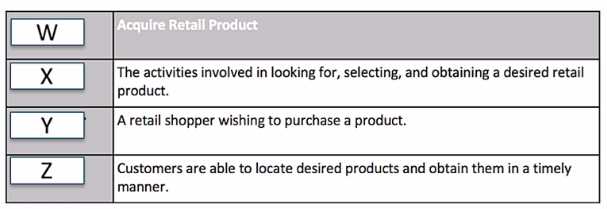
What is the element labeled 7?
- A. Outcome
- B. Viewpoint
- C. Value
- D. Concern
Answer:
C
Explanation:
This answer is based on the TOGAF Series Guide: Value Streams 2
, which states that “Value is a
measurable improvement to a stakeholder’s situation that is perceived to be positive by that
stakeholder.” Value is the element labeled 7 in the image, as it represents the benefit or outcome
that is delivered to the stakeholder by the value stream. Value is always defined from the perspective
of the stakeholder, and it can be expressed in quantitative or qualitative terms. The other options are
not correct, as they do not match the element labeled 7 in the image.
Comments
Question 9
Which of the following is a purpose of mapping capabilities to value stream stages?
- A. To provide a self-contained business that is Independent of the organizational structure.
- B. To Identity which business capabilities are critical to deliver value
- C. To describe the business in terms of services provided and consumed.
- D. To classify, group, and align capacities into categories for a deeper understanding
Answer:
B
Explanation:
This answer is based on the TOGAF Series Guide: Business Capabilities 3
, which states that “Mapping
capabilities to value stream stages allows an organization to identify which capabilities are critical to
deliver value to stakeholders and which capabilities are less important or even unnecessary.”
Mapping capabilities to value stream stages helps to assess the alignment and impact of the business
capabilities on the value delivery process. It also helps to prioritize and optimize the capabilities
based on their contribution to value creation. The other options are not correct, as they are not
purposes of mapping capabilities to value stream stages.
Comments
Question 10
Which of me following is considered a guying principle when creating value streams?
- A. Identify the lop-level value streams from components of capabilities
- B. Create an Initial set of value streams that map one-to-one to existing capabilities.
- C. Avoid going down to operational levels of detail
- D. Start with internal value streams within the organization
Answer:
C
Explanation:
This answer is based on the TOGAF Series Guide: Value Streams 2
, which states that “A guiding
principle when creating value streams is to avoid going down to operational levels of detail. The
purpose of a value stream is to provide a high-level view of how value is created and delivered by an
enterprise.” Going down to operational levels of detail can make the value stream too complex and
difficult to understand and communicate. It can also obscure the strategic focus and direction of the
value stream. The other options are not correct, as they are not guiding principles when creating
value streams.
Comments
Page 1 out of 2
Viewing questions 1-10 out of 30
page 2