Question 1
Consider the following diagram: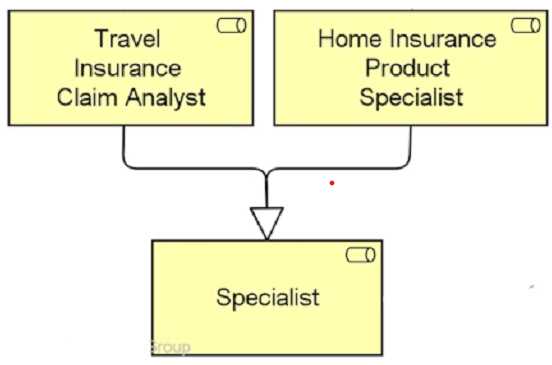
Which of the following correctly describes this diagram?
- A. The two business roles Travel Insurance Claim Analyst and Home Insurance Product Specialist are specializations of the business role Specialist
- B. The business role Specialist approves all claims handled by the two business roles Travel Insurance Claim Analyst and Home Insurance Product Specialist
- C. The two business roles Travel Insurance Claim Analyst and Home Insurance Product Specialist together realize the business role Specialist.
- D. The business role Specialist is an aggregation of the two business roles Travel Insurance Claim Analyst and Home Insurance Product Specialist.
Answer:
A
Explanation:
Based on the ArchiMate 3 documents or objectives, the diagram uses a specialization relationship to
indicate that the two business roles Travel Insurance Claim Analyst and Home Insurance Product
Specialist are more specific versions of the business role Specialist. A specialization relationship is a
type of structural relationship that indicates that an object is a specialization of another object. The
notation for a specialization relationship is a solid line with an empty triangle at the end that points
to the more general element.
Reference: ArchiMate® 3.2 Specification, Chapter 4 Generic Metamodel, Section 4.1 Behavior and
Structure Elements, Subsection 4.1.2 Structural Relationships 1
; ArchiMate Specialization
Relationship - ArchiMate Quick Guide - GitBook
.
Comments
Question 2
Which of the following is a Passive Structure Element?
- A. Application Component
- B. Actor
- C. Event
- D. Data Object
Answer:
D
Explanation:
Based on the ArchiMate 3 documents or objectives, a data object is a passive structure element that
represents a piece of data that can be manipulated by behavior elements such as application
functions or services. A passive structure element is a structural element that cannot perform
behavior. Active structure elements can perform behavior on passive structure elements.
Reference: ArchiMate® 3.2 Specification, Chapter 4 Generic Metamodel, Section 4.1 Behavior and
Structure Elements, Subsection 4.1.1 Active Structure Elements 1; ArchiMate® 3.2 Specification,
Chapter 10 Application Layer, Section 10.2 Passive Structure Elements 1
.
Comments
Question 3
Consider the following diagram: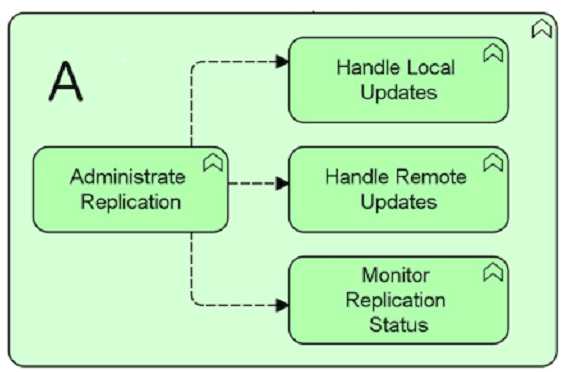
What correctly describes this diagram?
- A. Four technology functions realize technology function A The first function Administrate Replication triggers the other three functions in parallel
- B. Technology process A aggregates four technology services. The Administrate Replication service is broken down into three other services.
- C. Technology function A is composed of four technology processes. The technology process Administrate Replication reads information from the three other processes.
- D. Technology function A is composed of four technology functions. Information flows from Administrate Replication to the other functions.
Answer:
D
Explanation:
Based on the ArchiMate 3 documents or objectives, a technology function represents a collection of
technology behavior that can be performed by a node. The diagram uses a composition relationship
to indicate that technology function A consists of four other technology functions. The notation for a
composition relationship is a solid line with a filled diamond at the end that points to the whole
element. The diagram also uses an information flow relationship to indicate that information is
exchanged from Administrate Replication to the other functions. The notation for an information
flow relationship is a dashed line with an open arrowhead at the end that points to the direction of
the flow.
Reference: ArchiMate® 3.2 Specification, Chapter 4 Generic Metamodel, Section 4.1 Behavior and
Structure Elements, Subsection 4.1.2 Structural Relationships
; ArchiMate® 3.2 Specification,
Chapter 11 Technology Layer, Section 11.2 Behavior Elements
; ArchiMate® 3.2 Specification,
Chapter 5 Relationships, Section 5.5 Other Relationships
; ArchiMate Patterns – Technology Layer –
General Geekery
.
Comments
Question 4
Complete the sentence. The ArchiMate standard provides a set of entities and relationships for
1. modeling detailed workflow
2. providing fine-grained descriptions of business motivation
3. representing Architecture Description
4. supporting a fixed set of diagram types
Answer:
C
Explanation:
Based on the ArchiMate 3 documents or objectives, the ArchiMate standard provides a set of entities
and relationships for representing Architecture Description. Architecture Description is a work
product used to express an architecture for a system-of-interest. The ArchiMate language is an open
and independent modeling language for Enterprise Architecture that is supported by different tool
vendors and consulting firms.
Reference: The ArchiMate® Enterprise Architecture Modeling Language | The Open Group Website
;
ArchiMate® 3.2 Specification, Chapter 1 Introduction, Section 1.1 Objective
.
Comments
Question 5
A Risk Assessment service provided by a Risk Measurement application enables actuaries to assess
and mitigate financial risks as part of the Enterprise Risk Management process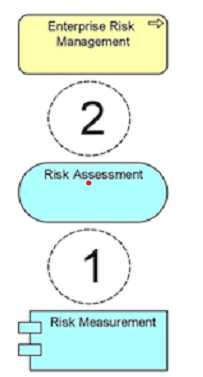
Which combination of relationships, when added to this diagram, would best represent this
situation?
- A. Realization and 2. Serving
- B. Realization and 2. Assignment
- C. Realization and 2. Realization
- D. Serving and 2. Realization
Answer:
A
Explanation:
Based on the ArchiMate 3 documents or objectives, a realization relationship indicates that an entity
plays a critical role in the creation, achievement, sustenance, or operation of a more abstract entity.
A serving relationship models that an element provides its functionality to another element. The
diagram should use a realization relationship from the Risk Assessment service to the Enterprise Risk
Management process to indicate that the service realizes the process. The diagram should also use a
serving relationship from the Risk Measurement application to the Risk Assessment service to
indicate that the application serves the service.
Reference: ArchiMate® 3.2 Specification, Chapter 5 Relationships, Section 5.1 Structural
Relationships 1; ArchiMate® 3.2 Specification, Chapter 5 Relationships, Section 5.2 Dependency
Relationships 1
; ArchiMate Notation: Part 8 – Relationships - ArchiMate Resources for FREE
.
Comments
Question 6
What are the types of elements defined in the top-level language structure of the ArchiMate
concepts?
- A. Application, Business, Strategy, Technology
- B. Active, Behavior, Passive
- C. Behavior, Composite, Motivation, Structure
- D. Abstract, Core, Composite
Answer:
C
Explanation:
Based on the ArchiMate 3 documents or objectives, the top-level language structure of the
ArchiMate concepts defines four types of elements: Behavior, Composite, Motivation, and Structure.
Behavior elements represent units of activity performed by one or more active structure elements.
Composite elements represent collections of other concepts that belong together based on some
criteri
a. Motivation elements represent the reasons for designing and implementing an architecture.
Structure elements represent structural concepts that model the static construction or composition
of concepts of the same or different types.
Reference: ArchiMate® 3.2 Specification, Chapter 3 Language Structure, Section 3.2 Top-Level
Language Structure 1
; ArchiMate - Wikipedia
.
Comments
Question 7
What concept would you use to define a point of access where an application service is made
available to a user?
- A. Application service
- B. Application interface
- C. Application interaction
- D. Application function
Answer:
B
Explanation:
Based on the ArchiMate 3 documents or objectives, an application interface represents a point of
access where an application service is made available to a user, another application component, or a
node. An application interface specifies how the functionality of a component can be accessed by
other elements. The notation for an application interface is a square with a small circle attached to it.
Reference: ArchiMate® 3.2 Specification, Chapter 10 Application Layer, Section 10.1 Active Structure
Elements 1; Application Layer in ArchiMate Part 2 – Notation and Concepts - ArchiMate Resources for
FREE 2
.
Comments
Question 8
Complete following sentence: In the generic metamodel the main types of elements can be divided
into
- A. resources and events
- B. structure and behavior
- C. grouping and location
- D. process and function
Answer:
B
Explanation:
Based on the ArchiMate 3 documents or objectives, the generic metamodel defines two main types
of elements: structure and behavior. Structure elements represent the structural concepts that model
the static construction or composition of concepts of the same or different types. Behavior elements
represent units of activity performed by one or more active structure elements.
Reference: ArchiMate® 3.2 Specification, Chapter 4 Generic Metamodel, Section 4.1 Behavior and
Structure Elements 1
; ArchiMate® 3.0.1 Specification - The Open Group
.
Comments
Question 9
Consider the following diagram: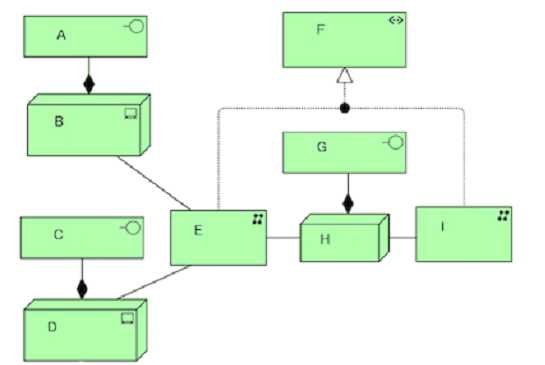
What correctly describes the elements E, F and I?
- A. The two communication networks E and I together realize a path F.
- B. Communication network E passes data from server B through the path F to communication network I
- C. Technology collaboration F aggregates the two communication networks E and l.
- D. Users on servers B and D trigger data from communication network E to I through path F.
Answer:
B
Explanation:
Based on the ArchiMate 3 documents or objectives, a communication network represents a set of
structures that connects devices or system software for transmission, routing, and reception of dat
a. A path models the relation between two or more technology internal active structure elements,
through which these can exchange information. The diagram uses a flow relationship to indicate that
data flows from server B to communication network E, then through path F to communication
network I. The notation for a flow relationship is a dashed line with an open arrowhead at the end
that points to the direction of the flow.
Reference: ArchiMate® 3.2 Specification, Chapter 11 Technology Layer, Section 11.2 Active Structure
Elements 1; ArchiMate® 3.2 Specification, Chapter 5 Relationships, Section 5.4 Dynamic
Relationships 1
; ArchiMate communication network
.
Comments
Question 10
In the Application Layer metamodel, what is the relationship type from an application service to a
data object?
- A. Realization
- B. Composition
- C. Access
- D. Aggregation
Answer:
C
Comments
Page 1 out of 7
Viewing questions 1-10 out of 78
page 2