Question 1
Which artifact from the SAP Reference Solution Architecture shows which data objects are exchanged
between SAP application components in a given end-to-end scenario?
- A. SAP Data Object Diagram, which is available from SAP API Business Accelerator Hub (api.sap.com)
- B. SAP Data Flow Diagram, which is available from SAP API Business Accelerator Hub (api sap.com)
- C. SAP Data Component Diagram, which is available in SAP Signavio Process Explorer
Answer:
B
Explanation:
The SAP Data Flow Diagram (DFD) is an artifact from the SAP Reference Solution Architecture that
shows which data objects are exchanged between SAP application components in a given end-to-end
scenario. The DFD uses a graphical representation to show the flow of data between different
components of a system.
The SAP Data Object Diagram (DOD) is also an artifact from the SAP Reference Solution Architecture,
but it does not show the flow of data between different components. The DOD shows the structure
of data objects, including their attributes and relationships.
The SAP Data Component Diagram (DCD) is an artifact from SAP Signavio Process Explorer, which is a
tool for modeling business processes. The DCD shows the different components of a system,
including their relationships.
Therefore, the correct answer is option B.
Here is a table that summarizes the different artifacts and their purposes: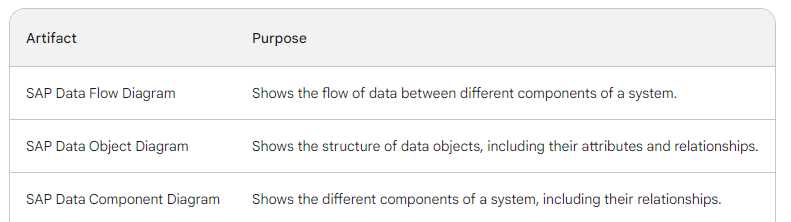
According to the SAP Reference Architecture Content: An Overview – Part 2 , the SAP Data Flow
Diagram is an artifact that shows the flow of data through the SAP solution, from the source to the
destination. It also shows which data objects are exchanged between the different components and
services of the SAP solution, such as master data, transactional data, analytical data, or configuration
data. The SAP Data Flow Diagram can help you to understand and communicate how data is created,
transformed, and consumed in a SAP solution, and to identify and optimize the data integration
points and dependencies.
The other options (A and C) are not correct for the artifact from the SAP Reference Solution
Architecture that shows which data objects are exchanged between SAP application components in a
given end-to-end scenario, because they either do not exist or do not show the data flow. For
example:
Option A is not correct because there is no such artifact as SAP Data Object Diagram in the SAP
Reference Solution Architecture content. The SAP API Business Accelerator Hub (api.sap.com) is a
platform that provides access to SAP APIs, events, and related resources, but it does not provide any
diagrams that show the data objects exchanged between SAP application components.
Option C is not correct because the SAP Data Component Diagram is not an artifact that shows the
data flow, but rather an artifact that shows the main components and services that constitute the
target application architecture, as well as their relationships and interactions. The SAP Data
Component Diagram does not show which data objects are exchanged between the different
components and services of the SAP solution. The SAP Signavio Process Explorer is a tool that helps
you to model, analyze, and optimize business processes, but it does not provide any diagrams that
show the data flow.
Comments
Question 2
Green Elk & Company is the world's leading manufacturer of agricultural and forestry machinery. The
former company slogan "Elk always runs has recently been changed to Elk feeds the world". One of
Green Elk's strategic goals is to increase its revenue in the emerging markets of China, India, and
other parts of Asia by 80 % within three years. This requires a new business model that caters to
significantly smaller farms with limited budgets. You are the Chief Enterprise Architect and the CIO
asks you to assess the new business model for smaller farms with smaller budgets. Given the
principle and statement, which of the following combinations of rationale and implication do you
consider well-defined?
A)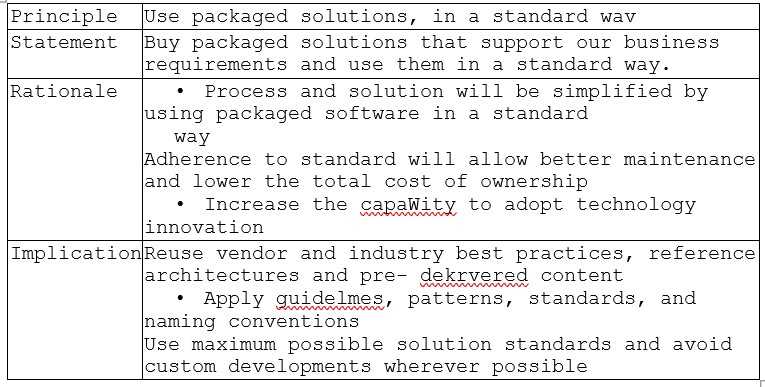
B)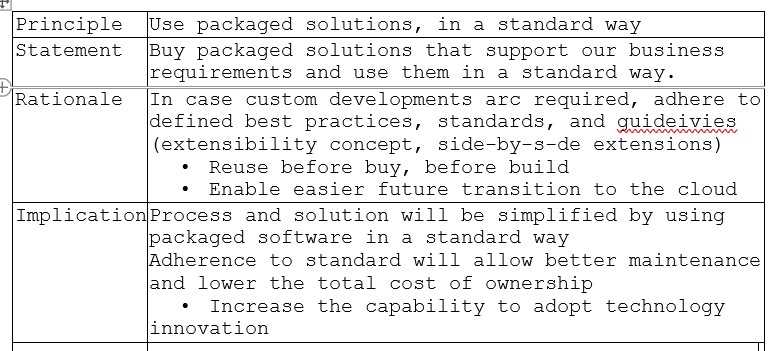
C)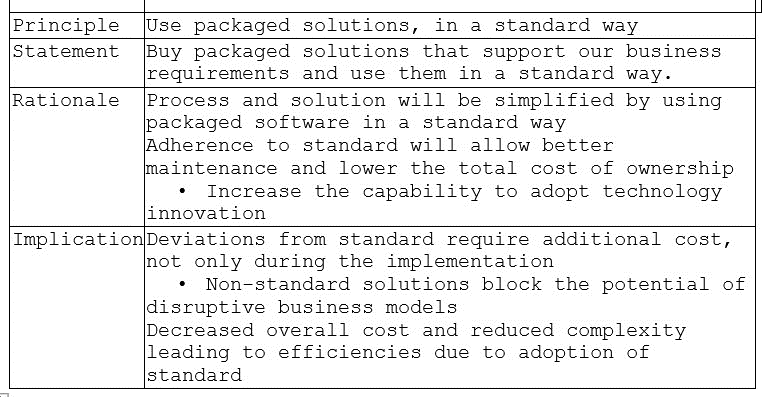
D)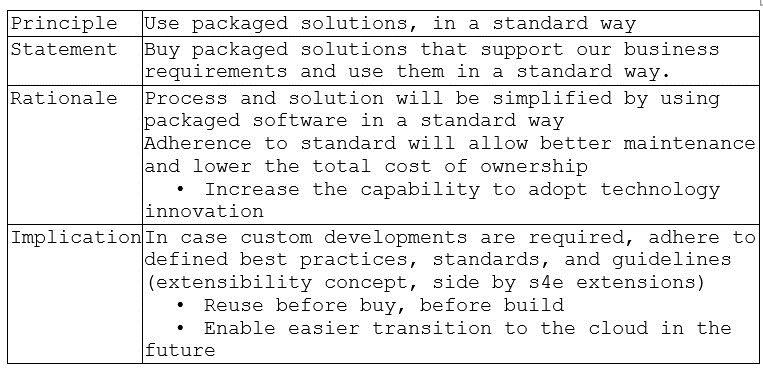
- A. Option A
- B. Option B
- C. Option C
- D. Option D
Answer:
D
Explanation:
The rationale and implication in this combination are well-defined because they both support the
principle of using packaged solutions in a standard way. The rationale explains the benefits of using
packaged solutions, while the implication outlines the steps that need to be taken to ensure that
packaged solutions are used in a standard way.
According to the SAP Enterprise Architecture Framework, which is a methodology and toolset by the
German multinational software company SAP that helps enterprise architects define and implement
an architecture strategy for their organizations, a principle is a general rule or guideline that
expresses a fundamental value or belief, and that guides the design and implementation of the
architecture. A principle consists of four elements: a name, a statement, a rationale, and an
implication. The name is a short and memorable label that summarizes the principle. The statement
is a concise and precise description of the principle. The rationale is an explanation of why the
principle is important and beneficial for the organization. The implication is a description of the
consequences or impacts of applying or not applying the principle.
The principle in option D is:
Name: Use packaged solutions, in a standard way.
Statement: Buy packaged solutions that support our business requirements and use them in a
standard way.
Rationale: Process and solution will be simplified by using packaged software in a standard way.
Adherence to standard will allow better maintenance and lower the total cost of ownership. Increase
the capability to adopt technology innovation.
Implication: In case custom developments are required, adhere to defined best practices, standards,
and guidelines (extensibility concept, side-by-side extensions). Reuse before buy, before build.
Enable easier transition to the cloud in the future.
This combination of rationale and implication is well-defined because it clearly and logically explains
the benefits and consequences of following or not following the principle. The rationale shows how
using packaged solutions in a standard way can simplify the process and solution, reduce the cost and
effort of maintenance, and increase the ability to adopt new technologies. The implication shows
how custom developments should be minimized and standardized, how reuse should be preferred
over buying or building new solutions, and how cloud readiness should be considered for future
scalability.
The other options (A, B, C) are not correct for the combination of rationale and implication that is
well-defined because they either mix up or confuse some of the elements of the principle. For
example:
Option A is not correct because it mixes up the rationale and implication elements. The first sentence
of the rationale (“Process and solution will be simplified by using packaged software in a standard
way”) is actually an implication of following the principle, not a reason for following it. The first
sentence of the implication (“Reuse vendor and industry best practices, reference architectures and
pre-delivered content”) is actually a rationale for following the principle, not a consequence of
following it.
Option B is not correct because it confuses the rationale and implication elements. The first sentence
of the rationale (“In case custom developments are required, adhere to defined best practices,
standards, and guidelines (extensibility concept, side-by-side extensions)”) is actually an implication
of following the principle, not a reason for following it. The first sentence of the implication (“Process
and solution will be simplified by using packaged software in a standard way”) is actually a rationale
for following the principle, not a consequence of following it.
Option C is not correct because it confuses the rationale and implication elements. The second
sentence of the rationale (“Adherence to standard will allow better maintenance and lower the total
cost of ownership”) is actually an implication of following the principle, not a reason for following it.
The second sentence of the implication (“Reuse before buy, before build”) is actually a rationale for
following the principle, not a consequence of following it.
Comments
Question 3
As part of the mapping of a Business Architecture to the Solution Architecture, an Environment &
Location Diagram must be developed in the Technology Architecture phase. In this context,
numerous architecture decisions have to be made. Among other things, you must check which SAP
BTP services and which SAP SaaS solutions are available as part of the Solution Architecture in which
data center of the desired hyperscaler. How do you go about this validation?
- A. I use the SAP Business Accelerator Hub (api.sap.com) because it provides all the required information regarding SAP BTP service and SAP SaaS solution availability for each hyperscaler, in a central location.
- B. I use the SAP Discovery Center to check which of the selected SAP BTP services are offered by which hyperscaler. With help from the SAP Trust Center, I check in which data center the involved SAP SaaS solutions are available.
- C. I use the SAP Discovery Center to check in which data centers the respective SAP BTP services and the SAP SaaS solutions are available.
Answer:
B
Explanation:
According to the SAP Discovery Center 1
and the SAP Trust Center
, the steps involved in this
validation are:
Use the SAP Discovery Center to check which of the selected SAP BTP services are offered by which
hyperscaler. The SAP Discovery Center is a platform that provides access to SAP BTP services, events,
and related resources, and helps you to implement your use cases on SAP BTP with step-by-step
guidance and support from topic experts and SAP Community. In the Service Catalog section of the
SAP Discovery Center, you can browse and filter the available SAP BTP services by category, region,
or hyperscaler. You can also compare the features and pricing of different services, and learn how to
use them in your projects.
Use the SAP Trust Center to check in which data center the involved SAP SaaS solutions are available.
The SAP Trust Center is a platform that provides information on cloud performance, security, privacy,
and compliance. In the Certification and Compliance section of the SAP Trust Center, you can find
certificates, reports, and attestations that show how SAP meets various industry standards and
regulatory requirements. You can also filter the documents by solution, region, or hyperscaler, and
download them for your reference.
The other options (A and C) are not correct for how to validate the availability of SAP BTP services
and SAP SaaS solutions in the desired hyperscaler’s data center, because they either do not exist or
do not provide the required information. For example:
Option A is not correct because there is no such platform as SAP Business Accelerator Hub
(api.sap.com) that provides all the required information regarding SAP BTP service and SAP SaaS
solution availability for each hyperscaler. The correct name of the platform is SAP API Business Hub
(api.sap.com), which is a platform that provides access to SAP APIs, events, and related resources,
but it does not provide any information on the availability of SAP BTP services or SAP SaaS solutions
for each hyperscaler or data center.
Option C is not correct because the SAP Discovery Center does not provide any information on the
availability of SAP SaaS solutions for each hyperscaler or data center. The SAP Discovery Center only
provides information on the availability of SAP BTP services for each hyperscaler or region, but not
for specific data centers. To check the availability of SAP SaaS solutions for each data center, you need
to use the SAP Trust Center instead.
Comments
Question 4
Why is it useful to create Transition Architectures in the Application Architecture domain?
- A. They structure complex application architectures that require multiple changes to existing independent applications and/or the rollout of new applications. Considered applications/solutions do NOT depend on the existence of others.
- B. They reduce the total number of solution components in the target state of complex application architectures that require multiple changes of existing applications and/or rollout of new applications. All applications/solutions do NOT depend on the existence of others.
- C. They structure complex application architectures that require multiple changes of existing interdependent applications and/or the rollout of new applications. Some applications/solutions depend on the existence of others.
Answer:
C
Explanation:
According to the SAP Enterprise Architecture Framework, which is a methodology and toolset by the
German multinational software company SAP that helps enterprise architects define and implement
an architecture strategy for their organizations, Transition Architectures are intermediate states
between the Baseline Architecture (the current situation) and the Target Architecture (the desired
future state). Transition Architectures describe how to move from one state to another in a feasible
and manageable way, taking into account the constraints and dependencies of the project. Transition
Architectures are useful for structuring complex application architectures that require multiple
changes of existing interdependent applications and/or the rollout of new applications. Some
applications/solutions depend on the existence of others, meaning that they cannot be implemented
or operated without the presence or functionality of other applications/solutions. For example, a
new application that relies on data from an existing application, or an existing application that needs
to be integrated with a new application. By creating Transition Architectures, enterprise architects
can:
Define and prioritize the sequence and timing of the changes and rollouts that are needed to achieve
the Target Architecture.
Identify and mitigate the risks and issues that might arise during the transition process, such as
technical, operational, or organizational challenges.
Communicate and align with the stakeholders and sponsors of the project, such as business owners,
users, developers, vendors, etc.
Monitor and control the progress and performance of the project, and ensure that it meets the
requirements and expectations of the project.
Transition Architectures are useful in the Application Architecture domain because they can help to
structure complex application architectures that require multiple changes of existing interdependent
applications and/or the rollout of new applications.
In some cases, it may be possible to make changes to existing applications independently of each
other. However, in many cases, changes to one application will require changes to other applications.
This is because applications often depend on each other for data or functionality.
Transition Architectures can help to identify these dependencies and to plan the changes to the
applications in a way that minimizes the impact on the business. They can also help to ensure that
the changes are made in a consistent and orderly fashion.
The following are some of the benefits of using Transition Architectures in the Application
Architecture domain:
They can help to improve the visibility of complex application architectures.
They can help to identify dependencies between applications.
They can help to plan the changes to applications in a way that minimizes the impact on the
business.
They can help to ensure that the changes are made in a consistent and orderly fashion.
Therefore, Transition Architectures can be a valuable tool for managing complex application
architectures.
Comments
Question 5
Green Elk & Company is the world's leading manufacturer of agricultural and forestry machinery. The
former company slogan "Elk always runs has recently been changed to "Elk feeds the world". One of
Green Elk's strategic goals is to increase its revenue in the emerging markets of China, India, and
other parts of Asia by 80% within three years. This requires a new business model that caters to
significantly smaller farms with limited budgets. The CIO asks you, the Chief Enterprise Architect, to
present an Architecture Roadmap that addresses the business challenge. According to the SAP
Enterprise Architecture Framework, what is the best answer?
- A. Create a work breakdown structure to identify milestones, key deliverables and resources to outline the planned transformation.
- B. Reuse the artifacts of previous phases as input for creating roadmaps. Focus on the Target Architecture and define an application architecture roadmap.
- C. Reuse the artifacts of previous phases as input for creating roadmaps. Focus on the Business Strategy Map with business capabilities and initiatives and define a business architecture roadmap
- D. Reuse the artifacts of previous phases as input for creating roadmaps. Start with a roadmap construction table, by defining initiatives and business outcomes, and detailing the business capabilities and solutions, to create two versions of a roadmap (outcome-based and application- specific)
Answer:
D
Explanation:
The SAP Enterprise Architecture Framework (EAF) defines an Architecture Roadmap as a "high-level
plan that describes the sequence of activities and deliverables required to achieve the target
architecture." The roadmap should be based on the artifacts of the previous phases of the EAF, such
as the Business Strategy Map, the Solution Concept, and the Baseline Business and Solution
Architecture.
The first step in creating an Architecture Roadmap is to define the initiatives that will be needed to
achieve the target architecture. These initiatives should be aligned with the business outcomes that
the organization is trying to achieve.
The next step is to detail the business capabilities and solutions that will be needed to support the
initiatives. This will help to ensure that the roadmap is realistic and achievable.
Finally, the roadmap should be created in two versions: an outcome-based roadmap and an
application-specific roadmap. The outcome-based roadmap will show how the initiatives will achieve
the business outcomes. The application-specific roadmap will show how the solutions will be
implemented.
By following these steps, you can create an Architecture Roadmap that will help you to achieve your
organization's strategic goals.
Here are some of the benefits of creating an Architecture Roadmap:
It can help you to visualize the sequence of activities and deliverables required to achieve your goals.
It can help you to identify dependencies between activities and deliverables.
It can help you to track progress and to make adjustments as needed.
It can help you to communicate your plans to stakeholders.
Therefore, an Architecture Roadmap can be a valuable tool for managing complex transformations.
According to the SAP Enterprise Architecture Framework, which is a methodology and toolset by the
German multinational software company SAP that helps enterprise architects define and implement
an architecture strategy for their organizations, the steps involved in creating an Architecture
Roadmap are:
Reuse the artifacts of previous phases as input for creating roadmaps. The previous phases of the
architecture development cycle are: architecture vision, business architecture, information systems
architecture, and technology architecture. The artifacts of these phases provide the information and
guidance for defining the scope, objectives, stakeholders, requirements, constraints, and solutions of
the architecture project. Some of the artifacts that can be reused for creating roadmaps are:
stakeholder map, business strategy map, solution strategy, solution context diagram, solution
component diagram, solution application use-case diagram, solution value flow diagram, etc.
Start with a roadmap construction table, by defining initiatives and business outcomes, and detailing
the business capabilities and solutions. A roadmap construction table is a tool that helps to structure
and organize the information and elements that are needed to create a roadmap. It consists of four
columns: initiatives, business outcomes, business capabilities, and solutions. Initiatives are the
strategic actions or projects that are planned to achieve the business goals and drivers. Business
outcomes are the measurable results or benefits that are expected from implementing the
initiatives. Business capabilities are the skills, resources, and competencies that are required or need
to mature to support the initiatives and outcomes. Solutions are the products or services that are
used or delivered to enable the capabilities and outcomes.
Create two versions of a roadmap (outcome-based and application-specific). A roadmap is a visual
representation of the transition architectures that will move the organization from its current state
(baseline architecture) to its desired future state (target architecture). A roadmap shows the
sequence and timing of the transition architectures, as well as the deliverables, resources, and risks
associated with each transition architecture. There are two types of roadmaps that can be created:
outcome-based and application-specific. An outcome-based roadmap focuses on the business
outcomes that are achieved by implementing the transition architectures. An application-specific
roadmap focuses on the solutions or applications that are implemented or changed by the transition
architectures.
The other options (A, B, C) are not correct for how to present an Architecture Roadmap that
addresses the business challenge because they either skip or misrepresent some of the steps in
creating an Architecture Roadmap. For example:
Option A is not correct because it does not include reusing the artifacts of previous phases as input
for creating roadmaps, which is an important step to ensure alignment and consistency with the
architecture project. It also suggests creating a work breakdown structure instead of a roadmap
construction table, which is not a tool in this framework.
Option B is not correct because it does not include creating two versions of a roadmap (outcome-
based and application-specific), which is an important step to provide different perspectives and
levels of detail for the roadmap. It also suggests focusing on the target architecture instead of the
transition architectures, which is not a logical approach since the latter determine how to achieve
the former.
Option C is not correct because it does not include starting with a roadmap construction table, which
is an important step to structure and organize the information and elements that are needed to
create a roadmap. It also suggests focusing on the business strategy map instead of the initiatives
and outcomes, which is not a sufficient level of detail for creating a roadmap.
Comments
Question 6
In the SAP Enterprise Architecture Framework, which of the following artifacts are part of the
opportunities & solution phase? Note: There are 3 correct answers to this question.
- A. Business Architecture Roadmap
- B. Work Breakdown structure
- C. Implementation Roadmap
- D. Application Architecture Roadmap
- E. Migration plan
Answer:
ABD
Explanation: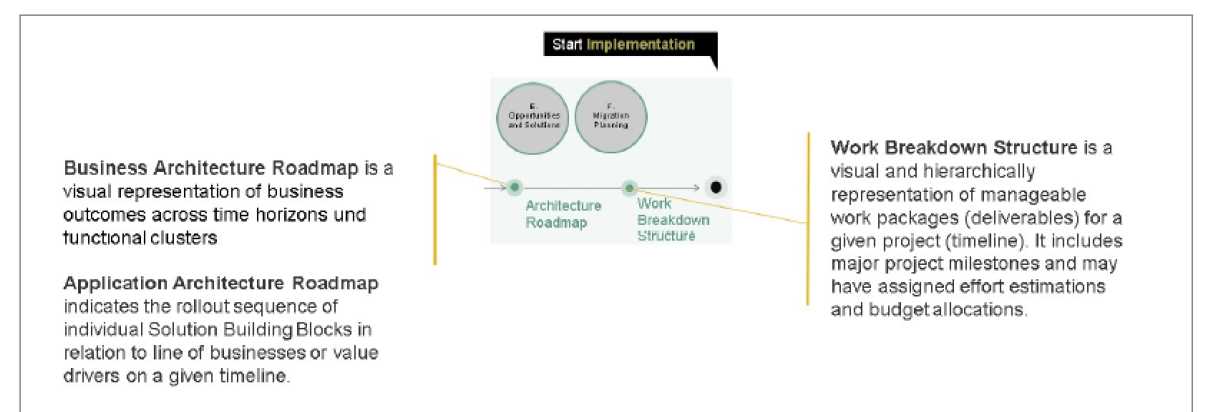
Comments
Question 7
A custom web application developed with SAPUI5 and running on SAP Business Technology Platform
uses large custom data objects deployed in a central data store (SAP HANA Cloud). The solution
architect of the application is unsure about which tools to use for integration of this data from
different SAP Sources into the central data store and asks you as the Enterprise Architect for
guidance. Under which conditions is a data-oriented integration approach (Data Integration)
preferable to other integration styles?
- A. The data objects are built with data from different SAP and non-SAP sources that change infrequently and are available from REST and Message APIs (event-driven systems).
- B. If the data objects are built with data from different SAP and non-SAP sources that can be structured and unstructured, change with high frequency, and need to be cleansed, correlated and partly newly calculated.
- C. If the data objects are built with data from different SAP and non-SAP sources that can be structured and unstructured, change with high frequency, and need to be newly calculated.
Answer:
B
Explanation:
A data-oriented integration approach is optimal when dealing with diverse data sources and complex
data requirements. This includes scenarios where the data is both structured and unstructured,
changes rapidly, and needs significant processing such as cleansing, correlation, and partial
recalculation. The advantage of this approach is that it centralizes data handling and transformation
logic, allowing for more efficient data processing and integration into a central store like SAP HANA
Cloud.
Reference = SAP's guidelines on data integration recommend this approach when handling large and
complex data sets that require intensive processing and are sourced from a variety of SAP and non-
SAP systems. It is supported by SAP's data management and integration tools that are designed to
handle such complexity and frequency of change.
Comments
Question 8
What kind of applications can you develop with SAP Business Application Studio?
- A. SAPUI5 (SAP Fiori) applications and ABAP applications
- B. ABAP applications
- C. SAPUI5 (SAP Fiori) applications
Answer:
C
Explanation:
SAP Business Application Studio is a modern development environment designed to support the
development of various SAP-centric applications. Among the supported application types are:
SAPUI5 (SAP Fiori) applications (C): SAP Business Application Studio provides extensive tools and
templates specifically tailored for developing SAPUI5 applications, which are the backbone of the
SAP Fiori user experience. This includes support for frontend development with rich user interfaces,
integration with SAP services, and adherence to SAP Fiori design principles.
Options A and B are incorrect because SAP Business Application Studio does not support ABAP
development directly within its environment. ABAP development traditionally requires a different
set of tools and environments provided by SAP, such as the ABAP Development Tools (ADT) in Eclipse
or the ABAP environment on SAP Cloud Platform.
Reference:
SAP Business Application Studio documentation.
SAP Fiori development guidelines provided by SAP.
Comments
Question 9
Which artifacts does SAP provide as part of the SAP Reference Business Architecture content?
- A. Business Capability Model/Business Data Model/Business Role Model/Product Map
- B. Business Process Model/Solution Process Model
- C. Business Capability Model/Business Process Model
Answer:
C
Comments
Question 10
What are important factors of the SAP BTP. Cloud Foundry environment during runtime that you
need to consider?
- A. Programming language and buildpacks
- B. CPU capacity and memory size of the application
- C. Number of users and API calls
Answer:
B
Explanation:
In the SAP BTP Cloud Foundry environment, several factors are critical during runtime to ensure
optimal application performance and scalability. The correct answer, A, highlights two fundamental
aspects:
Programming language: This determines the specific buildpack to be used, as Cloud Foundry
supports multiple programming languages through different buildpacks which provide framework
and runtime support for applications.
Buildpacks: These are key components in the Cloud Foundry architecture that provide runtime and
framework support necessary to build and deploy applications in various programming languages
effectively.
These elements are crucial as they directly impact how applications are built, deployed, and run
within the Cloud Foundry environment, influencing performance, compatibility, and scalability.
Reference:
SAP BTP Cloud Foundry documentation.
Buildpacks and programming language support in SAP BTP.
Comments
Page 1 out of 4
Viewing questions 1-10 out of 47
page 2