Question 1
A large consumer goods manufacturer operating in multiple countries is planning to implement
Salesforce for their Sales and Support operations globally. They have the following security
requirements:
1. Internal users from each country have to be authenticated with their local active directory.
2. Customers can create their own login or use Google login.
3. Partners have to be authenticated through a central system which is to be determined.
4. Internal users will have access to the central ERP with their credentials maintained in the ERP.
5. Additional internal systems will be integrated with Salesforce for Sales and Support business
processes.
Which three requirements should the integration architect evaluate while designing the integration
needs of this project?
Choose 3 answers
- A. Evaluate Salesforce solution for customers and for partners, using third party solution for internal users.
- B. Assess security requirements for internal systems and decide Integration methods that support the requirements.
- C. Evaluate the build of a custom authentication mechanism for users in each country and support for customers and partners.
- D. Consider Third party Single Sign On solution supporting all user authentication including customer and partner.
- E. Evaluate Salesforce native authentication mechanism for all users including customers and partners.
Answer:
B, C, E
Comments
Question 2
Universal Containers (UC) is a large printing company that sells advertisement banners. The company
works with third-party agents on banner initial design concepts. The design files are stored in an on-
premise file store that can be accessed by UC internal users and the third party agencies. UC would
like to collaborate with the 3rd part agencies on the design files and allow them to be able to view
the design files in the community.
The conceptual design files size is 2.5 GB.
Which solution should an integration architect recommend?
- A. Create a lightning component with a Request and Reply integration pattern to allow the community users to download the design files.
- B. Define an External Data Source and use Salesforce Connect to upload the files to an external object. Link the external object using Indirect lookup.
- C. Create a custom object to store the file location URL, when community user clicks on the file URL, redirect the user to the on-prem system file location.
- D. Use Salesforce Files to link the files to Salesforce records and display the record and the files in the community.
Answer:
B
Explanation:
https://help.salesforce.com/articleView?id=collab_files_connect_share.htm&type=5
Comments
Question 3
An organization needs to integrate Salesforce with an external system and is considering
authentication options. The organization already has implemented SAML, using a third-party Identity
Provider for integrations between other systems.
Which use case can leverage the existing SAML integration to connect Salesforce with other internal
systems?
- A. Make formula fields with HYPERLINK() to external web servers more secure.
- B. Make Apex SOAP outbound integrations to external web services more secure.
- C. A Make Apex REST outbound integrations to external web services more secure.
- D. Make an API inbound integration from an external Java client more secure.
Answer:
A
Comments
Question 4
The URL for an external service has been changed without prior notice. The service provides up to
date money exchange rates that is accessed several times from Salesforce and is a business critical
function for end users.
Which two solutions should an Integration Architect recommend be implemented to minimize
potential downtime for users in this situation?
Choose 2 answers
- A. Named Credentials
- B. Remote Site Settings
- C. Content Security Policies
- D. Enterprise ESB
Answer:
A, D
Explanation:
https://help.salesforce.com/articleView?id=collab_files_overview.htm&type=5
Comments
Question 5
A US business-to-consumer (B2C) company is planning to expand to Latin Americ
a. They project an initial Latin American customer base of about one million, and a growth rate of
around 10% every year for the next 5 years. They anticipate privacy and data protection
requirements similar to those in the European Union to come into effect during this time. Their initial
analysis indicates that key personal data is stored in the following systems:
1. Legacy mainframe systems that have remained untouched for years and are due to be
decommissioned.
2. Salesforce Commerce Cloud Service Cloud, Marketing Cloud, and Community Cloud.
3. The company's CIO tasked the integration architect with ensuring that they can completely delete
their Latin American customer's personal data on demand.
Which three requirements should the integration architect consider?
Choose 3 answers
- A. Manual steps and procedures that may be necessary.
- B. Impact of deleted records on system functionality.
- C. Ability to delete personal data in every system.
- D. Feasibility to restore deleted records when needed.
- E. Ability to provide a 360-degree view of the customer.
Answer:
B, C, D
Comments
Question 6
A customer of Salesforce has used Platform Events to integrate their Salesforce instance with an
external third party Artificial Intelligence (AI) system. The AI system provides a prediction score for
each lead that is received by Salesforce. Once the prediction score is received, the lead information is
saved to Platform events for other processes. The trigger on the Platform Events is failing once this
was rolled out to Production.
What type of monitoring should the Integration Consultant have considered to monitor this
integration?
- A. Monitor Platform Events created per hour limits across the Salesforce instance.
- B. Set up debug logs for Platform Event triggers to monitor performance .
- C. Validate the Platform Event definition matches leads definition.
- D. Monitor the volume of leads that are created in Salesforce.
Answer:
B
Comments
Question 7
A large B2C customer is planning to implement Salesforce CRM to become a Customer centric
enterprise. Below, is their current system landscape diagram.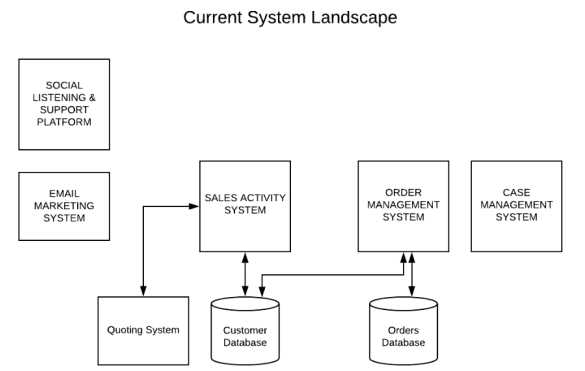
The goals for implementing Salesforce follows:
1. Develop a 360 view of customer
2. Leverage Salesforce capabilities for Marketing, Sales and Service processes
3. Reuse Enterprise capabilities built for Quoting and Order Management processes
Which three systems from the current system landscape can be retired with the implementation of
Salesforce?
Choose 3 answers
- A. Order Management System
- B. Case Management System
- C. Sales Activity System
- D. Email Marketing System
- E. Quoting System
Answer:
B, C, D
Comments
Question 8
What is the first thing an Integration Architect should validate if a callout from a Lightning Web
Component to an external endpoint is failing?
- A. The endpoint domain has been added to Cross-Origin Resource Sharing.
- B. The endpoint URL has been added to Content Security Policies.
- C. The endpoint URL has added been to an outbound firewall rule.
- D. The endpoint URL has been added to Remote Site Settings.
Answer:
B
Comments
Question 9
A company needs to integrate a legacy on premise application that can only support SOAP API. After
the Integration Architect has evaluated the requirements and volume, they determined that the Fire
and Forget integration pattern will be most appropriate for sending data from Salesforce to the
external application and getting response back in a strongly typed format.
Which integration capabilities should be used to integrate the two systems?
- A. Outbound Message for Salesforce to Legacy System direction and SOAP API using Enterprise WSDL for the communication back from legacy system to salesforce.
- B. Platform Events for Salesforce to Legacy System direction and SOAP API using Partner WSDL for the communication back from legacy system to salesforce.
- C. Platform Events for Salesforce to Legacy System direction and SOAP API using Enterprise WSDL for the communication back from legacy system to salesforce.
- D. Outbound Message for Salesforce to Legacy System direction and SOAP API using Partner WSDL for the communication back from legacy system to salesforce.
Answer:
A
Comments
Question 10
A company's cloud-based single page application consolidates data local to the application with data
from on premise and 3rd party systems. The diagram below typifies the application's combined use
of synchronous and asynchronous calls.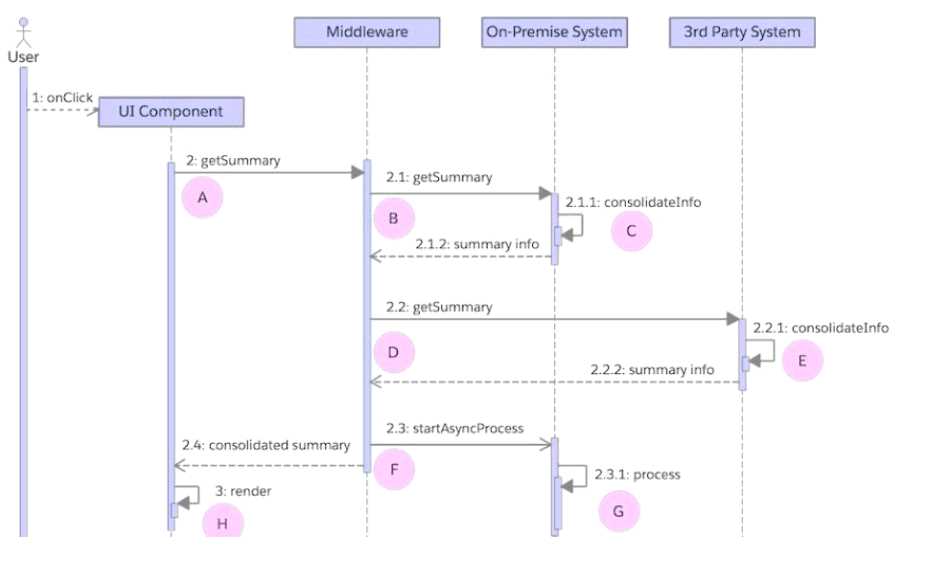
The company wants to use the average response time of its application's user interface as a basis for
certain alerts. For this purpose, the following occurs:
1. Log every call's start and finish date and time to a central analytics data store.
2. Compute response time uniformly as the difference between the start and finish date and time —
A to H in the diagram.
Which computation represents the end-to-end response time from the user's perspective?
- A. Sum of A to H
- B. Sum of A to F
- C. Sum of A, G, and H
- D. Sum of A and H
Answer:
D
Comments
Page 1 out of 10
Viewing questions 1-10 out of 106
page 2