Question 1
A customer wants to deploy AI/ML using Pure Storage AIRI reference architecture.
Which model should the architect use to meet the requirements?
- A. An architecture that is made up of 4xUCS X220 servers, 2xCisco Nexus 9000 switches, and FlashBlade single chassis
- B. An architecture that is made up of 4xDGX-1 servers, 2xArista 7060x switches, and FlashBlade single chassis ***
- C. An architecture that is made up of 4xDGX-1 servers, 2xArista 7060x switches, and FlashArray //X70
- D. An architecture that is made up of 4xDGX-1 servers, FlashBlade XFM, and FlashBlade single chassis.
Answer:
B
Comments
Question 2
A customer has noticed their all-flash arrays are constantly running at or near 100% load and
impacting application performance. They are running dozens of applications on the arrays and ask
for help to identify some workloads that could be moved to another storage system to reduce load
and improve overall performance of all applications.
Which (three) workload or data characteristics should an architect look for to identify potential
candidates for migration to FlashBlade? (Choose three.)
- A. Applications requiring high throughput ***
- B. Large number of simultaneous connections
- C. Applications that can use NFS or S3 ***
- D. Highly transactional application.
- E. Low latency is critical to application performance. ***
Answer:
A, C, E
Comments
Question 3
Refer to the exhibit.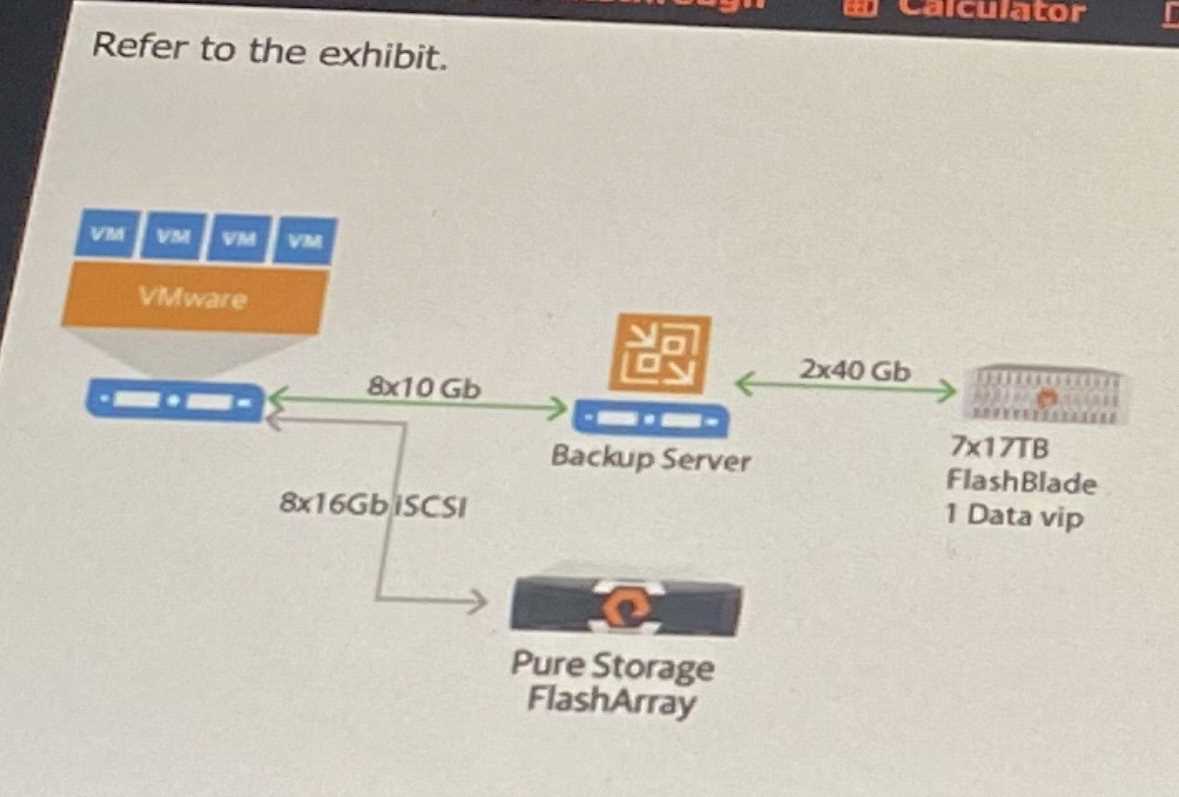
A customer decides to use S3 as a protocol between the Backup Server to FlashBlade. The Backup
Application S3 client in multi-threaded. What is the expected maximum restore throughput?
- A. ~10Gb/s
- B. ~80Gb/s ***
- C. ~70Gb/s
- D. ~20Gb/s
Answer:
B
Comments
Question 4
What must an architect do to delete a filesystem?
- A. Unmount the file system from clients
- B. Turn off the system services
- C. Enable Fast Remove ***
- D. Take a snapshot and then remove file system
Answer:
C
Comments
Question 5
A company has an existing database running a critical application. Users are complaining of slow
response times. The company asks Pure Storage for help fixing this problem.
Which (three) questions should the architect ask to determine if FlashBlade is a good fit for the use
case? (Choose three.)
- A. What is the current storage the database is running on today?
- B. How long has the database been up?
- C. How many users does the application support? ***
- D. What type of queries does the database support for the application? ***
- E. Is it and OLAP or OLTP database? ***
Answer:
C, D, E
Comments
Question 6
Refer to the exhibit.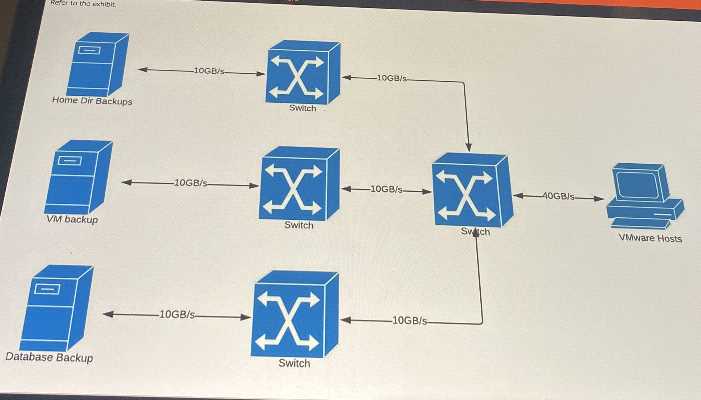
A customer provides a diagram and reports no complaints about backup completion times. The
customer is concerned about the complexity of the environment.
What is the illustrated pain point?
- A. Siloing
- B. Throughput***
- C. Latency
- D. Security
Answer:
B
Comments
Question 7
What is the maximum file size that is supported by the FlashBlade?
- A. 32TiB
- B. 64TiB ***
- C. 70TiB
- D. 84TiB
Answer:
B
Comments
Question 8
A customer is implementing a new backup system using four backup appliances, with dual 10Gbps
NICs writing to a FlashBlade. Each backup appliance can write at line speed.
What is the minimum number of 52TB blades to be able to handle this workload?
- A. 8 blades ***
- B. 15 blades
- C. 27 blades
- D. 35 blades
Answer:
A
Comments
Question 9
What happens when a blade is added to an existing 7x17TB FlashBlade system?
- A. The system gains ~1GB of write performance and ~15TB of capacity.
- B. The system gains ~1GB of read performance and ~15TB of capacity.***
- C. The system notifies support via Pure1 and waits for blade acknowledgement.
- D. The system gains additional fault tolerance and increases the reserve capacity.
Answer:
B
Comments
Question 10
An oil company moves geological data between their offices in Dubai and Houston for redundancy.
The data is accessed via NFS mounts on a cluster of three 10GB connected Linux servers at each
location.
A series of cron jobs are leveraged to replicate data from data storage pool A in Dubai to data storage
B in Houston and from data storage A in Houston to data storage pool B in Dubai.
Data in storage pool A is read-write, updated by 50 cellular connected data collector running in the
field, and deleted after 30 days.
Data in the storage pool B is read-only, queried by the firm’s analytics team, and copied to a cloud-
based archive repository every 30 days.
The total amount of data in pool A in Dubai is 1.5PB
The total amount of data in pool B in Houston is 500TB
The data is not expected to grow in the next 12 months and is compressed by the application.
Which configuration should the architect present to meet this customer needs?
A . A Multi-Chassis FlashBlade with 52TB blades for each site focusing on simplicity.
B. A Multi-Chassis FlashBlade with 17TB blades for each site focusing on performance.
C. A Multi-Chassis FlashBlade with 52TB blades for each site and third-party replication software. ***
D. A Multi-Chassis FlashBlade with 17TB blades for each site and third-party replication software.
Answer:
C
Comments
Page 1 out of 7
Viewing questions 1-10 out of 75
page 2