Question 1
Which one of the following estimate types is a form of expert judgment?
- A. Parametric estimate
- B. Analogous estimate
- C. Bottom-up estimate
- D. Definitive estimate
Answer:
B
Explanation:
An analogous estimate is a form of expert judgment because it relies on historical information. The
historical information, assuming that it is accurate, serves as the conduit to the expert that created
the historical information. Answer option C is incorrect. A bottom-up estimate creates an activity
duration estimate for each work package in the WBS. Answer option A is incorrect. Parametric
estimating uses a parameter, such as 10 hours per fixture installation, as a base to predict the
duration of the project. Answer option D is incorrect. A definitive estimate, also known as a bottom-
up estimate, accounts for the cost of each work package.
Comments
Question 2
You are the project manager of the NHA Project. This project is expected to last one year with
quarterly milestones throughout the year. Your project is supposed to be at the third milestone
today but you're likely only 60 percent complete. Your project has a BAC of $745,000 and you've
spent $440,000 of the budget-to-date. What is your schedule performance index for this project?
- A. 80
- B. 1.02
- C. 102
- D. 0.80
Answer:
D
Explanation:
The schedule performance index can be found by dividing the earned value by the planned value. In
this project, it's $447,000 divided by the $558,750 for a value of 0.80. Schedule performance index
(SPI) is the measure of schedule efficiency on a project. It is used in trend analysis to predict future
performance. SPI is the ratio of earned value to planned value. The SPI is calculated based on the
following formula:
SPI = Earned Value (EV) / Planned Value (PV)
If the SPI value is greater than 1, it indicates better than expected performance, whereas if the value
is less than 1, it shows poor performance. The SPI value of 1 indicates that the project is right on
target.
Answer option A is incorrect. "80" is not the same value as ".80". Answer option B is incorrect. 1.02
is the cost performance index. Answer option C is incorrect. 102 is not a valid calculation for this
question.
Comments
Question 3
Fill in the blank with an appropriate phrase.
The __________ includes a description of any collateral services required, such as performance
reporting or post-project operational support for the procured item.
Answer:
procurement
SOW Explanation:
The procurement
SOW consists of a
description of som
collateral services required, such as performance reporting or post- project operational support for
the procured item. The procurement SOW is revised and refined as required when it moves through
the procurement process until incorporated into a signed contract award.
Comments
Question 4
Mark is the project manager of the GHQ Project. He is happily reporting that his project has a
schedule performance index of 2.12. Management, however, does not think this is good news. What
is the most likely reason why management does not like an SPI of 2.12?
- A. It is not good news because a larger number means the schedule duration estimates were likely to be wrong to begin with.
- B. They likely do not understand the SPI formula.
- C. It is not good news, as the number should be closer to 100 than 0.
- D. It is good news, but Mark may have large cost variances to achieve this value.
Answer:
A
Explanation:
Cost and schedule performance indexes should be as close to 1 as possible. A larger value, such as
2.12, means that the schedule duration estimates were likely bloated or incorrect to begin with.
Answer option B is incorrect. This is not the best choice for this question. Answer option C is
incorrect. The number should not be close to 100; it should be close to 1. Answer option D is
incorrect. While Mark may have crashed the schedule and driven up costs to achieve the SPI value, a
more likely reason is that the time estimates were bloated.
Comments
Question 5
You are the project manager of the BHG Project. You are creating a network diagram as shown in the
figure: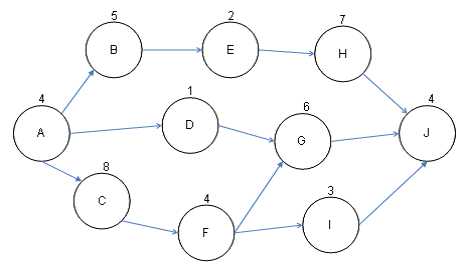
Mary, a project team member, reports that an identified risk is likely to happen in the project that
will affect the completion date of Activity D . She reports that the risk event will likely cause the
duration of the activity to increase by six days. If this happens what is the earliest the project can
complete?
- A. 32 days
- B. 29 days
- C. 27 days
- D. 26 days
Answer:
D
Explanation:
If Activity D increases by six days, the duration of the project will not change. There is 11 days of
float available for Activity D so it may delay by six days without affecting the project end date. What
is float? Float or total float (TF) is the total amount of time that a schedule activity may be delayed
from its early start date without delaying the project finish date, or violating a schedule constraint. It
is calculated by using the critical path method technique and determining the difference between
the early finish dates and late finish dates. Answer options A, B, and C are incorrect. These are not
valid answers for the question.
Comments
Question 6
Sam is the project manager of the NQQ project. He and the project team have completed the
stakeholder identification process for his project. What is the main output of the identify
stakeholders process?
- A. Communications management plan
- B. Stakeholder register
- C. Requirements
- D. Stakeholder management strategy
Answer:
B
Explanation: According to the PMBOK, the main output of the identify stakeholders process is the
stakeholder register. The stakeholder register is a project management document that contains a list
of the stakeholders associated with the project. It assesses how they are involved in the project and
identifies what role they play in the organization. The information in this document can be very
perceptive and is meant for limited exchange only. It also contains relevant information about the
stakeholders, such as their requirements, expectations, and influence on the project. Answer option
A is incorrect. The communications management plan is an output of communications planning.
Answer option D is incorrect. The stakeholder management strategy is an output of stakeholder
identification, but it is not the main output. Answer option C is incorrect. Requirements are not an
output of the stakeholder identification process.
Comments
Question 7
You work as a project manager for BlueWell Inc. Management has asked you not to communicate
performance unless the CPI is less than 0.96 or the SPI dips below 0.98. What type of report would
you create for management, if these instances develop in your project?
- A. Cost variance report
- B. Exceptions report
- C. Performance management report
- D. Schedule variance report
Answer:
B
Explanation:
The best answer is simply an exception report.
An exception report refers and documents the major mistakes, mishaps, and goofs. In other words, it
itemizes the important and critically significant piece of documentation that is vital to the proper
and effective functioning of a project. It does not document what has gone right, but rather
documents what has gone wrong. Answer option C is incorrect. A performance management report
is not a valid project management report. Answer option A is incorrect. The question is asked a out
cost and schedule so this answer would not be appropriate for both the cost and the schedule.
Answer option D is incorrect. The question is asked about cost and schedule so this answer would
not be appropriate for both the cost and the schedule.
Comments
Question 8
You are the project manager of the HQQ Project. Your project is running late by ten percent of where
you should be at this time. Management is concerned. Considering that the project has a BAC of
$567,899, you are thirty percent complete, and you have spent $179,450. What is this project's to-
complete performance index based on the current BAC?
- A. 1.02
- B. 0.010
- C. 0.75
- D. 0.95
Answer:
A
Explanation: This project is not performing well on schedule, but moderately well on costs. The
project's TCPI based on the current BAC is 1.02. To-complete Performance Index (TCPI) is the
measured projection of the anticipated performance required to achieve either the BAC or the EAC.
TCPI indicates the future required cost efficiency needed to achieve a target EAC (Estimate At
Complete).Once approved, the EAC supersedes the BAC as the cost performance goal. Any
significant difference between TCPI and the CPI needed to meet the EAC should be accounted for by
management in their forecast of the final cost. The formula for TCPI is as follows: TCPI = {(BAC-
EV)/(BAC-AC)} Answer option D is incorrect. 0.95 is the project's TCPI value based on the estimate at
completion. Answer option C is incorrect. 0.75 is the project's schedule performance index. Answer
option B is incorrect. 0.010 is not a valid calculation.
Comments
Question 9
Andy works as the project manager for Bluewell Inc. He is developing the schedule for the project.
There are eight tools and techniques that a project manager can use to develop the project
schedule. Which of the following is a tool and technique for the Schedule Development process?
- A. Schedule compression
- B. Reserve analysis
- C. Variance analysis
- D. Expert judgment
Answer:
A
Explanation:
Schedule compression is a tool used as part of the Schedule Development process. The tools and
techniques for schedule development are as follows: Schedule network analysis Critical path
method Critical chain method Resource leveling What-if scenario analysis Applying leads and lags
Schedule compression Scheduling tool Answer options D, B, and C are incorrect. These are not tools
and techniques for schedule development.
Comments
Question 10
You are the project manager for your organization. You have recorded the following duration
estimates for an activity in your project: optimistic 20, most likely 45, pessimistic 90. What time will
you record for this activity?
- A. 48
- B. 20o, 45m, 90p
- C. 90
- D. 45
Answer:
A
Explanation:
This is an example of a three-point estimate. A three-point estimate records the optimistic, most
likely, and the pessimistic duration, and then records an average for the predicted duration Three-
point estimate is a way to enhance the accuracy of activity duration estimates. This concept is
originated with the Program Evaluation and Review Technique (PERT). PERT charts the following
three estimates:
Most likely (TM): The duration of activity based on realistic factors such as resources assigned,
interruptions, etc. Optimistic (TO): The activity duration based on the best-case scenario Pessimistic
(TP): The activity duration based on the worst-case scenario The expected (TE) activity duration is a
weighted average of these three estimates: TE = (TO + 4TM + TP) / 6 Duration estimates based on
the above equations (sometimes simple average of the three estimates is also used) provide more
accuracy. It can be calculated as follows: TE = ( 20 + 45*4 + 90) / 6 = 290/6 =48 Answer options B,
C, and D are incorrect. These are not the valid answers for this question.
Comments
Page 1 out of 32
Viewing questions 1-10 out of 326
page 2