Question 1
A Customer Service application requires customer data assembled from multiple external systems.
The customer data is captured by a parent case. Subcases of that parent case need to reference the
same customer data.The customer data must be as current as possible.
Which two options are used as part of the solution? (Choose Two)
- A. Have each subcase load a portion of the customer data prior to updating the parent case.
- B. Use the Snapshot data access pattern to capture the customer data prior to subcase spin off.
- C. Load the customer data in parallel using the Load -Data Page and Connect-Wair methods.
- D. Use the System of Record (SOR) data access pattern when capturing the customer data.
Answer:
C, D
Explanation:
When designing a solution that requires customer data from multiple external systems and ensuring
it is as current as possible, consider the following:
Parallel Data Loading: Use the Load-Data Page and Connect-Wait methods to load the data in
parallel. This approach improves performance by reducing the time taken to gather the required
customer data since multiple data sources are queried simultaneously.
System of Record (SOR) Pattern: Employ the System of Record (SOR) data access pattern to fetch the
most current customer data from the external systems directly. This ensures that the data used is up-
to-date and reflects the latest information available from the source systems.
Reference: Pega Platform documentation on data pages, Connect-Wait methods, and data access
patterns.
Comments
Question 2
MyMealth Corporation wants to use the age of the claim to increase the urgency on the assignment
so that claims processors work on the most urgent claims first. The claim assignment urgency
increases by 1 each day the claim remains in an unresolved status. At any time. My Health has up to
10,000 claims in process. Claims in the PendingProcessing workbasket are subject to this calculation.
The application updates the claim urgency daily before the work day begins. AM claims are
processed within 30 days.
MyHealth also processes complaint cases from health plan members. Complaint cases use a service
level agreement (SLA) to ensure the customer service representatives respond to complaints within
48 hours. All claims processors work in Los Angeles 9:00 AM-5:OQ PM PST.
Which approach satisfies the claim urgency requirement and provides the best experience for the
claims processor?
- A. Use an advanced agent on a dedicated node to increment the pyUrgencyAssignAdjust value by 1 for every assignment that matches the selection criteria.
- B. Use the assignment SLA to increment the pyUnjerncyAssiqnAdjust value by 1 every day the claim is in an open status.
- C. Use a declare expression to increment the pytJrgcncyAsp/gnAdjur.t value to 1. When a claim processor opens the assignment, the urgency is increased by 1.
- D. Use the overall SLA to increment the pyUrgencyAssignAdjust value by 1. Reset the goal date to the following day
Answer:
A
Explanation:
To ensure claim processors work on the most urgent claims first, consider the following approach:
Advanced Agent: Implement an advanced agent on a dedicated node to increment the
pyUrgencyAssignAdjust value by 1 for each assignment that meets the selection criteria. This agent
can run at the start of each day to update the urgency of all claims in the PendingProcessing
workbasket.
Dedicated Node: Using a dedicated node ensures that the urgency update process does not interfere
with other application processes and can handle the large volume of claims efficiently.
Reference: Pega Platform documentation on advanced agents and configuring assignment urgency.
Comments
Question 3
While configuring GetNextWork, overriding the System Settings rule
GetNextWork__WorkBasketUrgencyThreshold imposes a minimum cutoff value for assignment
urgency.
Which statement accurately depicts the system behavior when the
GetNextWork_WorkBaseketUrgencyThreshold setting is overridden?
- A. The override ignores other criteria in GetNextWork.
- B. The override causes the application to revisit workbaskets for assignments with lower urgency.
- C. The override causes a search of only those assignments with the urgency higher than the threshold value.
- D. The override causes a search of all assignments in a work queue that equal or exceed the set urgency threshold.
Answer:
C
Explanation:
When the GetNextWork_WorkBasketUrgencyThreshold setting is overridden, the system behavior
changes as follows:
Urgency Threshold: The system will search for assignments in the work queue that have an urgency
higher than the specified threshold value. This means that only the assignments meeting or
exceeding this urgency level will be considered for processing.
Filtering Assignments: This filtering ensures that only the most urgent tasks are prioritized and
assigned, improving efficiency and focus on critical work items.
Reference: Pega Platform documentation on GetNextWork and system settings.
Comments
Question 4
You need to create custom workspaces for the manager and for the Customer service
representative (CSR), Also, you are asked to display some properties in custom formats that arc not
supported by Pega.
Which approach satisfies these requirements?
- A. Each access group can use separate portals, harnesses, and sections. Use Specialty Components and use XML to pass data.
- B. Level age the Case Manager and Case Worker as reference points to create new portals, if required. Use Special Components and use JSON to pass data.
- C. Create different harnesses for each user's workspace. New portal rules are not needed. Define Specialty Components and use JSON to pass data.
- D. Identify the functionality required for each portal. Customize the portal either by modifying the section or harness. Use Specialty Components and use XML to pass data.
Answer:
A
Explanation:
To create custom workspaces for different user roles and display custom formatted properties:
Separate Portals and Harnesses: Define separate portals, harnesses, and sections for each access
group (managers and customer service representatives). This approach allows you to tailor the user
interface and functionality according to the specific needs of each role.
Specialty Components and XML: Use Specialty Components to create custom formats for properties.
XML can be used to pass data in and out of these components, allowing for complex and specialized
data handling.
Reference: Pega Platform documentation on portals, harnesses, and using Specialty Components
with XML.
Comments
Question 5
You want to avoid creating unnecessary case-related properties and views. Which three actions do
you take to accomplish this goal? (Choose Three)
- A. Define most of the properties and sections at the work pool level.
- B. Create a data type (if required) that corresponds to the case type.
- C. Use the data reference field type in a case type's data model tab.
- D. Drag and-drop a field group when defining a case view.
- E. Define case type views using ".page.property" syntax.
Answer:
B, C, A
Explanation:
To avoid creating unnecessary case-related properties and views:
Work Pool Level Definitions: Define most properties and sections at the work pool level to ensure
they are reusable across multiple case types. This approach reduces redundancy and simplifies
maintenance.
Data Types: Create data types that correspond to the case type when necessary. This helps in
organizing related data and promotes reuse.
Data Reference Field Type: Use the data reference field type in the case type's data model tab. This
allows you to link to existing data types without duplicating properties, maintaining data integrity
and reducing redundancy.
Reference: Pega Platform documentation on data modeling, work pools, and data reference field
types.
Comments
Question 6
BiyCo has two development projects currently in progress developed by independent teams. One
team builds the Quoting application. Another team builds the Policy Administration application.
Development takes place on different servers with separate rulebases.
The Quoting application is built on the Policy Administration application.
The Policy Administration application requires enhancements to support other areas of the business.
The Quoting team is notified when the Policy Administration application is versioned. The Quoting
team responds by importing a HAP containing the new version.
Select the two best practices to minimize potential development conflicts and work with the most
current version of the Policy Administration application. (Choose Two)
- A. Periodically rebase the Policy Administration application.
- B. Switch between applications when modifying rules.
- C. Perform branch reviews when merging brandies.
- D. Share rulesets between both applications.
Answer:
AC
Explanation:
To minimize development conflicts and work with the most current version of the Policy
Administration application:
Periodic Rebasing: Regularly rebase the Policy Administration application to ensure that the Quoting
application is built on the most recent version. This practice helps in keeping the applications
synchronized and reduces integration issues.
Branch Reviews: Conduct branch reviews when merging branches. This ensures that all changes are
thoroughly reviewed and validated before they are integrated, reducing the likelihood of conflicts
and maintaining code quality.
Reference: Pega Platform documentation on branching, rebasing, and branch review processes.
Comments
Question 7
Using the information shown in the case structure below, which option is always true?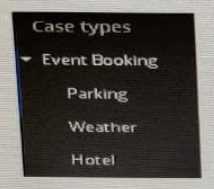
- A. Resolution of the Event Booking case requires the Parking case to be resolved.
- B. Parking, Weather, and Hotel cases must be instantiated for the Event case to process correctly.
- C. The Weather case can be instantiated without a parent Event Booking case.
- D. The Parking class must inherit from the Event Booking class.
Answer:
C
Explanation:
To determine which option is always true based on the case structure, let's analyze each option:
A . Resolution of the Event Booking case requires the Parking case to be resolved.
This may not always be true unless explicitly defined in the case dependencies or resolution
conditions within the application.
B . Parking, Weather, and Hotel cases must be instantiated for the Event case to process correctly.
This is not necessarily true unless the Event Booking case is designed to always require these sub-
cases.
C . The Weather case can be instantiated without a parent Event Booking case.
This is always true as sub-cases can typically be instantiated independently of their parent cases. The
Weather case can be a standalone case type or instantiated through other means.
D . The Parking class must inherit from the Event Booking class.
This is not always true as class inheritance depends on the application design and how classes are
structured in the hierarchy.
Based on this analysis, the verified answer is:
C . The Weather case can be instantiated without a parent Event Booking case.
Reference:
Pega Documentation on Case Types: Case Types
Pega Documentation on Sub-Cases: Sub-Cases
Comments
Question 8
Inconsistent formatting of phone numbers is causing, usability issues. You hnvo been asked to enh
interface to ensure all phone numbers are automatically reformatted consistently.
Which two options incorporate best practices for applying the required formatting? (Choose Two)
- A. Configure a Declare Constraint rule.
- B. Configure an Edit Validate rule.
- C. Configure a Custom Control.
- D. Configure an Edit Input rule.
Answer:
B, D
Explanation:
To ensure consistent formatting of phone numbers and improve usability, you can use the following
options:
B . Configure an Edit Validate rule:
Edit Validate rules are used to enforce specific data formats and validations. By configuring an Edit
Validate rule, you can ensure that phone numbers adhere to a consistent format.
D . Configure an Edit Input rule:
Edit Input rules allow you to transform and standardize data before it is processed by the system.
Using an Edit Input rule, you can automatically reformat phone numbers to a consistent format upon
input.
Reference:
Pega Documentation on Edit Validate Rules: Edit Validate Rules
Pega Documentation on Edit Input Rules: Edit Input Rules
Comments
Question 9
Select the primary reason for developing a set of unit lest cases and automated testing Suites in a
continuous integration and continuous deployment (CI/CD) model.
- A. Automated testing reduces costs by reducing the need to hire and I rain testing resources.
- B. Automated testing accelerates the deployment of rules from the development environment to target environments.
- C. Automated testing programmatically ensures quality of rules to maintain the integrity of the pipeline.
- D. Automated testing allows for orchestration between automation server and the Execute Test REST service.
Answer:
C
Explanation:
The primary reason for developing a set of unit test cases and automated testing suites in a CI/CD
model is:
C . Automated testing programmatically ensures quality of rules to maintain the integrity of the
pipeline.
Automated testing helps ensure the quality and correctness of the rules being deployed. It verifies
that changes do not introduce errors and maintains the integrity of the pipeline by catching issues
early in the development cycle.
Reference:
Pega Documentation on CI/CD: CI/CD
Comments
Question 10
XYZ Corporation wants to ensure that every attempt by a developer to check a rule into a certain
ruleset version is reviewed before that rule is allowed to be checked in. The rule should be
automatically sent back to the developer without being checked in if all warnings are not justified
and the fields on the history tab are not complete.
How do you address this requirement?
- A. Prior to the first assignment in the ApproveRuleCheckin flow, add a decision shape where one output connector is equivalent to the submitting the SendBack flow action.
- B. Implement a CheckForCustomWarnings activity for each rule included in the requirement. The activity issues a warning whenever the requirement's history tab criteria are not met.
- C. Override the FindReviewers decision tree to invoke a when rule that evaluates the criteria, if the when rule returns true, the decision tree returns SendBack.
- D. Override the SendBack Flow Action adding a pre-ctivity that transfers the assignment to the create operator if the rule's criteria are not met.
Answer:
C
Explanation:
To ensure that every attempt by a developer to check a rule into a certain ruleset version is reviewed
before that rule is allowed to be checked in:
C . Override the FindReviewers decision tree to invoke a when rule that evaluates the criteria, if the
when rule returns true, the decision tree returns SendBack.
By overriding the FindReviewers decision tree and incorporating a when rule, you can enforce
criteria such as complete history tab fields and justified warnings. If the criteria are not met, the
decision tree returns SendBack, preventing the rule from being checked in.
Reference:
Pega Documentation on Rule Check-In: Rule Check-In
Pega Documentation on Decision Trees: Decision Trees
Comments
Page 1 out of 23
Viewing questions 1-10 out of 238
page 2