Question 1
DRAG DROP
Select each Use Case on the left and drag it to the appropriate Automation on the right.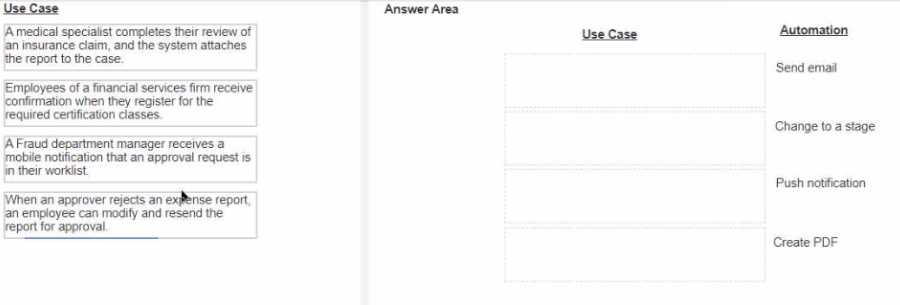
Answer:
"A medical specialist completes their review of an insurance claim, and the system
attaches the report to the case."
Create PDF
"Employees of a financial services firm receive confirmation when they register for the
required certification classes."
Send email
"A Fraud department manager receives a mobile notification that an approval request is in
their worklist."
Push notification
"When an approver rejects an expense report, an employee can modify and resend the
report for approval."
Change to a stage
A medical specialist completes their review of an insurance claim, and the system attaches the
report to the case.
Create PDF
In this use case, the system needs to generate a report that can be attached to the case. The
appropriate automation for generating documents like reports is creating a PDF. This ensures the
report is in a standardized, non-editable format that can be easily attached to the case.
Reference: Pega Platform Business Architect Essentials, Chapter on Case Design.
Employees of a financial services firm receive confirmation when they register for the required
certification classes.
Automation: Send email
This use case involves sending a confirmation to employees upon registration. The most suitable
method for sending such confirmations is through an email. Email notifications ensure that the
employee receives a record of their registration.
Reference: Pega Platform Business Architect Essentials, Chapter on Notifications and
Correspondence.
A Fraud department manager receives a mobile notification that an approval request is in their
worklist.
Automation: Push notification
The manager needs to be alerted promptly about an approval request. Push notifications are ideal
for this purpose as they provide real-time alerts directly to the mobile device.
Reference: Pega Platform Business Architect Essentials, Chapter on Mobile and Multi-Channel.
When an approver rejects an expense report, an employee can modify and resend the report for
approval.
Automation: Change to a stage
When an expense report is rejected, the case needs to move back to a stage where the employee
can modify and resubmit it. This involves changing the stage of the case to enable the necessary
actions.
Reference: Pega Platform Business Architect Essentials, Chapter on Case Management and Workflow.
Comments
Question 2
The business process for an automobile insurance claim consists of the following phases:
• Submission: The customer contacts a customer service representative (CSR) to file the claim.
• Review: An adjuster reviews the claim, assesses the damages to each vehicle, and provides an
estimate of the cost of repairs.
• Repair: A third party performs the repairs on each vehicle, communicating with the adjuster and
customer as necessary.
• Verification: After each vehicle repair, the adjuster closes the claim.
According to Pega best practices, which phase can you implement as a child case?
- A. Verification
- B. Submission
- C. Review
- D. Repair
Answer:
D
Explanation:
Submission: This phase involves the initial contact and filing of the claim, which typically doesn't
need to be a separate case as it's an initial action.
Reference: Pega Academy, Case Management Essentials, Case Lifecycle Design.
Review: This phase involves an adjuster reviewing the claim and assessing damages, which can be
handled within the primary case.
Reference: Pega Academy, Case Management Essentials, Case Lifecycle Design.
Repair: The repair phase involves interaction with third-party vendors and ongoing communication,
making it suitable to be implemented as a child case to track each repair separately.
Reference: Pega Academy, Case Management Essentials, Child Cases.
Verification: This phase is a closing action performed after repairs, which doesn't typically require a
separate case.
Reference: Pega Academy, Case Management Essentials, Case Lifecycle Design.
Comments
Question 3
DRAG DROP
Select each Process Step Description on the left and drag it to the appropriate Process Step on the
right.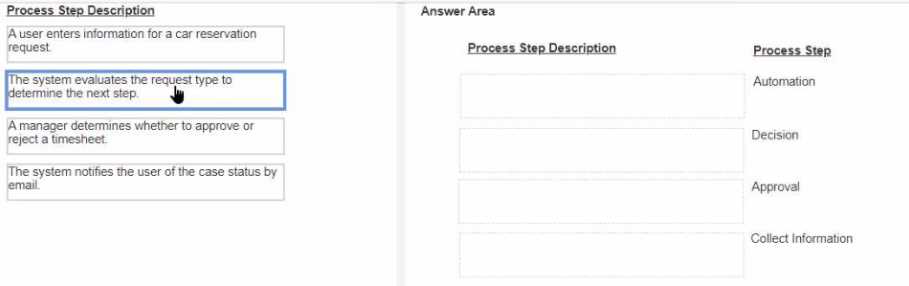
Answer:
None
Explanation:
Process Step Description: "A user enters information for a car reservation request."
Process Step: Collect Information
Process Step Description: "The system evaluates the request type to determine the next step."
Process Step: Decision
Process Step Description: "A manager determines whether to approve or reject a timesheet."
Process Step: Approval
Process Step Description: "The system notifies the user of the case status by email."
Process Step: Automation
A user enters information for a car reservation request.
Process Step: Collect Information
This step involves gathering data from the user. In Pega, collecting information typically involves
prompting the user to enter necessary details to move the case forward.
Reference: Pega Platform Business Architect Essentials, Chapter on Data Collection.
The system evaluates the request type to determine the next step.
Process Step: Decision
This step involves the system making a determination based on the provided information. A decision
step in Pega is used to evaluate conditions and determine the next path or action in the case
workflow.
Reference: Pega Platform Business Architect Essentials, Chapter on Decision Management.
A manager determines whether to approve or reject a timesheet.
Process Step: Approval
This step is about reviewing and making an approval decision. In Pega, approval steps are used when
a human needs to review the case and make a decision to approve or reject it.
Reference: Pega Platform Business Architect Essentials, Chapter on Case Life Cycle Management.
The system notifies the user of the case status by email.
Process Step: Automation
This step involves automated communication. Automation steps in Pega can be configured to
perform tasks like sending emails, updating records, or other system actions without manual
intervention.
Reference: Pega Platform Business Architect Essentials, Chapter on Notifications and
Correspondence.
Comments
Question 4
Your client is planning their next Minimum Lovable Product (MLP) release.
Which three pillars of case design must the Pega Business Architect ensure are taken into account, to
capture information for the release? (Choose Three)
- A. Personas and Channels
- B. Reports
- C. Case types
- D. Data and Interfaces
- E. Dashboards
Answer:
A, D C
Explanation:
When planning the next Minimum Lovable Product (MLP) release, a Pega Business Architect should
focus on the three pillars of case design: Personas and Channels, Case Types, and Data and
Interfaces.
Personas and Channels:
Personas: Identify the different user roles (personas) that will interact with the application.
Understanding personas helps in designing user experiences that meet their needs.
Channels: Determine the channels (e.g., web, mobile) through which users will interact with the
system. This ensures that the application is accessible and user-friendly across different platforms.
Case Types:
Case Types: Define the different types of cases that the application will manage. Case types are
fundamental to structuring the application and ensuring that it can handle various processes and
workflows efficiently.
Data and Interfaces:
Data: Identify the data required to support the case types and processes. This includes understanding
data sources, data structures, and how data will be captured and used.
Interfaces: Determine the interfaces needed to integrate with external systems. Interfaces are crucial
for ensuring that the application can interact with other systems and exchange information
seamlessly.
Reference:
Pega Academy: Case Design
Pega Documentation: Minimum Lovable Product (MLP)
Comments
Question 5
Identify the name of Pega's business architecture design that aligns human intelligence and process
automation with business logic to deliver high-value software solitons.
- A. Center-out
- B. Customer-centric
- C. Business-first
- D. Pega Express
Answer:
A
Explanation:
The name of Pega's business architecture design that aligns human intelligence and process
automation with business logic to deliver high-value software solutions is Center-out.
Center-out Design:
This approach focuses on designing the core business logic and processes first (the "center") and then
extending outwards to include the user interface (UI) and channels.
By centering on the core logic, Pega ensures that the most critical aspects of the business process are
well-defined and robust. This approach supports scalability and adaptability as the system grows and
evolves.
Reference:
Pega Academy: Center-out Business Architecture
Pega Documentation: Center-out Design Principles
Comments
Question 6
Identify the Pega Express phase in which Pega Business Architects plan for future sprints by creating
user stories with the Directly Capture Objectives (DCO) discipline.
- A. Adopt
- B. Discover
- C. Build
- D. Prepare
Answer:
B
Explanation:
The Pega Express phase in which Pega Business Architects plan for future sprints by creating user
stories with the Directly Capture Objectives (DCO) discipline is Discover.
Discover Phase:
During the Discover phase, the focus is on understanding the business problem, identifying the
scope, and defining the high-level requirements.
Pega Business Architects work with stakeholders to capture objectives directly into the Pega
platform, creating user stories and refining the backlog in preparation for future sprints.
Reference:
Pega Academy: Pega Express Methodology
Pega Documentation: Pega Express Phases and Activities
Comments
Question 7
Which three tasks should be done as part of the DevOps pipeline? (Choose Three)
- A. Extract data using Business Intelligence Exchange (BIX).
- B. Track Security checklist completion.
- C. Run both unit and scenario tests.
- D. Verify the guardrail compliance score.
- E. Review the three basic authorization models.
Answer:
C D B
Explanation:
Project delivery leader: The Project Delivery Leader is responsible for overseeing the project plan,
managing resources, and ensuring that project milestones are met. They play a key role in verifying
the project plan and adjusting schedules to manage expectations and ensure timely delivery.
Reference: Pega Business Architect Essentials, Project Management Roles and Responsibilities.
Comments
Question 8
Which two statements are true about Minimum Lovable Product (MLP) sizing when using the
Estimator tool? (Choose Two)
- A. Complex features are always reserved for MLP 2 and later.
- B. MLP sizing leads to more precise resource planning.
- C. Creation of case steps is factored into MLP sizing.
- D. Initial estimations are high-level approximations.
Answer:
BD
Explanation:
MLP sizing leads to more precise resource planning: Proper sizing of the MLP ensures that resource
planning is accurate, allowing the team to allocate the necessary resources effectively to meet the
delivery timelines.
Reference: Pega Business Architect Essentials, Estimating and Resource Planning.
Initial estimations are high-level approximations: During the early stages of planning, the
estimations are high-level approximations that provide a general idea of the effort required. These
estimations are refined as the project progresses and more details are known.
Reference: Pega Business Architect Essentials, Estimation Techniques.
Comments
Question 9
HOTSPOT
The following view of a timesheet application an employee enters their hours for the week The total
hours highlighted are automatically updated with the appropriate values as the fee enters their time.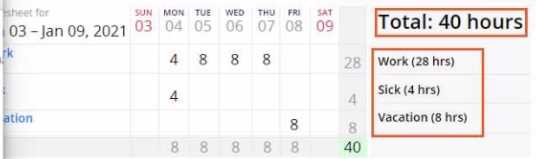
The employee submits the timesheet. the following view is shown. The application reduces the
vacation and sick time balances by the hours entered in the previous view.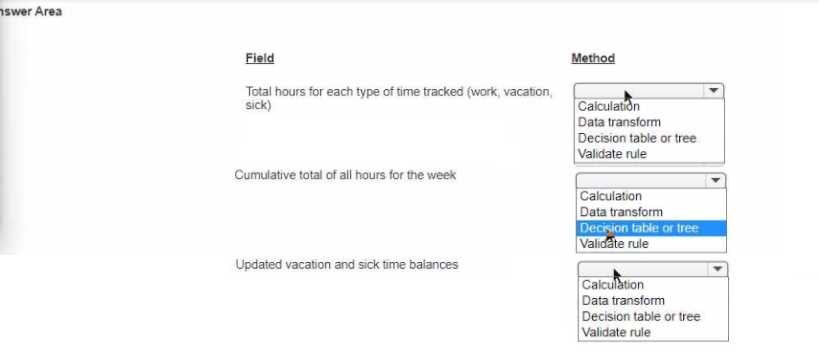
Answer:
None
Explanation:
Field: Total hours for each type of time tracked (work, vacation, sick)
Method: Calculation
Field: Cumulative total of all hours for the week
Method: Calculation
Field: Updated vacation and sick time balances
Method: Data transform
Total hours for each type of time tracked (work, vacation, sick)
Method: Calculation
The total hours for each type of time (work, vacation, sick) are derived by summing up the
respective hours entered by the employee for each day. This involves simple arithmetic operations
which are best handled by a calculation rule in Pega.
Reference: Pega Platform Business Architect Essentials, Chapter on Calculations and Decision Rules.
Cumulative total of all hours for the week
Method: Calculation
The cumulative total of all hours for the week is computed by summing up the total hours of work,
vacation, and sick time. This is another straightforward arithmetic operation that should be
implemented using a calculation rule.
Reference: Pega Platform Business Architect Essentials, Chapter on Calculations and Decision Rules.
Updated vacation and sick time balances
Method: Data transform
When the employee submits the timesheet, the application needs to update the vacation and sick
time balances by subtracting the entered hours from the available balances. This involves data
manipulation which is appropriately handled using a data transform. Data transforms in Pega are
used to copy and manipulate data.
Reference: Pega Platform Business Architect Essentials, Chapter on Data Transforms and Activities.
Comments
Question 10
Which two statements about data records are true? (Choose Two)
- A. Data records require external storage.
- B. Data records are displayed in a drop-down list by default.
- C. Data records need unique, user-generated IDs.
- D. Data records define permissible values for data fields.
Answer:
BD
Explanation:
Data records are displayed in a drop-down list by default: This is true because Pega displays data
records in drop-down lists to facilitate user selection.
Reference: Pega Academy, Data Management, Data Records and Drop-down Lists.
Data records define permissible values for data fields: This is true because data records are used to
define the set of permissible values for a particular field.
Reference: Pega Academy, Data Management, Data Validation.
Comments
Page 1 out of 14
Viewing questions 1-10 out of 144
page 2