Question 1
Which two sections of the AWR report shows statistics for X9M Persistent Memory Cache?
- A. PMEM Pool cache Read Hits in the Cache Sizes portion of the Report Summary
- B. PMEM Pool Misses in the Exadata Outlier Summary
- C. cell PMEM cache Read Hits in the Database IOs portion of the Performance Summary
- D. PMEM Cache section within Memory Statistics
- E. PMEM Cache section within Exadata Smart Statistics
Answer:
CE
Explanation:
Option C shows the number of read hits from PMEM cache on storage servers which indicates how
much data was served from PMEM instead of flash or disk1
.
Option E shows detailed information about PMEM cache such as size, utilization, hit ratio, read
latency and write latency2
.
Comments
Question 2
A new Exadata Quarter Rack with 2 Database Servers and 3 HC Storage Servers and 3-phase 15kVA
PDUs is being installed in a Data Center. However, the Data Center is only providing enough power
for a single cable from each PDU.
Which statement is correct?
- A. The installation can go ahead, no change is required.
- B. The installation cannot proceed until two power feeds are available per PDU.
- C. A splitter cable can be used to provide power to all PDU cables.
- D. The power cables from the servers to the PDUs can be rearranged inside the rack following OECA guidance to utilize a single PDU power cable.
Answer:
A
Explanation:
According to the Oracle Exadata Database Machine X9M-2 Data Sheet
, each PDU has two power
input cables that can be connected to separate power sources for redundancy. However, if only one
power source is available per PDU, then a single cable can be used to provide sufficient power for
normal operation.
https://www.oracle.com/a/ocom/docs/engineered-systems/exadata/exadata-x9m-2-ds.pdf
Comments
Question 3
Which dbmcli command is NOT valid on Exadata X9M?
- A. dbmcli -e "LIST METRICHISTORY WHERE name LIKE 'DS_.*’”
- B. dbmcli -e "LIST METRICCURRENT WHERE name = 'DS_TEMP’ ”
- C. dbmcli -e "LIST IBPORT DETAIL"
- D. dbmcli -e "LIST ALERTHISTORY WHERE agelnMinutes < 15"
Answer:
C
Explanation:
The dbmcli -e "LIST IBPORT DETAIL" command is not valid on Exadata X9M. According to the Oracle
Exadata Database Machine X9M Implementation Essentials Official Text Book
[1][2]
, this command is
only valid on Exadata X3 and X4 models. The other three commands are valid on Exadata X9M.
https://forums.oracle.com/ords/apexds/map/tech/apps-infra/discussion/4342715/monitoring-roce-
performance
Comments
Question 4
Which are two correct statements for managing virtual deployment using Oracle Exadata
Deployment Assistant (OEDA)?
- A. OEDA allows customers to have both bare metal (BM) and virtual machine (VM) in an Exadata X9M Quarter Rack.
- B. There is no limit on the number of VMs in an Exadata rack as long as the Exadata rack has adequate resources.
- C. OEDA deployment steps include calibrate cells, create cell disks, and resecure machine.
- D. OEDA sets up key-based authentication for the root user by using the setuprootssh.sh utility included with OEDA.
Answer:
CD
Explanation:
C . OEDA deployment steps include calibrate cells, create cell disks, and resecure machine
.
D .
OEDA sets up key-based authentication for the root user by using the setuprootssh.sh utility
included with OEDA2
.
Comments
Question 5
Which three steps are required to expand an Exadata X9M-2 Database Server with the lowest
memory configuration available to the highest memory configuration?
- A. Add 12x 32GB DIMMs.
- B. Add 12x 64GB DIMMs.
- C. Shutdown the Database Server if running.
- D. Add 16x 32GB DIMMs.
- E. Add 16x 64GB DIMMs.
- F. Memory cannot be expanded on Exadata X9M-2 Database Servers.
- G. Remove existing memory modules.
- H. Add 32x 64GB DIMMs.
- I. Add 24x 32GB DIMMs.
Answer:
CGH
Explanation:
https://www.oracle.com/a/ocom/docs/engineered-systems/exadata/exadata-x9m-2-ds.pdf
https://chriscraftoracle.wordpress.com/2022/11/09/what-makes-exadata-faster/
Comments
Question 6
You are adding a disk expansion kit to a running Exadata X8M Database Machine's Database Servers,
and have a filesystem layout that includes: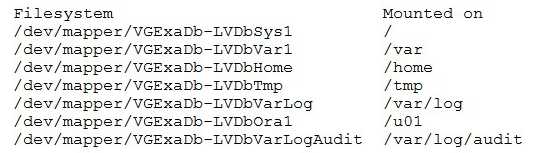
After running the following commands, which command needs to be run to add 20G of space to the
filesystem mounted on /u01?
- A. # lvextend -L +20G —verbose /dev/mapper/VGExaDb-LVDbOral
- B. # xfs_growfs /uOl +20G
- C. # resize2fs +20G /dev/VGExaDb/LVDbOral
- D. # lvextend -L +20G —verbose /dev/VGExaDb/LVDbOral
Answer:
A
Explanation:
After running the commands above, the filesystem mounted on /u01 is on the logical volume
/dev/mapper/VGExaDb-LVDbOral. So, to add 20G of space to the filesystem mounted on /u01, the
command that needs to be run is:
lvextend -L +20G --verbose /dev/mapper/VGExaDb-LVDbOral
This command will extend the logical volume /dev/mapper/VGExaDb-LVDbOral by 20 GB of space. It
is important to note that the option --verbose is used to display the progress of the operation.
Comments
Question 7
You are going to create an ACFS Filesystem for use as a staging area for data loads. Examine the
following commands: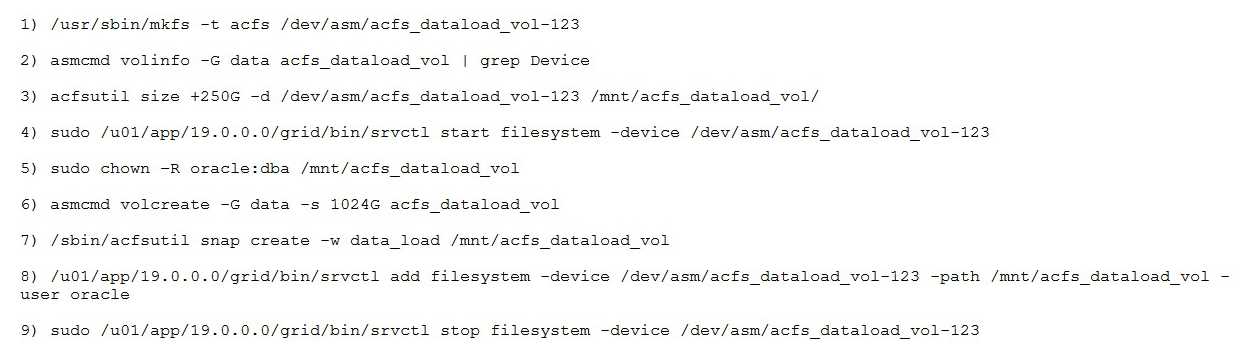
What steps and in which order should they be executed?
- A. 6, 2, 1, 8, 4, 5
- B. 6, 8, 3, 4, 2, 1
- C. 6, 3, 1, 9, 7, 8
- D. 6, 1, 2, 7, 5, 8
Answer:
A
Explanation:
The steps and the order in which they should be executed to create an ACFS Filesystem for use as a
staging area for data loads are:
asmcrad volcreate -G data -s 1024G acfs_dataload_vol : This command creates a new volume in the
data diskgroup, with a size of 1024 GB, and named acfs_dataload_vol.
asmcmd vol info -G data acfs_dataload_vol | grep Device: This command will show the device name
of the newly created volume
/usr/sbin/mkfs -t acfs /dev/asm/ac:fs_dataload_vol-123: This command creates a new ACFS
filesystem on the volume created in step 1
sudo /u01/app/19.0.0.0/grid/bin/srvctl start filesystem -device /dev/asn/acfs_dataload_vol-123: This
command starts the filesystem created in step 3
sudo chovn -R oracle:dba /mnt/acfs_dataload_vol: This command changes the ownership of the
/mnt/acfs_dataload_vol to the oracle:dba user.
/sbin/acfsutil snap create -v data_load /mnt/acfs_dataload_vol: This command creates a snapshot of
the filesystem to be used as a staging area.
acfsutil size +2S0G -d /dev/asm/acfs_dataload_vol-123 /mnt/acfs_dataload_vol/ : This command
increases the size of the filesystem by 2GB
/u01/app/19-G.O-Q7grid/bin/srvctl add filesystem -device /dev/asm/acfs_dataload_vol-
Comments
Question 8
I/O performance of the prod database on your Exadata Database Machine has degraded slightly over
the past month. The database has been allocated to the OLTP I/O Resource Management (IORM)
category.
Which two monitoring tools might be useful in examining I/O performance for the prod database?
- A. OS I/O metrics using Enterprise Manager host pages for the storage servers
- B. OS I/O metrics using OS tools such as iostat on the database servers
- C. I/O-specific dynamic performance views such as v$iostat_fiie, v$iostat_function, and v$iostat_consumer_group from the prod database instances using SQL *p1us
- D. cellcli (or exacli/exadcli) to examine storage server metrics such as database, category, ceiidisk, and griddisk
- E. OS I/O metrics using OS tools such as iostat on the storage servers
Answer:
CD
Explanation:
According to the Oracle documentation1
, two monitoring tools that might be useful in examining
I/O performance for the prod database are:
cellcli (or exacli/exadcli) to examine storage server metrics such as database, category, ceiidisk, and
griddisk (D). This tool can help you monitor the I/O Resource Management (IORM) metrics and
identify any bottlenecks or imbalances in the storage layer.
I/O-specific dynamic performance views such as v$iostat_fiie, v$iostat_function, and
v$iostat_consumer_group from the prod database instances using SQL *p1us ©. These views can
help you monitor the I/O activity and latency at the file, function, and consumer group level.
Comments
Question 9
Which two statements are true about enabling write-back flash cache?
- A. Write-back flash cache is on by default for High Capacity Storage Servers in High Redundancy configurations.
- B. Write-back Flash Cache cannot be used on Extreme Flash Storage Servers.
- C. When enabling write-back flash cache in a rolling manner, DBCLI should be used to inactivate the grid disks on all cells first.
- D. Before write-back flash cache is enabled, you need to drop the Flash Cache first.
- E. When enabling write-back flash cache in a non-rolling manner, you need to drop the Persistent Memory Commit Accelerator (PMEMLog) first.
Answer:
AD
Explanation:
According to the Oracle documentation1
, two statements that are true about enabling write-back
flash cache are:
Write-back flash cache is on by default for High Capacity Storage Servers in High Redundancy
configurations (A). This is because write-back flash cache provides better performance and reliability
for data file writes than write-through flash cache.
Before write-back flash cache is enabled, you need to drop the Flash Cache first (D). This is because
changing the flash cache mode requires recreating the flash cache with a different configuration.
Comments
Question 10
Which two Exadata security features would you configure to control which databases can access
which griddisks, when multiple databases share space on your storage servers in an unpartitioned
storage grid?
- A. Exadata storage realms using ASM-scoped security mode
- B. File permissions on the griddisks in each database server
- C. Using EXADCLI instead of CELLCLI to create the griddisks
- D. File permissions on the griddisks in each storage server
- E. Exadata storage realms using database-scoped security mode
Answer:
AE
Explanation:
Exadata storage realms using ASM-scoped security mode allows you to control which database can
access which griddisks by creating realms at the ASM level, thereby allowing you to limit the access
of each database to the griddisks that it needs to access. This is covered in section 3.15.2 of the
Oracle Exadata Database Machine X9M Implementation Essentials Official Text Book and Resources
[1].
Exadata storage realms using database-scoped security mode allows you to control which database
can access which griddisks by creating realms at the database level
[1]
, thereby allowing you to limit
the access of each database to the griddisks that it needs to access. This is covered in section 3.15.3
of the Oracle Exadata Database Machine X9M Implementation Essentials Official Text Book and
Resources [2].
[1]
https://docs.oracle.com/en/engineered-systems/exadata-database-machine/x9m/exad-
implementing-database-machine-x9m.pdf
[2]
https://docs.oracle.com/en/engineered-
systems/exadata-database-machine/x9m/exad-implementing-database-machine-x9m.pdf
Comments
Page 1 out of 8
Viewing questions 1-10 out of 85
page 2