Question 1
Examine the domain diagram: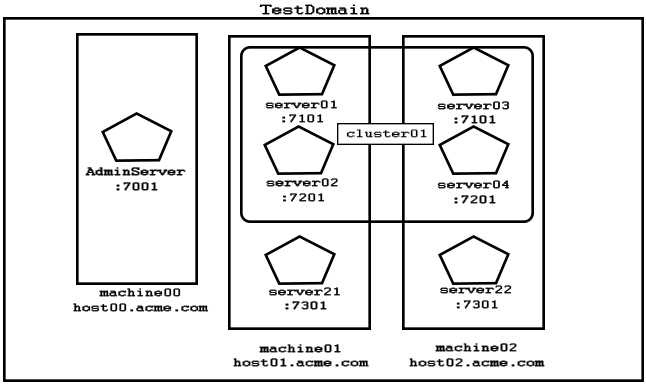
What is the correct path within the configuration hierarchy to the MBean that contains the log
rotation parameters for server04? (Choose the best answer.)
- A. Set the cluster “Migration Basis” policy to Consensus.
- A. B. /server04/log/rotation
- B. Migratable server should be associated with a node manager.
- B. C. /Cluster01/server04/log
- C. Set the server “Migration Basis” policy to Consensus.
- C. /Machine02/server04/log
- D. A high availability database must be configured to manage consensus leasing information.
- D. E. /Logs/server04
- E. /TestDomain/server04/log
- F. /server04/log
Answer:
A
Comments
Question 2
Which two automatic migration scenarios require node manager for all migratable services? (Choose
two.)
A. Consensus leasing
B. Database leasing with no pre and post migration scripts
C. Database leasing with pre and post migration scripts
D. Synchronous leasing
- A. Deployment Plan, Application descriptors, Library descriptors, Application annotations, Library annotations
- B. Deployment Plan, Application annotations, Library annotations, Application descriptors, Library descriptors
- C. Deployment Plan, Library descriptors, Application descriptors, Library annotations, Application annotations
- D. Deployment Plan, Application descriptors, Application annotations, Library descriptors, Library annotations
- E. Deployment Plan, Library descriptors, Library annotations, Application descriptors, Application annotations
Answer:
A,C
When using automatic service migration, the Node Manager is required to get health monitoring
* Consensus leasing Node Manager must be running on every machine hosting managed servers
within the cluster.
* Database leasing Node Manager must be running on every machine hosting managed servers
within the cluster only if pre/post-migration scripts are defined. If pre/post-migrations are not
defined, then Node manager is not required.
Comments
Question 3
Which two statements are true about the role of cluster master in whole server migration? (Choose
two.)
A. There is exactly one cluster master in the cluster at a given point of time.
B. The cluster master must host all the pinned services in the cluster.
C. Any managed server in the cluster can serve as the cluster master.
D. A cluster master must always be different from a singleton master.
E. The cluster master must always be started with the node manager.
- A. Silent Mode
- B. Isolated Mode
- C. MSI Mode
- D. Cluster Mode
Answer:
A,C
One server instance in a cluster that contains migratable servers acts as the cluster master and
orchestrates the process of automatic server migration, in the event of failure.
Any Managed Server in a cluster can serve as the cluster master, whether it hosts pinned services or
not.
Any server instance in the cluster can serve as the cluster master. When you start a cluster that
contains migratable servers, the first server to join the cluster becomes the cluster master and starts
up the cluster manager service. If a cluster does not include at least one migratable server, it does
not require a cluster master, and the cluster master service does not start up.
Comments
Question 4
You are trying to set up a JMS Session with a specified acknowledgment mode. You want the
application that receives the message to explicitly take care of the acknowledgment.
Which option represents a valid choice for the acknowledgment mechanism that you can use?
(Choose the best answer.)
A. AUTO_ACKNOWLEDGE
B. CLIENT_ACKNOWLEDGE
C. DUPS_OK_ACKNOWLEDGE
D. DEFAULT_ACKNOWLEDGE
- A. Authorization provider
- B. Authentication provider
- C. Auditor service
- D. Audit provider
Answer:
B
With CLIENT_ACKNOWLEDGE the Session object relies on the application to call an acknowledge
method on a received message. Once the method is called, the session acknowledges all messages
received since the last acknowledge.
Comments
Question 5
You created a script to monitor your WebLogic Server WLS Execute Thread: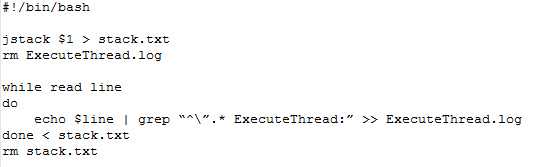
Here is a message in your ExecuteThread.log file:
What is the value of xxxx if the thread has been running a request for twenty minutes, assuming a
default configuration?
A. SRANDBY
B. ACTIVE
C. STUCK
D. RUNNING
E. WAITING
F. ADMIN
G. FAILED
- A. jstat -class 19142
- B. java weblogic.utils.ThreadDump 19142
- C. kill -5 19142
- D. jstack 19142
- E. kill -3 19142
Answer:
C
This thread is considered Stuck by WebLogic because it's been running for over the time defined in
MaxStuckThreadTime (600 seconds by default). Weblogic Server waits for this time to be reached
before marking a thread as stuck if the thread is still working after this time.
'weblogic.kernel.Default (self-tuning)' id=73
idx=0x128 nid=13410 prio=1 alive, in native, daemon
Comments
Question 6
A current production WebLogic Server (WLS) domain needs to be upgraded without affecting the
users. What are the five steps to follow for a Rolling Update? (Choose five.)
A. Back up the contents of your domain.
B. Use pack and unpack to upgrade each of the servers in the machine.
C. Shut down the servers in a single machine.
D. Repeat the process for all machines in the domain.
E. Restart the servers in the machine.
F. Repeat the process for all domains in the machine.
G. Upgrade the servers in the machine.
- A. Windows Start menu entries
- B. log files
- C. Java Enterprise Edition (JEE) applications and libraries
- D. config.xml and supporting configuration files
- E. embedded LDAP cached data
- F. proxy plug-ins
- G. server and services .lck files
- H. Unix and Windows start server scripts
Answer:
A,C,D,E,G
* Back up your applications, database schema, other application data, and domains.
* If required, obtain latest third party plug-ins or components that are compatible with required non-
Oracle components. For example, Apache Web Server libraries.
The rolling upgrade process includes stopping the Administration Server, installing the
upgrade, restarting the Administration Server, and then doing the same for each Managed Server in
the cluster (machine).
Comments
Question 7
You have a multithreaded application that looks up the WebLogic JMS ConnectionFactory object from
the JNDI tree.
Which statement is correct in this scenario? (Choose the best answer.)
A. It is not permitted. A multithreaded application cannot access the ConnectionFactory object.
B. The access to ConnectionFactory object MUST be synchronized.
C. The ConnectionFactory object can be referenced in a multithreaded application without any
special considerations.
D. Multiple threads trying to use the ConnectionFactory object simultaneously will throw an
exception.
E. In a multithreaded scenario, connection objects cannot be safely created from the
ConnectionFactory.
- A. when the onMessaqe() method of the MDB throws a Java error
- B. when the transaction the MDB participates in eventually fails and rolls back
- C. when the onMessage() method fails to acknowledge the reception of the message
- D. when messages are not being sent as part of a transaction
- E. when messages are non-persistent
Answer:
B
A connection factory supports concurrent use, enabling multiple threads to access the object
simultaneously.
A session and its message producers and consumers can only be accessed by one thread at a time
(i.e. the access must be synchronized). Their behavior is undefined if multiple threads access them
simultaneously.
Comments
Question 8
You are planning to use WebLogic JMS for implementing my enterprise messaging architecture.
Which messaging paradigm is invalid in this context? (Choose the best answer.)
- A. There is exactly one cluster master in the cluster at a given point of time.
- A. Point to Point messaging
- B. The cluster master must host all the pinned services in the cluster.
- B. Publish Subscribe messaging
- C. Any managed server in the cluster can serve as the cluster master.
- C. Datagram messaging
- D. A cluster master must always be different from a singleton master.
- D. Persistent messaging
- E. The cluster master must always be started with the node manager.
Answer:
C
Comments
Question 9
What are two differences between a group and a role? (Choose two.)
A. Groups are static and roles are dynamic and conditional.
B. Roles can be scoped to applications and groups are only global.
C. Roles are static and groups are dynamic and conditional.
D. Groups can be scoped to applications and roles are only global.
E. Groups can contain roles but roles cannot contain groups.
- A. JMS Server
- B. JOLT Service
- C. JTA Transaction Recovery Service
- D. User Defined Singleton Service
- E. JDBC Service
- F. JNDI Service
Answer:
A,B
A security role is a privilege granted to users or groups based on specific conditions. Like groups,
security roles allow you to restrict access to WebLogic resources for several users at once. Security
* Security roles are computed and granted to users or groups dynamically, based on conditions such
as user name, group membership, or the time of day. Groups are static.
* Security roles can be scoped to specific WebLogic resources within a single application in a
WebLogic Server domain (unlike groups, which are always scoped to an entire WebLogic Server
domain).
Comments
Question 10
A Web Module needs specific tuning. The Development team fine tunes the module in the
deployment descriptor (weblogic.xml) as follows: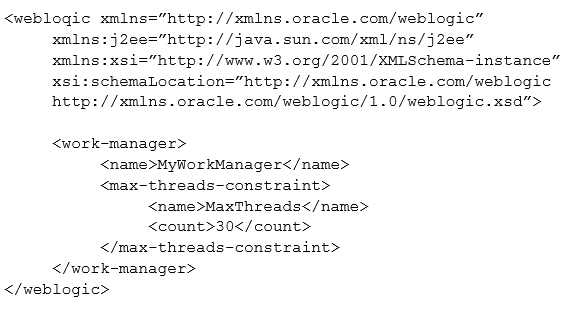
Which two are true? (Choose two.)
A. MyWorkManager is an application-scoped Work Manager.
B. Add the line <wl-dispatch-policy>MyWorkManager</wl-dispatch-policy> before <work-manager>
tags in weblogic.xml to make the Web Module use the Work Manager MyWorkManager.
C. MyWorkManager is a Global Work Manager.
D. MyWorkManager is a Default Work Manager.
E. Once the application is deployed and started on a Managed WebLogic Server, MyWorkManager
will appear under Environment/Work Managers on the WebLogic Console.
- A. an administration server
- B. a WLST session
- C. an HTTP server
- D. any other Node Manager
- E. a remote JMS client
- F. the weblogic.Deployer utility
Answer:
A,B
You can create Work Managers that are available only to a specific application or module. You can
define application-scoped Work Managers in the WebLogic Server Administration Console and in the
weblogic-application.xml
weblogic-ejb-jar.xml
weblogic.xml
A method is assigned to a Work Manager, using the <dispatch-policy> element in the deployment
descriptor.
Comments
Page 1 out of 12
Viewing questions 1-10 out of 125
page 2