Question 1
You plan to Install WeblLogic Server by using the generic JAR installer in silent mode.
What are two ways to create the required response file?
- A. This is only possible if the application is deployed to a cluster. Cluster deployments allow current users to continue to use the previous version of an application
- A. First install or deinstall graphically. There is an option to save a response file.
- B. This is possible if the application is versioned by using the WebLogic Server feature called Production Redeployment.
- B. Use the sample response file in the installation documentation as a template.
- C. This is not possible. When an application is redeployed, it replaces the old version and all users then access the new version
- C. First run the Repository creation utility. There is an option to save a response file.
- D. This is not possible. When an application is redeployed, all users continue to access the old version. Once all current users have exited the system, then all users from that point on access the new version
- D. The response file is not required. You can answer questions interactively at the command line.
- E. The genetic JAR installer does not have a silent mode .so you do not need a response file when using this installer.
Answer:
A,B
Comments
Question 2
Your domain consists of 30 servers. You are using the Administration Console.
Which is the quickest way to identify the servers that are in a Failed health state?
- A. The workload was lower than it is now
- A. Use the Filter button from the domain’s Monitoring >Health tab.
- B. The statement cache size is 20
- B. Use the Monitoring >Health tab for each server in the domain.
- C. The pool size has increased
- C. Write a custom WLST script to print out failed server.
- D. The statement cache size is 10
- D. Capture a diagnostic snapshot.
- E. The pool size has decreased
- F. The workload was higher than it is now
Answer:
A
Comments
Question 3
You use the Java based Node Manager to start your managed servers. You want Node Manager to:
Stop servers by using your custom stop script: mystopit.sh
Restart servers when the hardware cases
Use SSL communication
Check server heath once per second
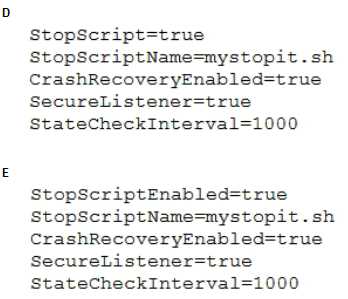
Below are portions of the nodemanager.properties file. Select the one that configures Node manager
as described.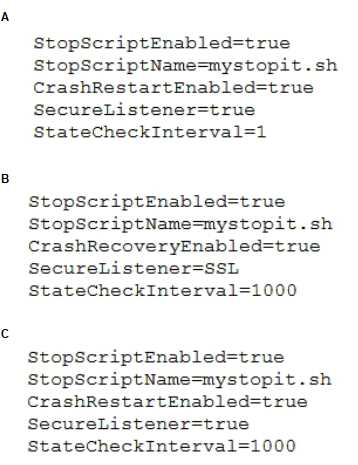
- A. There is nothing you can do, since inline help cannot be disabled.
- A. Option A
- B. There is nothing you can do for all users, since disabling inline help must be done per user.
- B. Option B
- C. Log into the administration console and disable inline help under "help."
- C. Option C
- D. Access WLST, connect to the domain's admin server, and use the command EnableInlineHelp (false).
- E. Option D
Answer:
E
Comments
Question 4
Which three statements are true about WebLogic clusters?
- A. In the domain configuration, the managed server is assigned to a machine.
- A. Clusters provide clients with transparent failover.
- B. The Node Manager process is running on the administration server's machine.
- B. EJB applications can be targeted to entire cluster.
- C. The Node Manager process is running on the managed server’s machine.
- C. All cluster members must bind to the same port number.
- D. The administration server uses one-way SSL to communicate with the Node Manager.
- D. Cluster members replicate application data by using heartbeats.
- E. In the domain configuration, the Node Manager has been configured for the machine.
- E. Cluster members can be associated with one or more domains.
- F. You have configured the Java-based Node Manager. The administration console cannot communicate with the script- based Node Manager.
- F. Web applications require a proxy in order to be used in a cluster.
Answer:
A,B,F
Comments
Question 5
You are using WebLogic Server Diagnostic Framework (WLDF) Instrumentation in a system diagnostic
module. The Dye Injection monitor is enabled. You know the diagnostic context ID of the request you
are Interested in that was processed by several. You are looking through the messages in the server
log file of several.
Which statement is true?
- A. None, inventories are used by Oracle databases only.
- A. You need to look at the Events Data Archive. Server log files do not contain WL DF context IDs
- B. *ORACLE_HOME/wlserver/bin/compareInventory.sh -oracle_home1 -oracle_home2 *.
- B. You need to look at the Harvested Data Archive. Server log files do not contain WL DF context IDs.
- C. The Oracle Inventory Viewer utility.
- C. You need to look at the domain log file. Only the domain log file contains WL DF context IDs.
- D. *ORACLE_HOME/oui/bin/compareInventory.sh -oracle_home1 -oracle_home2 *.
- D. You can search the server log file for the context ID. Any message that was written to the log IDs during that request will contain the context ID.
- E. You need to translate the context ID Into the corresponding transaction ID, which is the only ID in server log file entries.
Answer:
A
Comments
Question 6
You are deploying a web application called inventory, war. It has been installed and has the state of
prepared. It is targeted to the Managed server named managed1.The web application context root
is /inventory and the starting page is index .jap.
However ,you want to test the application before allowing end users access to it. In the
administration console, you select inventory. war, and then select Start and servicing only
administration request.
In you web browser, you need to enter a host and port followed by /inventory /index.jap.
Which host and port would you use?
- A. An Administration Server manages the domain configuration
- A. managed1 host and port
- B. A domain must have at least one of each type of server
- B. Administration Serve host and port
- C. An Administration Server keeps a domain log, but a Managed Server does not
- C. managed1 host and Administration port
- D. A Managed Server keeps a server log, but an Administration Server does not
- D. Administration server host and Administration port
- E. Java EE applications are deployed only to a Managed Server
Answer:
C
Comments
Question 7
You are creating and configuring a cluster by using the administration console. Which two statements
are true?
- A. Server startup fails
- A. All servers that will be part of the cluster must be created before the cluster is created.
- B. The server binds to localhost
- B. You must pick the cluster messaging mode.
- C. The server prompts for an address when it is started the first time
- C. Even though you create a non dynamic cluster, you can change it to a dynamic cluster later.
- D. The server attempts to bind to all network interfaces on the host OS
- D. Once the cluster is created, you cannot change its messaging mode.
- E. The administration console does not provide a way to manually migrate singleton services. It must be set up to be done automatically or by using WLST.
Answer:
B,C
Comments
Question 8
One Managed Server that is part of a large domain throws jav
a.lang.out of Memory error (OOM) occasionally.
You have been monitoring this server with the jvisualVM tool but that didnt help because the issue
occurs infrequently and not a specific scenario. So you decided to force the server to dump the heap
memory as soon as an OOM gets thrown in order to analyze the dump file later.
How do you modify the Java HotSpot Startup command to enable this feature and save the dump in
the directory D:\hprof-dumps\?
- A. Enable Use XA Data Source Interface in the transaction properties of each data source.
- A. Add –xx:+DumpHeaponoutofmemory-xx:Dumppath=D:\hprof.
- B. WebLogic Server supports distributed transactions by default, so no specific settings are required.
- B. Add-xx:+HeapDumponoutofmemoryError-xx:Heapdumppath=D:\hprof-dumps.
- C. Split the transaction into multiple local transactions.
- C. Add-xx:+DumpHeaponoutofmemoryError-xx:Heappath=D:\hprof-dump.
- D. Configure your data sources with the available XA-compliant driver for your DBMS.
- D. Add-xx:+HeapdumponoutofMemory-xx:HeapDumppath=D:\hprof-dumps.
- E. Enable Two-Phase Commit in each data source.
- E. Add-xx:+HeapDumponoutofMemoryError-xx:Dumppath=D\hprof-dumps.
- F. Add-xx:+HeapDumponoutofMemoryExecepttion-xx:HeapDumppath=D:\hprof-dumps.
Answer:
B
Comments
Question 9
You are using the Administration console to monitor a resource.
Which three techniques can you use to customize the monitoring output?
- A. Create a single domain with three clusters
- A. Sort the rows by a specific column.
- B. Create a single domain with three administration servers
- B. Limit the number of rows displayed.
- C. Create a single domain with three managed servers
- C. Change the order of the displayed columns.
- D. Create three domains
- D. Views the rows from a specific time range.
- E. Combine (add) multiple columns together.
Answer:
A,B,C
Comments
Question 10
You are working for a software company that mostly dealt with creating and reusing C++ and.
NET objects. There are many COM (Component Object Model) components that have been created
over time that provide standardized functionalities. Recently, platform independence has become a
major consideration for your organization and you have deployed WebLogic server12c.But you would
like to make use of some of your prebuilt COM objects for request processing. You need an interim
solution before implementing web services.
Which artifact within WebLogic server helps you achieve your objective?
- A. Average execution time for a web application URL.
- A. Messaging Bridge
- B. Number or transaction rollbacks for a web service
- B. IDL Mapper
- C. Maximum HTTP session timeout for a web application
- C. jCOM
- D. Number of current sessions for an EJB
- D. XML Registry
- E. Numbers of faults /errors for a web service
- E. COM2 Java
- F. Number of instances of an EJB
Answer:
E
Comments
Page 1 out of 12
Viewing questions 1-10 out of 127
page 2