Question 1
Which two statements are true about the SET VERIFY ON command? (Choose two.)
- A. It can be used only in SQL*Plus
- B. It displays values for variables used only in the WHERE clause of a query
- C. It can be used in SQL Developer and SQL*Plus
- D. It displays values for variables created by the DEFINE command
- E. It displays values for variables prefixed with &&
Answer:
C, E
Comments
Question 2
Which three statements are true about a self join? (Choose three.)
- A. The ON clause must be used
- B. The query must use two different aliases for the table
- C. It must be an equijoin
- D. It must be an inner join
- E. The ON clause can be used
- F. It can be an outer join
Answer:
B, E, F
Comments
Question 3
You want to write a query that prompts for two column names and the WHERE condition each time it
is executed in a session but only prompts for the table name the first time it is executed.
The variables used in your query are never undefined in your session.
Which query can be used?
- A. SELECT &&col1, &&col2FROM &tableWHERE &&condition = &&cond;
- B. SELECT &col1, &col2FROM &&tableWHERE &condition;
- C. SELECT &col1, &col2FROM “&table”WHERE &condition;
- D. SELECT ‘&&col1’, ‘&&col2’FROM &tableWHERE ‘&&condition’ = ‘&cond’;
- E. SELECT &&col1, &&col2FROM &tableWHERE &&condition;
Answer:
B
Comments
Question 4
Examine the description of the CUSTOMERS table: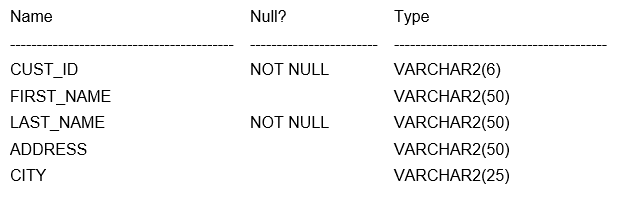
You want to display details of all customers who reside in cities starting with the letter D followed by
at least two characters.
Which query can be used?
- A. SELECT * FROM customers WHERE city LIKE ‘D_%’;
- B. SELECT * FROM customers WHERE city = ‘%D_’;
- C. SELECT * FROM customers WHERE city LIKE ‘D_’;
- D. SELECT * FROM customers WHERE city = ‘D_%’;
Answer:
A
Comments
Question 5
Examine this command: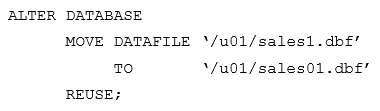
Which two statements are true? (Choose two.)
- A. DML may be performed on tables with one or more extents in this data file during the execution of this command.
- B. The tablespace containing SALES1.DBF must be altered READ ONLY before executing the command.
- C. The tablespace containing SALES1.DBF must be altered OFFLINE before executing the command.
- D. If Oracle Managed Files (OMF) is used, then the file is renamed but moved to DB_CREATE_FILE_DEST.
- E. The file is renamed and stored in the same location
Answer:
A, E
Comments
Question 6
Which three statements are true about dropping and unused columns in an Oracle database?
(Choose three.)
- A. A primary key column referenced by another column as a foreign key can be dropped if using the CASCADE option.
- B. An UNUSED column’s space is reclaimed automatically when the block containing that column is next queried.
- C. An UNUSED column’s space is reclaimed automatically when the row containing that column is next queried.
- D. Partition key columns cannot be dropped.
- E. A DROP COLUMN command can be rolled back
- F. A column that is set to UNUSED still counts towards the limit of 1000 columns per table
Answer:
A,D,F
Comments
Question 7
Which two statements are true regarding Oracle database space management within blocks
managed by Automatic Segment Space Management (ASSM)? (Choose two.)
- A. PCTFREE defaults to 10% for all blocks in all segments for all compression methods
- B. ASSM assigns blocks to one of four fullness categories based on what percentage of the block is allocated for rows
- C. Update operations always attempt to find blocks with free space appropriate to the length of the row being updated
- D. Insert operations always attempt to find blocks with free space appropriate to the length of the row being inserted
- E. A block will always be eligible for inserts if the row is short enough to fit into the block
Answer:
C,E
Comments
Question 8
Evaluate these commands which execute successfully: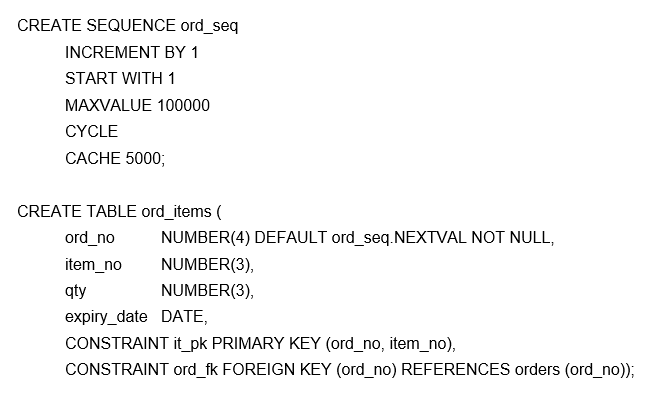
Which two statements are true about the ORD_ITEMS table and the ORD_SEQ sequence? (Choose
two.)
- A. If sequence ORD_SEQ is dropped then the default value for column ORD_NO will be NULL for rows inserted into ORD_ITEMS
- B. Any user inserting rows into table ORD_ITEMS must have been granted access to sequence ORD_SEQ
- C. Column ORD_NO gets the next number from sequence ORD_SEQ whenever a row is inserted into ORD_ITEMS and no explicit value is given for ORD_NO
- D. Sequence ORD_SEQ cycles back to 1 after every 5000 numbers and can cycle 20 times
- E. Sequence ORD_SEQ is guaranteed not to generate duplicate numbers
Answer:
B,C
Comments
Question 9
Which three instance situations are possible with the Oracle Database server without multi-tenant?
(Choose three.)
- A. two or more instances on separate servers all associated with one database
- B. one instance on one server associated with one database
- C. one instance on one server associated with two or more databases on the same server
- D. one instance on one server not associated with any database
- E. one instance on one server associated with two or more databases on separate servers
Answer:
ABD
Comments
Question 10
Which two statements are true about the ORDER BY clause when used with a SQL statement
containing a SET operator such as UNION? (Choose two.)
- A. Column positions must be used in the ORDER BY clause
- B. Only column names from the first SELECT statement in the compound query are recognized
- C. The first column in the first SELECT of the compound query with the UNION operator is used by default to sort output in the absence of an ORDER BY clause
- D. Each SELECT statement in the compound query must have its own ORDER BY clause
- E. Each SELECT statement in the compound query can have its own ORDER BY clause
Answer:
B,C
Comments
Page 1 out of 14
Viewing questions 1-10 out of 142
page 2