Question 1
A customer has NearSync configured. When the administrator tries to restore a snapshot from 3
minutes ago, it is not available. The snapshots are happening at 15-minute intervals instead of at the
5-minute configured interval. When the protection domain was initially set up, the snapshots were
happening at the expected 5-minute interval.
What should the customer do to enable the snapshots to happen at the expected interval?
- A. Utilize Metro Availability to meet this requirement
- B. Change the protection domain to use Async DR
- C. Fix a connectivity issue because the protection domain reverted to Async
- D. Configure the protection domain to take snapshots on 15-minute intervals
Answer:
C
Explanation:
If the administrator observes that the snapshot intervals have changed from the initially configured
5-minute intervals to 15-minute intervals, it indicates a potential issue with the setup. Option C, "Fix
a connectivity issue because the protection domain reverted to Async," addresses the likely cause—a
connectivity problem that caused the system to revert to longer, asynchronous DR snapshot
intervals.
NearSync typically allows for very frequent snapshots, but if there is a connectivity or configuration
issue, it might fall back to less frequent asynchronous DR settings. Identifying and resolving any
connectivity issues would allow the NearSync configuration to operate as initially intended.
Reference:
The mechanics of NearSync and its behavior under connectivity issues are discussed in detail in
Nutanix's documentation and troubleshooting guides, which describe how the system handles
fallback scenarios and how to rectify them.
Comments
Question 2
An administrator deploys Exchange on a Nutanix cluster. The administrator creates two containers
with RF2 configuration:
• One container for Exchange
• One container for the other VMs
The Exchange VM is experiencing I/O performance issues.
Which changes to Storage Optimization should be used on the Exchange container to enhance I/O
performance?
- A. No data reduction
- B. Post process Deduplication only
- C. Inline compression and EC-X
- D. Inline compression and Deduplication
Answer:
A
Explanation:
For the Exchange VM experiencing I/O performance issues, the recommended storage optimization
change is Option A, "No data reduction." Exchange, as an application, is highly sensitive to latency
and typically does not benefit significantly from data reduction technologies like deduplication or
compression, which can introduce additional processing overhead and potentially worsen
performance issues.
By configuring the container for Exchange with no data reduction, the system maximizes I/O
performance by eliminating any additional processing that could delay data access. This setup
ensures that Exchange has the fastest possible access to its data, which is crucial for its performance.
Reference:
This recommendation aligns with best practices for Exchange storage on Nutanix, as detailed in the
Nutanix best practices guide for deploying Microsoft Exchange, where it advises against using data
reduction features for databases requiring high I/O throughput.
Comments
Question 3
While creating an image placement policy on the organizations AOS 5.15-based Nutanix cluster, the
administrator wants to ensure there are no restrictions on using the selected images on clusters
outside of the identified set.
What type of Policy Enforcement must the administrator choose?
- A. Soft
- B. Internal
- C. Hard
- D. External
Answer:
A
Explanation: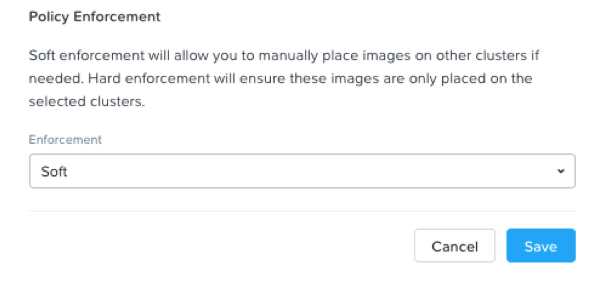
Comments
Question 4
An alert about RX errors on eth2 on a node is reported in the cluster. The administrator logs in to the
CVM in question, checks the ping_* files in the data/logs/syststats folder, and notices intermittent
ping loss.
The node in question has the following network configuration: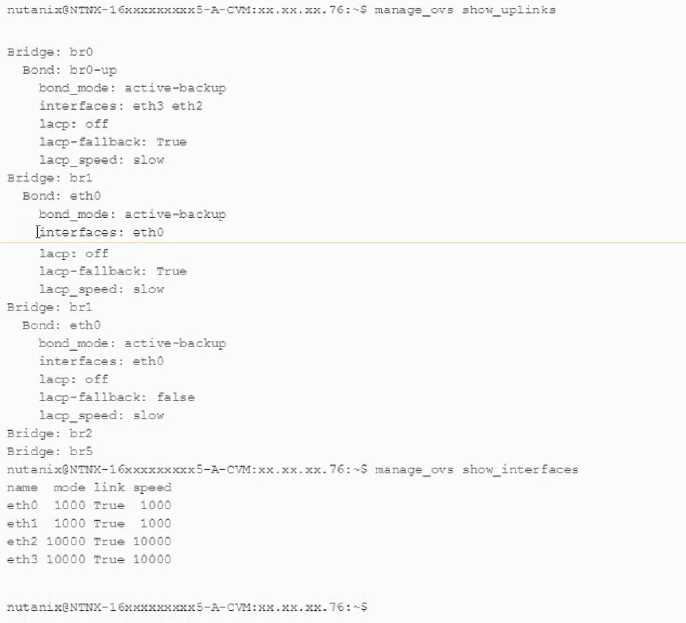
Which action should be used to troubleshoot without disrupting the VMs running on this node?
- A. Replace the cable from eth2 to the switch
- B. Remove eth3 from br0-up and monitor for new alerts
- C. Check the port on the switch side for any errors
- D. Enable balance-s1b on br0-up and monitor if a problem persists
Answer:
C
Explanation:
Given the reported RX errors on eth2 and the intermittent ping loss as observed from the CVM logs,
the best initial troubleshooting step that avoids VM disruption is to inspect the switch port for errors.
Option C, "Check the port on the switch side for any errors," is the most direct and non-invasive
approach to determining if the issue lies with the network infrastructure rather than the server
hardware itself or the configuration.
This action helps identify whether the problem is related to the physical connection (e.g., port issues,
switch configuration errors) without altering the current active network setup on the Nutanix node. If
errors are found on the switch port, adjustments or repairs can be made accordingly, potentially
resolving the RX errors without impacting the running VMs.
Reference:
This recommendation follows Nutanix's best practices for network troubleshooting, focusing first on
external network components before altering host configurations.
Comments
Question 5
An administrator protected a DB VM running on a Nutanix cluster with NearSync Replication, which
schedules to repeat every 15 minutes □ to a second site. The daily change rate is low. During nightly
backups, the replication window is missed due to write volume.
Which two options describe the expected behavior? (Choose two.)
- A. NearSync stops working and fails over to the remote site.
- B. Protection Domain transitions back to the hourly schedule.
- C. The Administrator needs to re-enable it manually.
- D. The system continuously tries to get to the NearSync schedule.
Answer:
BD
Explanation:
When a NearSync Replication window is missed due to high write volume during nightly backups,
the expected behavior of the system is to adjust the replication schedule temporarily and
continuously attempt to return to the configured NearSync schedule. The correct answers are:
Option B, "Protection Domain transitions back to the hourly schedule." If the NearSync cannot
maintain the 15-minute schedule due to excessive write volume, it may temporarily fall back to a less
frequent schedule, such as hourly, to stabilize.
Option D, "The system continuously tries to get to the NearSync schedule." NearSync is designed to
handle transient high-load situations by trying to catch up and revert to the pre-set NearSync
schedule as conditions allow.
Reference:
These behaviors are outlined in the Nutanix documentation for NearSync, which describes how the
system manages periods of high I/O and missed replication windows.
Comments
Question 6
An administrator is deploying a three-tier application on a Nutanix Enterprise Cloud consisting of
web, application, and database VMs. Traffic between the servers must be limited to specific
services/ports. There is an application layer firewall VM deployed on one host in the cluster.
In which way should the administrator meet this requirement?
- A. Create a network for each type of VM, and use policy-based routing to control the traffic flow
- B. Configure a security policy and service chain redirecting the server traffic through the firewall
- C. Separate the web. application and database VMs on to dedicated VLANs
- D. Categorize the VMs in Prism Central and utilize Flow to set a security policy
Answer:
D
Explanation:
For a multi-tier application where traffic must be limited to specific services and ports across web,
application, and database VMs, the optimal approach is to use microsegmentation features provided
by Nutanix. Option D, "Categorize the VMs in Prism Central and utilize Flow to set a security policy,"
is the correct choice.
Nutanix Flow allows for detailed security policies that control VM-to-VM traffic within the same
cluster, effectively managing access and communication based on specified criteria like VM category,
service, or application type. This solution enables precise control over traffic flows, enhancing
security without requiring additional physical or virtual network segmentation.
Reference:
Nutanix Flow capabilities are detailed in Nutanix Prism Central's documentation, which explains how
to implement microsegmentation and security policies for application-specific traffic management.
Comments
Question 7
Refer to the exhibit.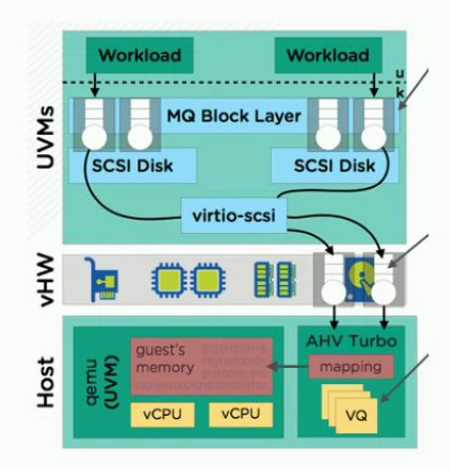
An administrator has an existing cluster and needs to improve performance using AHV Turbo. Which
two items are required to achieve even greater performance? (Choose two.)
- A. Workloads are multi-threaded.
- B. VMs have one vCPU configured.
- C. VMs have multi-queue disabled.
- D. VMs have more than one vCPU.
Answer:
AD
Explanation:
To maximize the performance benefits of AHV Turbo, which is designed to optimize network and
storage I/O operations for VMs, certain VM configurations are advantageous. The correct answers
are:
Option A, "Workloads are multi-threaded." Multi-threaded applications can better utilize the
improvements in I/O processing efficiency provided by AHV Turbo, leading to better overall
performance.
Option D, "VMs have more than one vCPU." This configuration allows VMs to handle multiple
processes or threads simultaneously, which is particularly beneficial when combined with AHV
Turbo's enhanced I/O operations.
Reference:
The benefits of configuring VMs with multiple vCPUs and supporting multi-threaded applications are
discussed in Nutanix's documentation on AHV and performance optimization, where AHV Turbo is
highlighted for its ability to accelerate VM operations in a Nutanix environment.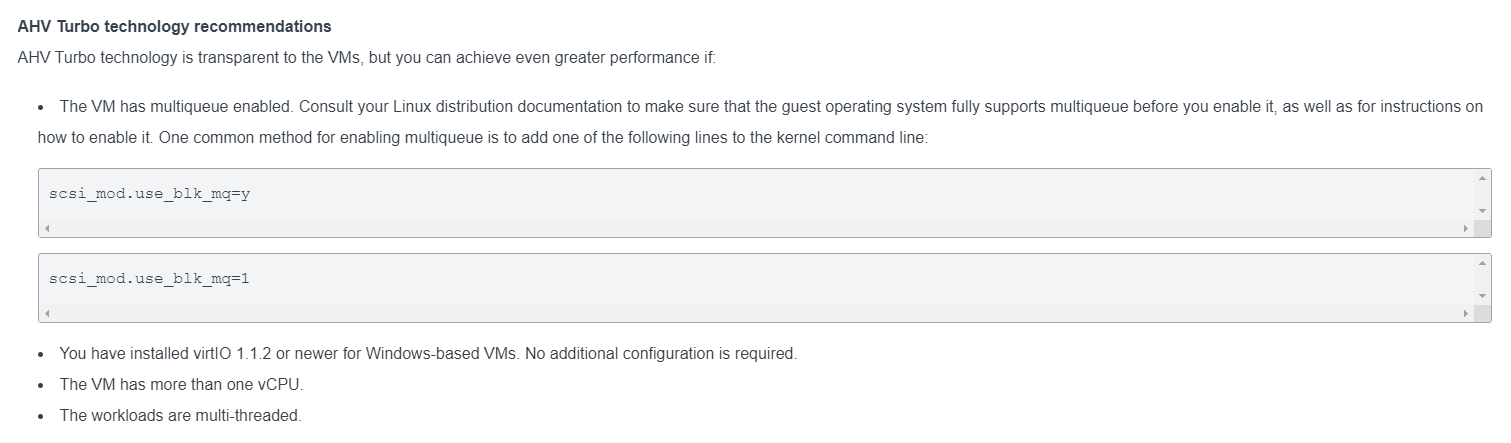
Comments
Question 8
An administrator is performing a set of routine checks and notes that Prism Central is running with 4
vCPUs and 21 GB RAM. The organizations environment is based on two Nutanix clusters with 170
VMs plus a Legacy vSphere infrastructure. No manual changes have been done on Prism Central VM.
Which configuration justifies the current Prism Central configuration?
- A. Nutanix Move is running on Prism Central to import VMs from the Legacy Cluster.
- B. Prism Central was installed for Large Deployment environments.
- C. Prism Central is running on the legacy duster and requires more RAM.
- D. Nutanix Leap and Nutanix Flow have been enabled on Prism Central
Answer:
D
Comments
Question 9
An administrator finds that home shares cannot be configured in a new Files 3.5 deployment. Why is
this happening?
- A. NFS default access is set to Read Only.
- B. Multi-protocol access is not configured.
- C. Access Based Enumeration is not enabled.
- D. The system is deployed as a single FSVM.
Answer:
D
Explanation:
Comments
Question 10
Refer to the exhibit.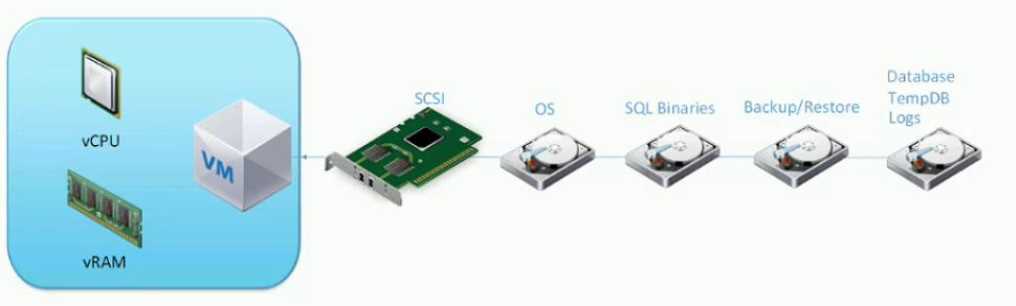
A Microsoft SQL 2016 deployment is shown in the exhibit. The administrator receives user reports
that database queries take too long to return.
Which optimization should be made to this configuration to improve performance?
- A. Combine both of the OS and SQL Binaries disks
- B. Add a second SCSI controller for the Database.
- C. TempDB, and Logs disk Separate the Database. TempDB, and Logs onto their own disks
- D. Configure the VM to use a PCI disk controller
Answer:
C
Comments
Page 1 out of 30
Viewing questions 1-10 out of 302
page 2