Question 1
Which of the following best describes self-phase modulation?
- A. It is a type of modulation format exploiting the phase to carry information.
- B. It is a phase shift suffered by an optical signal caused by its power intensity.
- C. It is s type of impairment that can be compensated using DCMs
- D. It is a type of impairment cause by spectrally adjacent channels.
Answer:
D
Comments
Question 2
Consider the exhibit that shows a link power budget diagram. Which of the following is represented
at location 2?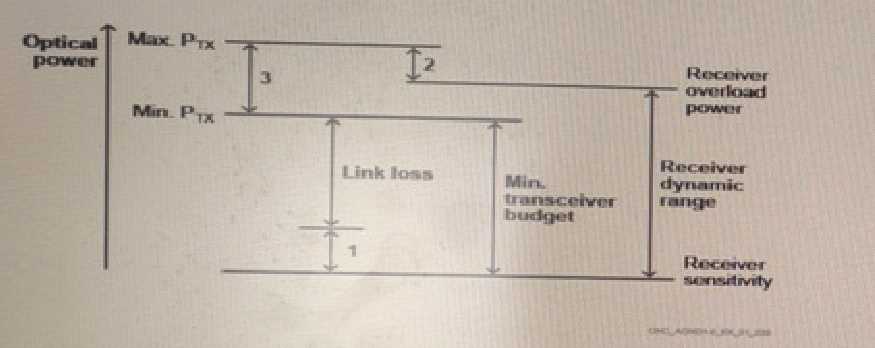
- A. Power range
- B. OSNR margin
- C. Minimum attenuation
- D. System aging margin
Answer:
A
Comments
Question 3
Which of the following statements about the Decision (HDEFC) decoding and soft decision FEC
(SDFEC) decoding is FALSE?
- A. HDFEC injects less latency into the decoding process than SDFEC.
- B. HDFEC provides a higher coding gain than SDEFC
- C. HDFEC uses fewer thresholds than SDEFC.
- D. HDFEC discards bits earlier in the decoding process than SDEFC.
Answer:
A
Comments
Question 4
Which of the following statements about Bit Error Rate (BER) is correct?
- A. BER is the ratio of redundant bits to correct bits.
- B. BER is measured at both the transmitted and receiving ends.
- C. BER can be measured before after the FEC decoding.
- D. BER can be accurately measured in a short period of time , for any rate.
Answer:
B
Comments
Question 5
Consider two EDFA amplifiers in cascade. Each EDFA has an average input signal power of 10 mW and
an average noise power of 1 mW. What is the OSNR of the system at the receiver.
- A. 20 dB
- B. 10 dB
- C. 7 dB
- D. 5 bB
Answer:
A
Comments
Question 6
Which of the following best describes Four Wave Mixing (FWM)?
- A. FWM is a linear impairment that produces crosstalk four adjacent wavelengths are used.
- B. FWM is a non-linear impairment that produces crosstalk at the sum and difference of two wavelengths.
- C. FWM is a non-linear impairment resulting from varying velocities at different frequencies.
- D. FWM is a linear impairment resulting from pulses broadening over ultra-long distances
Answer:
A
Comments
Question 7
Which of the following statements about Raman amplification is FALSE?
- A. Amplification occurs along the fiber
- B. Chromatic dispersion within the fiber is increased.
- C. Flat gain can be achieved in any transmission band.
- D. OSNR is improved compared to EDFAs permitting lingers spans
Answer:
D
Comments
Question 8
Refer to the exhibit.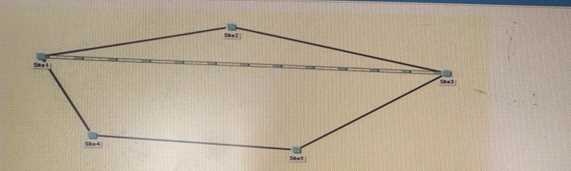
Consider the above exhibit, which shows a WDM network map from EPT. A new trail at 10G needs to
be created from Site1 to Site3. The design tool routes the trail through Site1 but the trail is evaluated
as invalid due to insufficient OSNR margin. Among the following option, which is NOT effective for
making the 10G trail valid?
- A. Use a FEC with a lower code rate
- B. Use 3R regeneration at Site2
- C. Use a DCM at Site 2 D, Use a Raman amplifier at Site2
Answer:
A
Comments
Question 9
Which of the following statements about power commissioning system is most accurate?
- A. A system must be either linear or a ring. A system can stop if there is a through communication in a node.
- B. A system must be a ring only A system can stop if there is a through connection in a node.
- C. A system must be a ring only A system cannot stop if there is a through connection in a node.
- D. A system must be either linear or a ring A system cannot stop if there is a through connection in a node
Answer:
D
Comments
Question 10
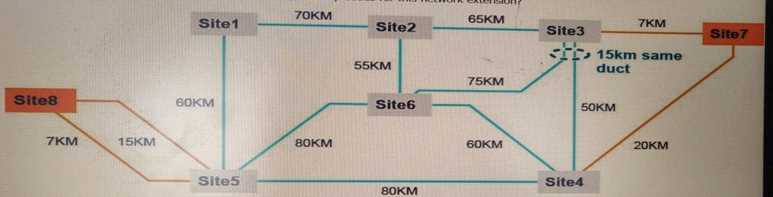
Consider the exhibit. The grey sites (Site 1 through Site6) from an existing network, which will be
extended by adding Site7 and Site8. Which of the following is NOT a common source of
interoperability issues for this network extension?
- A. Spectrum grid of the extension
- B. Fiber connectors at Site6
- C. Cascading in the existing network
- D. Regeneration requirements at Site5
Answer:
B
Comments
Page 1 out of 3
Viewing questions 1-10 out of 40
page 2