Question 1
Which of the following statements about SR-TE administrative constraints is FALSE?
- A. A strict hop must be adjacent to the previous hop in the list.
- B. The TE metric for a link is by default the same as the IGP metric.
- C. Shared-Risk-Link Groups are only taken into account when calculating the secondary path.
- D. The head-end router may calculate a path that takes into account max hop count and bandwidth constraints.
Answer:
C
Explanation:
Shared-Risk-Link Groups(SRLG) is taken into account when calculating both primary and secondary
path to avoid routing over the same physical link.
Comments
Question 2
A router participating in SR-TE is advertising a value of Ox11 for the admin-group membership of one
of its interfaces. Which of the following statements is TRUE?
- A. The interface belongs to admin group RED, configured with a value of 17.
- B. The interface belongs to two different admin groups.
- C. The interface belongs to three different admin groups.
- D. The interface belongs to four different admin groups.
Answer:
B
Explanation:
In SR-TE, the admin-group is represented by a 32-bit value, where each bit represents a different
admin-group. The value Ox11 in binary is 000100010001, which has two bits set to 1, indicating that
the interface belongs to two different admin groups. The exact admin-groups that the interface
belongs to depends on how the admin-groups have been configured on the router.
Comments
Question 3
Which of the following statements about enabling and using traffic engineering for Segment Routing
is FALSE?
- A. One interface can belong to an admin group and SRLG group at the same time.
- B. A link attribute has to be assigned to a particular interface under the [/configure router interface] context
- C. Bandwidth availability as a link attribute cannot be configured.
- D. The interfaces used for SR-TE LSPs have to be added to the MPLS context.
Answer:
C
Explanation:
Bandwidth availability can be configured as a link attribute in SR-TE, it is used to control the amount
of traffic that can be sent over a particular link.
Comments
Question 4
Which of the following list of SR-TE attributes has to be advertised among routers?
- A. Administrative groups that each link belongs to, TE metric of links, bandwidth availability of each link, SRLG that each link belongs to.
- B. Administrative groups that each link belongs to, TE metric of links, SRLG that each link belongs to.
- C. Administrative groups that each link belongs to, TE metric of links, bandwidth availability of each link, SRLG that each link belongs to, link status up/down.
- D. Administrative groups that each link belongs to, TE metric of links, SRLG that each link belongs to, link status up/down.
Answer:
A
Explanation:
In SR-TE, routers need to advertise certain attributes of their links to other routers in the network in
order to calculate traffic-engineered paths. These attributes include:
Administrative groups that each link belongs to: This information is used to restrict the use of certain
links to specific traffic types or groups.
TE metric of links: This information is used to calculate the cost of using a particular link for a traffic-
engineered path.
Bandwidth availability of each link: This information is used to control the amount of traffic that can
be sent over a particular link.
SRLG that each link belongs to: This information is used to avoid routing over the same physical link.
Link status up/down is not needed to be advertised as it is part of the IGP protocol and is used to
check the reachability of a link.
Comments
Question 5
Based upon the exhibit, which of the following statements regarding the configuration is FALSE?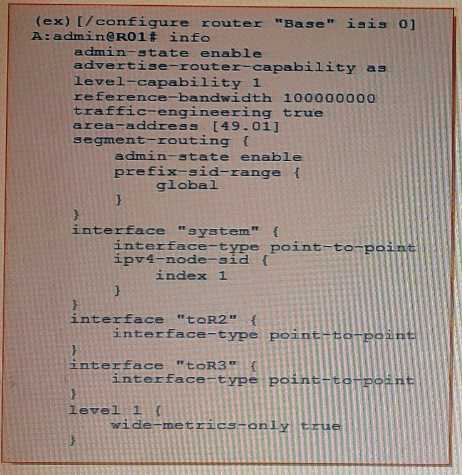
- A. Traffic engineering information will only be advertised for the interfaces that have both MPLS and RSVP enabled.
- B. The Node-SID assigned to this router is the second label in the defined range.
- C. Traffic engineering has been enabled on this router.
- D. Adjacency-SID labels will not be advertised as they have not been defined under the physical interfaces.
Answer:
A
Comments
Question 6
OSPF is being used for segment routing with traffic-engineering (SR-TE). The traffic-engineering
option has been set to "sr-te false". Which of the following statements is TRUE?
- A. The TE information will be advertised for all the OSPF links that have MPLS enabled.
- B. The TE information will only be advertised using application-specific sub-TLVs.
- C. The TE information will only be advertised for the OSPF links that have both MPLS and RSVP enabled.
- D. The TE information will only be advertised using extended-link opaque LSAs.
Answer:
D
Explanation:
When using Segment Routing with Traffic Engineering (SR-TE) in OSPF, the TE information is
advertised using extended-link opaque LSAs. The option "sr-te false" indicates that OSPF will not
advertise the TE information in the OSPF database, thus the routers will not be aware of the TE
information.
Comments
Question 7
Examine the exhibit.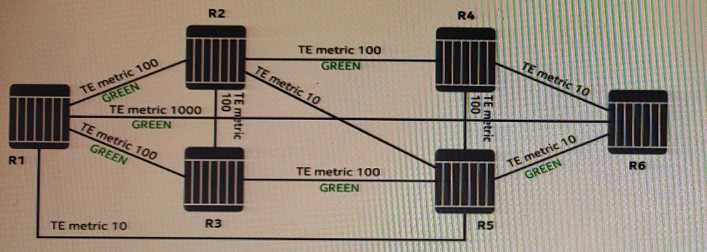
An LSP is being configured to start at R1 and end at R6 using local CSPF. The LSP has the following
constraints. Include admin-group GREEN, use the TE metric and hop-limit 3. What routers will be
included in the LSP path?
- A. R1, R2, R4, R6
- B. R1, R5, R6
- C. R1, R3, R5, R6
- D. R1, R6
Answer:
C
Comments
Question 8
Examine the exhibit. Based upon the configuration, which routers will the LSP go through?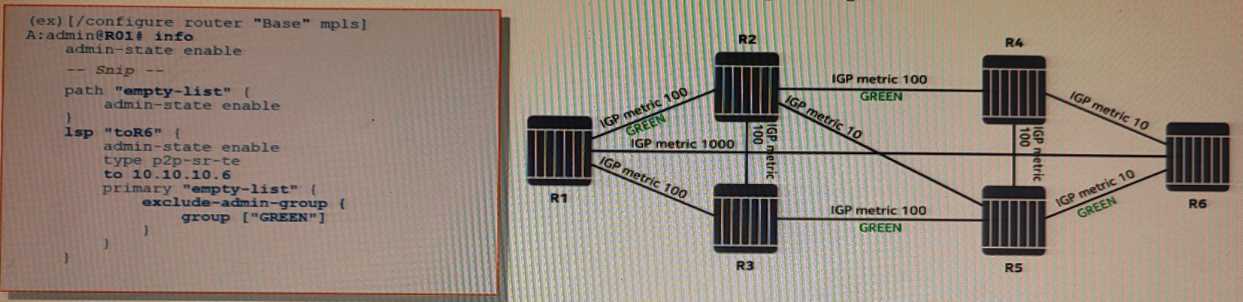
- A. R1, R3, R2, R5, R4 and R6
- B. R1, R2, R5 and R6
- C. R1, R3, R4 and R6
- D. R1, R2, R4 and R6
Answer:
C
Comments
Question 9
Which of the following statements about path definitions is FALSE?
- A. Once a path is associated with an LSP, it cannot be used by other LSPs.
- B. A loose hop is one that does not have to be directly adjacent to the previous hop in the path list
- C. The path hops can be defined by either the system or physical interface IP address.
- D. In addition to the hops defined in the path list, the head-end and tail-end routers are implicitly added.
Answer:
C
Comments
Question 10
Which of the following is an advantage of enabling label stack reduction for a CSPF-calculated path,
as compared to using plain CSPF?
- A. The number of hops included in the end-to-end path is reduced.
- B. The path calculation can be delegated to an external path computation element (PCE).
- C. There is a larger list of traffic-engineering constraint types that can be imposed on the LSP path.
- D. The routers in the calculated path can take advantage of ECMP to better distribute the traffic load.
Answer:
A
Explanation:
Once a path is associated with an LSP, it cannot be used by other LSPs is False. A path can be used by
multiple LSPs, but each LSP can have different attributes like bandwidth, priority and other
constraints.
Comments
Page 1 out of 3
Viewing questions 1-10 out of 40
page 2