Question 1
In MAC address 00-20-60-CE-2B-28, which part is the Organisationally Unique Identifier (OUI)?
- A. 2B-28
- B. 00-20
- C. CE-2B-28
- D. 00-20-60
Answer:
D
Explanation:
A MAC address (Media Access Control address) is a 48-bit identifier typically expressed in six groups
of two hexadecimal digits (e.g., 00-20-60-CE-2B-28). It consists of two key parts:
OUI (Organizationally Unique Identifier) – The first 24 bits (or first 3 octets, e.g., 00-20-60) are
assigned by the IEEE to hardware manufacturers. This identifies the vendor or manufacturer.
Device Identifier (NIC Specific) – The remaining 24 bits (e.g., CE-2B-28) are assigned uniquely by the
vendor to each device/interface.
So in the address 00-20-60-CE-2B-28:
00-20-60 is the OUI
CE-2B-28 is the device-specific portion
Thus, the correct answer is D. 00-20-60.
Reference:
IEEE MAC Address Standard (IEEE 802)
Nokia IP Networking Fundamentals Study Guide – Chapter: "Ethernet Addressing"
Comments
Question 2
Refer to the exhibit.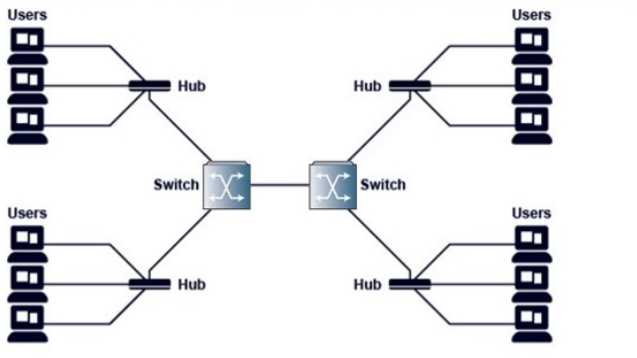
An Ethernet Local Area Network (LAN) consists of the components shown in the diagram. Assuming
there are no VLANs, how many broadcast domains are on this LAN?
- A. 1
- B. 2
- C. 5
- D. 6
Answer:
A
Explanation:
A broadcast domain is a logical division of a network in which all nodes can reach each other with
broadcast frames (Layer 2). Devices within the same broadcast domain receive broadcast packets
sent by others.
In the diagram:
Multiple users connect to hubs.
Hubs are Layer 1 devices and do not break broadcast domains. They simply replicate incoming
electrical signals to all ports.
Hubs are then connected to switches.
Switches, unless VLANs are configured, forward broadcasts to all ports except the incoming one,
effectively keeping all devices in the same broadcast domain.
The two switches are connected together without VLAN segmentation.
Therefore:
The entire LAN depicted is a single Layer 2 broadcast domain.
There are no routers or VLANs to break or separate the domain.
Correct answer: A. 1
Reference:
Nokia IP Networking Fundamentals Study Guide – Chapter: "LAN Switching and Broadcast Domains"
Cisco and CompTIA Network+ materials on "Hubs vs Switches vs Routers in Broadcast Domains"
Comments
Question 3
Which of the following is required if devices on different VLANs wish to communicate with each
other?
- A. They can communicate if they are connected to the same switch.
- B. They can communicate if they are in the same broadcast domain.
- C. They can communicate if there is a router to connect them.
- D. They cannot communicate.
Answer:
C
Explanation:
A Virtual Local Area Network (VLAN) is a logical separation of devices at Layer 2, even if those
devices are connected to the same physical switch. Each VLAN forms its own broadcast domain, and
traffic cannot cross from one VLAN to another without Layer 3 routing.
Option A is incorrect – devices on the same switch but in different VLANs still cannot communicate
directly.
Option B is incorrect – VLANs explicitly create separate broadcast domains.
Option D is technically incorrect – communication is possible with the right setup.
Option C is correct – to enable communication between different VLANs, a router or a Layer 3 switch
with inter-VLAN routing capability is required.
This process is called inter-VLAN routing, and it's a fundamental task in enterprise networks using
VLANs.
Reference:
Nokia IP Networking Fundamentals Study Guide – Chapter: "LAN Segmentation and VLANs"
Cisco CCNA and CompTIA Network+ – Inter-VLAN Routing Concepts
Comments
Question 4
Which of the following enables service providers to support multiple customers with the same VLAN
ID over the same backbone?
- A. VLAN Trunking
- B. VLAN Stacking
- C. VLAN Tagging
- D. VLAN Routing
Answer:
B
Explanation:
VLAN Stacking, also known as Q-in-Q tunneling, is a technology that allows multiple customers to
use overlapping VLAN IDs while being transported over a shared service provider network.
Key Concepts:
Customer VLAN (C-VLAN): The VLAN used by the customer in their own network.
Service VLAN (S-VLAN): The VLAN used by the service provider to encapsulate the customer VLAN.
When VLAN stacking is applied:
A customer's Ethernet frame already tagged with a C-VLAN is encapsulated with an additional outer
S-VLAN tag.
This way, multiple customers can use the same C-VLAN ID, but remain isolated by the unique S-VLAN
assigned to them by the service provider.
Why Other Options Are Incorrect:
A . VLAN Trunking: Used to carry multiple VLANs over a single physical link but doesn’t allow reuse of
VLAN IDs across customers.
C . VLAN Tagging: Refers to the general process of adding a VLAN tag; it doesn't provide the isolation
needed across shared infrastructure.
D . VLAN Routing: Refers to Layer 3 routing between VLANs, not to ID reuse or transport over a
shared provider backbone.
Reference:
Nokia Service Architecture and VPNs Study Guide – Section: “Q-in-Q VLAN Stacking”
IEEE 802.1ad Standard – Provider Bridges (Q-in-Q)
Comments
Question 5
In which of the following types of network would STP be used?
- A. An MPLS network with multiple LSPs to the same LER.
- B. An Ethernet network with redundant paths.
- C. An OSPF network with multiple equal-cost paths.
- D. An eBGP network with multiple ASes.
Answer:
B
Explanation:
Spanning Tree Protocol (STP) is used specifically in Ethernet Layer 2 networks to prevent loops
caused by redundant paths.
STP detects loops and blocks one or more redundant paths to ensure there is a loop-free topology in
a bridged network.
STP dynamically recalculates the topology if a link fails, reactivating previously blocked paths.
Explanation of other options:
A . MPLS with LSPs: MPLS uses its own mechanisms for path management, such as RSVP or Segment
Routing. STP is not applicable here.
C . OSPF with ECMP (Equal-Cost Multi-Path): OSPF is a Layer 3 protocol that inherently supports
multiple paths without loops; STP is not involved.
D . eBGP (Exterior Border Gateway Protocol): Operates at Layer 3 for inter-AS communication; STP is
not used in BGP routing.
Therefore, Option B is correct, as STP is explicitly designed for Layer 2 Ethernet networks with
redundant paths.
Reference:
Nokia IP Networking Fundamentals Study Guide – Chapter: "Layer 2 Technologies"
IEEE 802.1D Standard – Spanning Tree Protocol Overview
Comments
Question 6
Which of the following is a characteristic of a subnet created with a /31 prefix?
- A. There is no broadcast address on the network.
- B. The address is only used as a loopback address.
- C. This specifies a single host address.
- D. The address is only used for router IDs.
Answer:
A
Explanation:
A /31 subnet in IPv4 provides exactly two IP addresses (e.g., 192.168.1.0/31 → usable: 192.168.1.0
and 192.168.1.1). Traditionally, these would represent a network address and a broadcast address,
but RFC 3021 redefines /31 subnets for point-to-point links, such as router-to-router connections.
In a /31 subnet:
Broadcast address is not used.
Both IPs are treated as usable host addresses.
It's ideal for point-to-point links, saving address space.
This is widely supported and standardized in Nokia IP and routing platforms.
Reference:
Nokia IP Fundamentals Guide – Subnetting Techniques
RFC 3021 – "Using 31-Bit Prefixes on IPv4 Point-to-Point Links"
Comments
Question 7
Which of the following is IANA responsible for?
- A. The allocation of enterprise IP address space.
- B. The allocation of residential IP address space.
- C. The allocation of global IP address space.
- D. The allocation of North American IP address space.
Answer:
C
Explanation:
The Internet Assigned Numbers Authority (IANA) is responsible for managing the global IP address
pool, along with:
Allocating blocks of IP addresses to Regional Internet Registries (RIRs) such as ARIN (North America),
RIPE NCC (Europe), APNIC (Asia-Pacific), etc.
Managing autonomous system numbers (ASNs).
Overseeing DNS root zones and protocol parameters.
IANA does not assign IPs directly to enterprises or individuals — those tasks are delegated to RIRs
and ISPs.
Option A & B: Enterprises and residential allocations are handled by ISPs or RIRs.
Option D: North American IPs are managed by ARIN, not IANA.
Option C is correct – IANA manages the global IP address allocation hierarchy.
Reference:
IANA official site:
https://www.iana.org
Nokia IP Fundamentals – IP Address Management and Allocation Hierarchy
Comments
Question 8
What is the purpose of a broadcast IP address?
- A. To provide an address that refers to all the IP devices in a subnetwork.
- B. To provide an address that refers to a specific group of devices in a network.
- C. To provide an address that refers to a group of devices with the same IP address in different layer-2 domains.
- D. To provide an address that refers to a single device on a given subnetwork.
Answer:
A
Explanation:
A broadcast IP address is used to send a message to all devices on a specific IP subnet. This address is
the highest address in the subnet (i.e., all host bits set to 1).
Example: In 192.168.1.0/24 → broadcast is 192.168.1.255.
It is used for purposes like ARP requests or DHCP discovery.
Option A is correct – refers to all hosts in a subnet.
Option B refers to multicast, not broadcast.
Option C might refer to anycast, which is different.
Option D describes a unicast address.
Reference:
Nokia IP Fundamentals Study Guide – Chapter: "IP Addressing and Broadcast Communication"
RFC 919 – Broadcasting Internet Datagrams
Comments
Question 9
Which of the following statements about IP route summarization is FALSE?
- A. It divides a customer IP address pool into smaller portions, each of which is assigned to a different subnet.
- B. It reduces the size of the routers' forwarding tables.
- C. It improves scalability of the network.
- D. It increases routing advertisement stability.
Answer:
A
Explanation:
Route summarization (a.k.a. supernetting) is the process of combining multiple contiguous subnets
into a single summarized route, which:
Reduces routing table entries
Enhances scalability and efficiency
Minimizes instability by localizing route changes
Option A is false because it describes subnetting, not summarization. Summarization works in the
opposite direction – combining smaller routes into a larger one.
Reference:
Nokia IP Routing Guide – Chapter: “Route Summarization Techniques”
Cisco CCNA – IP Routing Concepts
Comments
Question 10
How many subnets and host addresses are obtained by subnetting network 201.148.26.0/24 using a
/26 subnet mask?
- A. 4 subnets, 64 hosts per subnet
- B. 8 subnets, 32 hosts per subnet
- C. 4 subnets, 62 hosts per subnet
- D. 8 subnets, 30 hosts per subnet
Answer:
C
Explanation:
Reference:
Nokia IP Fundamentals Guide – Chapter: “Subnetting and Address Calculations”
Subnet Math – RFC 950 principles
Comments
Page 1 out of 3
Viewing questions 1-10 out of 40
page 2