Question 1
A multistage centrifugal fire pump is defined as
- A. a pump installed on more than one floor or one building.
- B. requiring more than one input location connection.
- C. being able to operate with a diesel, steam or electric driver.
- D. having two or more impellers on one shaft as a single unit.
Answer:
D
Explanation: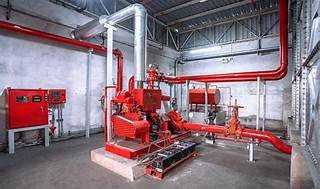
Explore
A multistage centrifugal fire pump is defined as having two or more impellers on one shaft as a
single unit. A multistage centrifugal pump is a type of centrifugal pump that uses multiple impellers
to increase the pressure and flow of water.
Each impeller acts like a single-stage pump within a chain
of pumps, and the water passes through each impeller in series, gaining pressure and velocity at
each stage1
.
A multistage centrifugal fire pump is used to provide high-pressure water for fire
protection systems, especially in high-rise buildings or large industrial facilities2
.
A multistage
centrifugal fire pump can be driven by an electric motor, a diesel engine, or a steam turbine3
.
Reference:
Our Guide to Multistage Centrifugal Pumps | C&B Equipment
Fire Pump Types | NFPA
NFPA 20: Changes to the fire pump standard - Consulting
Comments
Question 2
When evaluating the hydraulic properties of water for fire protection system, what is the
measurement of a fluid's
resistance to flow?
- A. Velocity
- B. Viscosity
- C. Pressure
- D. Density
Answer:
B
Explanation:
The measurement of a fluid’s resistance to flow is called viscosity.
Viscosity is the property of a fluid
that describes how easily it can deform or move when subjected to a shear stress, such as the force
exerted by a pipe wall or a pump1
. A fluid with high viscosity, such as honey, resists flow and requires
more pressure to overcome the friction between its layers.
A fluid with low viscosity, such as water,
flows easily and has less frictional resistance2
.
Viscosity affects the hydraulic properties of water for
fire protection systems, such as the flow rate, pressure loss, and pump power3
. Viscosity is usually
expressed in units of pascal-second (Pa s) or centipoise (cP) for liquids, and is dependent on the
temperature and composition of the fluid. Reference:
Viscosity | Definition, Facts, Formula, Units, & Examples
Viscosity – The Physics Hypertextbook
Fire Pump Types | NFPA
[12.4: Viscosity and Laminar Flow; Poiseuille’s Law]
Comments
Question 3
What are the two classes of fire models?
- A. Open and closed
- B. Field and laboratory
- C. Physical and mathematical
- D. Behavioral and theoretical
Answer:
C
Explanation:
The two classes of fire models are physical and mathematical. Physical fire models are scaled-down
representations of real fire scenarios, using laboratory experiments and measurements to study the
fire behavior and effects.
Physical fire models can be used to test hypotheses, validate mathematical
models, and provide empirical data for fire analysis1
. Mathematical fire models are numerical or
analytical solutions of the equations that govern the fire phenomena, such as heat transfer, fluid
dynamics, combustion, and chemical kinetics.
Mathematical fire models can be used to simulate fire
scenarios, predict fire outcomes, and optimize fire protection systems2
. There are two major
categories of mathematical fire models: zone models and field models. Zone models divide the fire
compartment into two or more homogeneous zones, such as upper and lower layers, and apply mass
and energy conservation equations to each zone.
Zone models are relatively simple, fast, and easy to
use, but they have limitations in accuracy and applicability3
. Field models solve the partial
differential equations that describe the fire-driven fluid flow and heat transfer in three dimensions,
using computational fluid dynamics (CFD) techniques.
Field models are more detailed, realistic, and
flexible, but they require more computational resources and expertise4
. Reference:
Fire modelling with Computational Fluid Dynamics - BRE Group
Fire modeling programs | NIST
interFIRE, A site dedicated to improving fire investigation worldwide.
Computer Fire Models for Fire Investigation and Reconstruction
Comments
Question 4
What type of property classifications experience the majority of fire deaths in the United States?
- A. Business
- B. Educational
- C. Public Assembly
- D. One- and two-family dwellings
Answer:
D
Explanation:
The type of property classifications that experience the majority of fire deaths in the United States
are one- and two-family dwellings.
According to the NFPA, one- and two-family dwellings accounted
for 64 percent of all civilian fire deaths in 2021, followed by apartments with 11 percent, and other
residential properties with 1 percent1
.
One- and two-family dwellings are more vulnerable to fire
fatalities because they often lack adequate fire protection systems, such as smoke alarms and
sprinklers, and have more potential sources of ignition, such as cooking, heating, and smoking2
.
Additionally, one- and two-family dwellings may have less escape routes, longer response times, and
more occupants, especially children and elderly, who are at higher risk of fire death. Reference:
US Fire Loss in 2021 NFPA
Home Structure Fires - NFPA
[Fire Death Rate Trends: An International Perspective]
Comments
Question 5
Which smoke detector type contains a small amount of radioactive material and functions by sensing
a decrease in conductance of the air when smoke particles enter the chamber?
- A. Photoelectric
- B. Cloud chamber air sampling
- C. Light scattering
- D. lonization
Answer:
D
Explanation:
The smoke detector type that contains a small amount of radioactive material and functions by
sensing a decrease in conductance of the air when smoke particles enter the chamber is the
ionization smoke detector. Ionization smoke detectors use a small amount of americium-241, a
radioactive element, to ionize the air molecules inside a sensing chamber. This creates a low-level
electric current between two electrodes. When smoke enters the chamber, it disrupts the ionized air
and reduces the current flow. This triggers the alarm to sound.
Ionization smoke detectors are more
sensitive to small particles of smoke, such as those produced by flaming fires1
.
However, they may
also be more prone to false alarms from cooking or steam, and they require proper disposal of the
radioactive source2
.
Reference:
Smoke Detector Types: Which Type of Smoke Detector Is Best? - X-Sense
How Does Your Smoke Detector Work? - ThoughtCo
Comments
Question 6
The minimum carbon dioxide design concentration for extinguishment of an ethylene fire is
- A. 34%
- B. 40%
- C. 43%.
- D. 49%.
Answer:
C
Explanation:
The minimum carbon dioxide design concentration for extinguishment of an ethylene fire is 43%.
This is based on the cup burner method, which is a standard test to determine the flame
extinguishing concentration of a gaseous agent for a liquid fuel. Ethylene is a flammable gas that can
form a liquid under pressure. The cup burner method involves placing a liquid fuel in a metal cup
with a central nozzle, and flowing a gaseous agent through the nozzle to create a diffusion flame. The
gaseous agent is gradually increased until the flame is extinguished.
The minimum concentration of
the gaseous agent required to extinguish the flame is recorded as the flame extinguishing
concentration1
.
According to a study by NIST, the flame extinguishing concentration of carbon
dioxide for ethylene was found to be 43%1
.
This value is also consistent with the NFPA 12 standard,
which specifies the minimum design concentrations of carbon dioxide for various fuels, including
ethylene2
.
Comments
Question 7
The maximum discharge time permitted for halocarbon clean agent systems is
- A. 10 seconds.
- B. 30 seconds.
- C. 45 seconds.
- D. 60 seconds.
Answer:
A
Explanation:
The maximum discharge time permitted for halocarbon clean agent systems is 10 seconds. This is
the requirement of NFPA 2001, which is the standard for clean agent fire extinguishing systems.
NFPA
2001 states that the discharge time for halocarbon agents shall not exceed 10 seconds, unless
otherwise permitted by the authority having jurisdiction1
. Halocarbon agents are synthetic
compounds that contain carbon, fluorine, and sometimes other elements, such as hydrogen,
chlorine, or bromine.
Examples of halocarbon agents include HFC-227ea, HFC-125, and FK-5-1-122
.
Halocarbon agents work by absorbing heat and interrupting the chemical chain reaction of the fire.
They are electrically nonconductive and leave no residue upon evaporation3
.
Halocarbon agents are
suitable for protecting Class A, B, and C fires involving electrical equipment, flammable liquids, and
ordinary combustibles4
. The discharge time is the time required to release the agent from the
storage containers to the protected enclosure.
A short discharge time is important to achieve the
design concentration of the agent before the fire grows or spreads5
. Reference:
NFPA 2001: Standard on Clean Agent Fire Extinguishing Systems
Clean Agent System Basics | NFPA
Fire Fighting Foams - Chemguard
Clean Agent Fire Suppression Systems | Fike
Category | Rotarex Firetec
Comments
Question 8
Critical Radiant Flux is used to classify
- A. roofing materials.
- B. interior wall finishes.
- C. interior floor finishes.
- D. exterior materials.
Answer:
C
Explanation:
Critical radiant flux is used to classify interior floor finishes. Critical radiant flux is a measure of the
minimum radiant heat energy required to sustain flame propagation on a floor material or covering.
It is determined by exposing a specimen to a radiant heat gradient and observing the distance from
the ignition point to the flame-out point.
The shorter the distance, the higher the critical radiant flux
and the better the fire performance of the floor material or covering1
.
Critical radiant flux is used to
classify floor materials and coverings according to their fire hazard and resistance, and to specify the
minimum requirements for different occupancies and applications2
.
For example, the International
Building Code (IBC) requires that interior floor finishes and coverings in exit access corridors and exit
enclosures have a critical radiant flux of not less than 0.45 W/cm2, while those in other spaces have a
critical radiant flux of not less than 0.22 W/cm23
.
Critical radiant flux is also used to evaluate the fire
safety of floor materials and coverings in transportation vehicles, such as aircraft, trains, and buses4
.
Comments
Question 9
Environmental Protection Agency standards require solid waste be treated as hazardous if it is a
listed waste and/or
meets the characteristics prescribed by the standard for toxicity, reactivity, corrosivity, and
- A. solubility.
- B. compactability.
- C. ignitability.
- D. treatability.
Answer:
C
Explanation:
The correct answer is C. Environmental Protection Agency (EPA) standards require solid waste be
treated as hazardous if it is a listed waste and/or meets the characteristics prescribed by the standard
for toxicity, reactivity, corrosivity, and ignitability.
A listed waste is a waste that appears on one of the
four lists of hazardous wastes in the Code of Federal Regulations (CFR) part 261 subpart D1
.
A
characteristic waste is a waste that exhibits one or more of the following traits: toxicity, reactivity,
corrosivity, or ignitability2
. Toxicity is the ability of a waste to leach harmful chemicals into the
environment. Reactivity is the tendency of a waste to undergo violent chemical reactions or generate
toxic gases. Corrosivity is the property of a waste to corrode metals or damage living tissues.
Ignitability is the capacity of a waste to catch fire under certain conditions2
.
These characteristics are
defined by specific tests and criteria in the CFR part 261 subpart C3
.
The EPA standards for hazardous
waste are based on the Resource Conservation and Recovery Act (RCRA), which is the federal law
that regulates the management of solid and hazardous waste in the United States4
.
Comments
Question 10
The greatest number of civilian home fire deaths can be attributed to what area of fire origin in the
home?
- A. Kitchen or cooking area
- B. Heating equipment room
- C. Garage or vehicle storage area
- D. Common room, living room
Answer:
D
Explanation:
The correct answer is D. The greatest number of civilian home fire deaths can be attributed to the
common room, living room, or family room area of origin in the home. According to a report by the
NFPA, based on data from the National Fire Incident Reporting System (NFIRS) and NFPA’s fire
experience survey, 31 percent of the civilian home fire deaths in 2017-2021 occurred in fires that
started in the common room, living room, or family room. This was followed by 29 percent of the
deaths in fires that started in the bedroom or sleeping area, and 12 percent of the deaths in fires that
started in the kitchen or cooking area. The common room, living room, or family room area of origin
is also the leading area of origin for home fires and civilian home fire injuries, accounting for 24
percent and 21 percent of those incidents, respectively. Some of the common causes of fires in the
common room, living room, or family room include smoking materials, heating equipment, electrical
equipment, candles, and fireplaces. To prevent fires and fire deaths in the common room, living
room, or family room, the NFPA recommends the following safety tips:
Keep smoking materials away from anything that can burn. Use deep, sturdy ashtrays and wet
cigarette butts before discarding them.
Keep space heaters at least 3 feet away from anything that can burn. Turn them off when you leave
the room or go to sleep.
Have a qualified electrician inspect and repair any faulty wiring or outlets. Avoid overloading circuits
or extension cords. Unplug appliances when not in use.
Keep candles in sturdy holders and away from children, pets, and anything that can burn. Blow them
out when you leave the room or go to sleep.
Have your chimney and fireplace cleaned and inspected annually by a professional. Use a metal or
glass screen to keep sparks from flying out. Dispose of ashes in a metal container with a lid, and keep
it outside at least 10 feet away from your home.
Install smoke alarms on every level of your home, inside each bedroom, and outside each sleeping
area. Test them monthly and replace the batteries at least once a year. Consider installing a home fire
sprinkler system for added protection.
Comments
Page 1 out of 18
Viewing questions 1-10 out of 189
page 2