Question 1
Refer to the exhibits.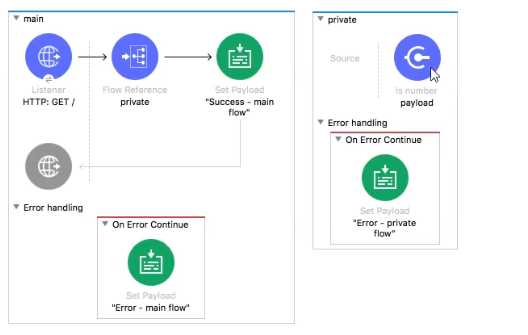
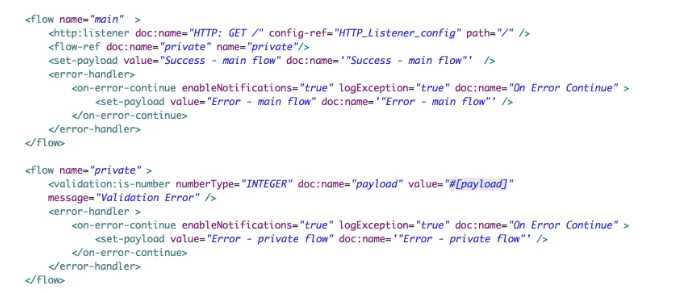
The Validation component in the private flow throws an error. What response message is returned to
a client request to the main flow's HTTP Listener?
- A. Error - private flow
- B. Error - main flow
- C. Success - main flow
- D. Validation Error
Answer:
B
Explanation:
Error in validation component will get processed by Processer level On Error Propagate block and
then error will be rethrown which will get processed by flow level error handler which will set
payload to "Error- main flow". Hence correct answer is Error - main flow
1) Request is received by HTTP listener
2) Try scope gets executed
3) The validator component in the Try scope creates an Error Object because the payload is not null.
4) The On Error Propagate handles the error. The payload is set to “Error – Try scope”
6) “Error – Try scope” is returned to the 'On Error Continue' block. Main flow execution stops.
Payload is set to "Error - main flow"
7) “Error - main flow” is returned to the requestor in the body of the HTTP request. HTTP Status
Code: 200
--------------------------------------------------------------------------------------------------------------------------------------
----
Reference Diagram though not exactly same, conditions are similar. They will help you answer any
new question on error handling in real exam: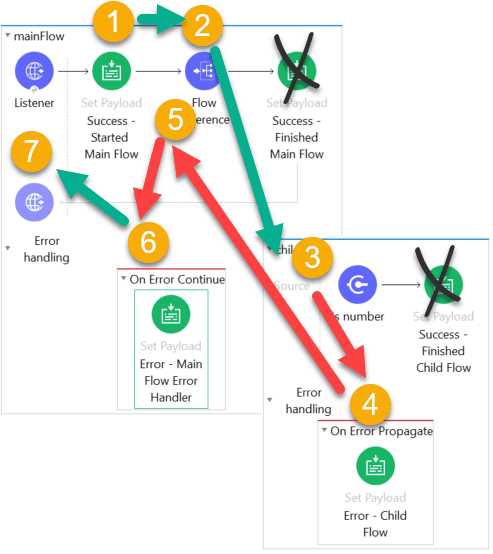
https://docs.mulesoft.com/mule-runtime/4.3/on-error-scope-concept#on-error-continue
Comments
Question 2
Refer to the exhibit.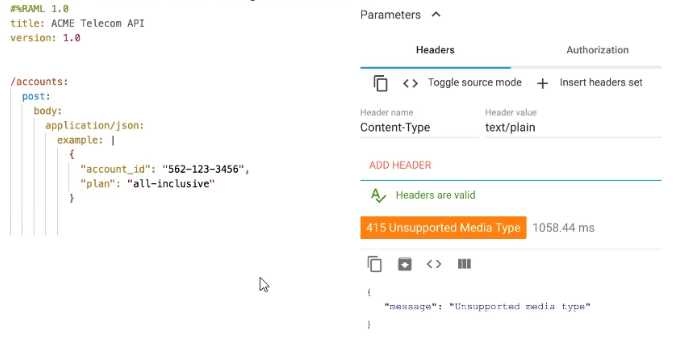
What should be changed to fix the 415 error?
- A. set the response Content-Type header to text/plain
- B. set the response Content-Type header to application/json
- C. Set the request Content-Type header to application/] son
- D. set the request Content-Type header to text/plain
Answer:
C
Explanation:
The HTTP 415 Unsupported Media Type client error response code indicates that the server refuses
to accept the request because the payload format is in an unsupported format. The format problem
might be due to the request's indicated Content-Type or Content-Encoding , or as a result of
inspecting the data directly. In this case as per RAML specification data is expected in
application/json and in request Content-Type is set as "text/plain" which is incorrect. Hence solution
is set the request Content-Type header to application/json
https://developer.mozilla.org/en-US/docs/Web/HTTP/Status/415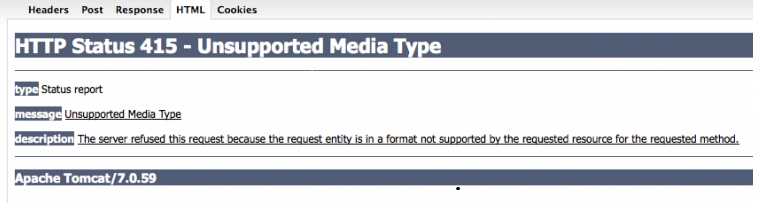
Comments
Question 3
Refer to the exhibit.
What is the output payload in the On Complete phase
- A. summary statistics with NO record data
- B. The records processed by the last batch step: [StepTwol, StepTwo2, StepTwo3]
- C. The records processed by all batch steps: [StepTwostepOnel, stepTwostepOne2, StepTwoStepOne3]
- D. The original payload: [1,2,31
Answer:
A
Explanation:
This is a trcik question. On complete phase pyalod consists of summary of records processed which
gives insight on which records failed or passed. Hence option 4 is correct answer
MuleSoft Documentation Reference : https://docs.mulesoft.com/mule-runtime/4.3/batch-
processing-concept#on-complete
Comments
Question 4
Refer to the exhibit.

The main flow is configured with their error handlers. A web client submit a request to the HTTP
Listener and the HTTP Request throws an HTTP:NOT_FOUND error.
What response message is returned?’’
What response message is returned?
- A. APP: API RESOURCE NOT FOUND
- B. HTTP: NOT FOUND
- C. other error
- D. success - main flow
Answer:
A
Explanation:
Correct answer is APP: API RESOURCE NOT FOUND
--------------------------------------------------------------------------------------------------------------------------------------
-------------
1) A web client submits the request to the HTTP Listener.
2) The HTTP Request throws an "HTTP:NOT_FOUND" error, execution halts.
3) The On Error Propagate error Handler handles the error. In this case ,HTTP:NOT_FOUND error is
mapped to custom error APP:API_RESOURCE_NOT_FOUND. This error processor sets payload to
APP:API_RESOURCE_NOT_FOUND.
4) “APP:API_RESOURCE_NOT_FOUND. ” is the error message returned to the requestor in the body
of the HTTP request with HTTP Status Code: 500
Reference Diagram: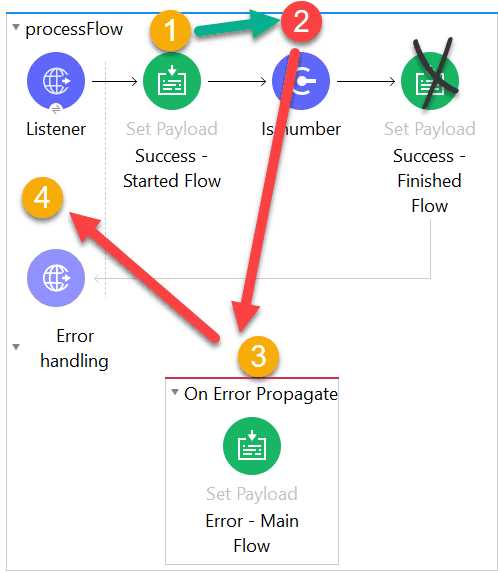
Comments
Question 5
What is the correct syntax for a Logger component to output a message with the contents of a 3SON
Object payload?
- A. The payload is: $(payload)
- B. #["The payload is: " ++ payload]
- C. The payload is: #[payload]
- D. #["The payload is: " + payload]
Answer:
B
Explanation:
Option 3 is the only corect answer as it concatenates payload with String.
Below option wont work.
#["The payload is " ++ payload]
Concatenation function expects both arguments to be string. As the question says payload is json
object , this will throw error while running it. You can try this in Anypoint Studio and you will get the
same result which I mentioned.
hence correct answer is
The payload is: #[payload]
Comments
Question 6
Refer to the exhibit.
What data is expected by the POST /accounts endpoint?
A)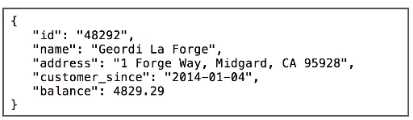
B)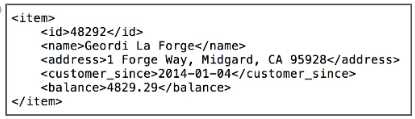
C)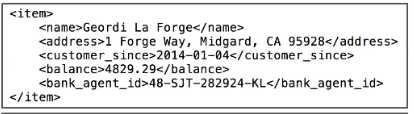
D)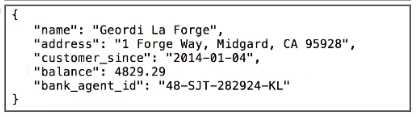
- A. Option A
- B. Option B
- C. Option C
- D. Option D
Answer:
D
Comments
Question 7
An API specification is designed using RAML. What is the next step to create a REST Connector from
this API specification?
- A. Download the API specification and build the interface using APIkit
- B. Publish the API specification to Any point Exchange
- C. Implement the API specification using flow designer in Design Center
- D. Add the specification to a Mule project's src/main/resources/api folder
Answer:
B
Explanation:
API Exchange creates REST conenctor automtaically once API is published. Hence correct answer is
Publish the API specification to Any point Exchange
Comments
Question 8
Refer to the exhibit.
The API needs to be updated using the company-wide standard for the Plan data type. The Object
data type has already been published in Anypoint Exchange with the global reference .
ACME/DataTypes/PlanDataType.raml.
What is a valid RAML specification that reuses the Plan data type?
A)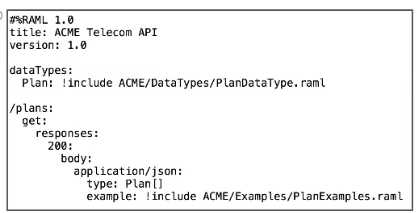
B)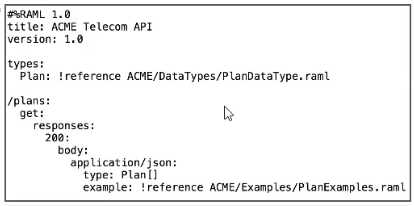
C)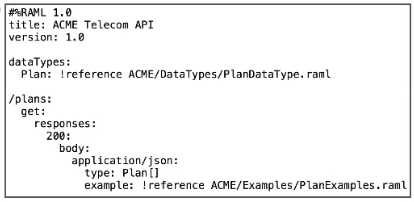
D)
- A. Option A
- B. Option B
- C. Option C
- D. Option D
Answer:
D
Explanation:
As can be seen in RAML, POST expects input in application/json format which eliminates two of the
options as two options are in xml format.
Now out of the two remaining options, one has id field in request which is only mentioned for get
response and not for POST request. Hence id field is not expected in POST request.
Hence correct answer is
{
"name": "GoerdiLa Forge",
"address": "1 Westland CA",
"customer_since": "2014-01-04",
"balance": "4829.29",
"bank_agend_id": "12556"
}
Comments
Question 9
What execution model is used by For Each and Batch Job scopes?
- A. For Each is single-threaded and Batch Job is multi-threaded
- B. Both are single-threaded
- C. Both are multi-threaded
- D. Batch Job is single-threaded and For Each Is multi-threaded
Answer:
A
Comments
Question 10
Refer to the exhibit.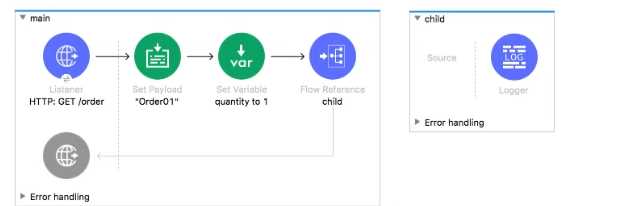
The main flow contains a Flow Reference for the child flow.
What values are accessible in the child flow after a web client submits a request to
http://localhost:8Q81/order? color=red?
- A. payload
- B. payload quantity var
- C. payload color query param
- D. payload quantity var color query param
Answer:
D
Explanation:
Flow Reference Component
Flow Reference routes the Mule event to another flow or subflow, executes all processors in the
referenced flow, and then routes the event back within the same Mule application. The following
diagram shows the order of processing when one flow references another: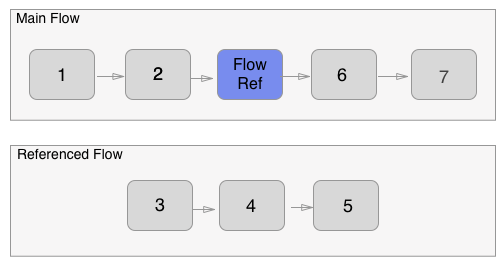
When the main flow is triggered, the Mule event travels through and executes the flow until the
event reaches the Flow Reference. The event then travels through and executes the referenced flow
from beginning to end, and then returns to the main flow.
This process enables you to treat the entire referenced flow like a single component in your current
flow.
Mule Ref Doc :
https://docs.mulesoft.com/mule-runtime/4.3/flowref-about
Correct answer is
payload
quantity var
color query param
Comments
Page 1 out of 23
Viewing questions 1-10 out of 235
page 2