Question 1 Topic 4, Case Study 4Case Study Question View Case
You need to recommend a model for the expense claims solution. What should you recommend?
- A. actionable messages via connectors that use an adaptive card
- B. actionable messages via email that uses an actionable message card
- C. actionable messages via connectors that use an actionable message card
- D. actionable messages via email that uses an adaptive card
Answer:
B
Explanation:
Sending actionable messages via email is supported. You use actionable message cards.
Scenario:
Create an email workflow solution for expense claims. Users will submit their expense claims and the system will email an
approval request to their manager.
The expense claims solution must provide managers with claim information and the ability to manage the claim by using
Microsoft Outlook, Outlook on the web, or Outlook for iOS and Android.
Reference: https://docs.microsoft.com/en-us/outlook/actionable-messages/send-via-email
Comments
Question 2 Topic 4, Case Study 4Case Study Question View Case
HOTSPOT
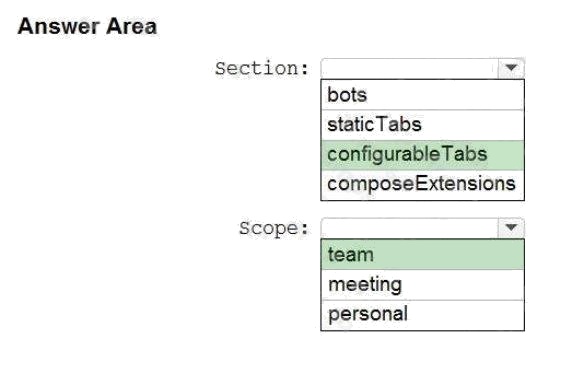
You need to modify the HRApp manifest to provide a tab that supports querying the third-party HR system.
Which section of the manifest should you modify, and which value should you set as the scope? To answer, select the
appropriate options in the answer area.
NOTE: Each correct selection is worth one point.
Hot Area: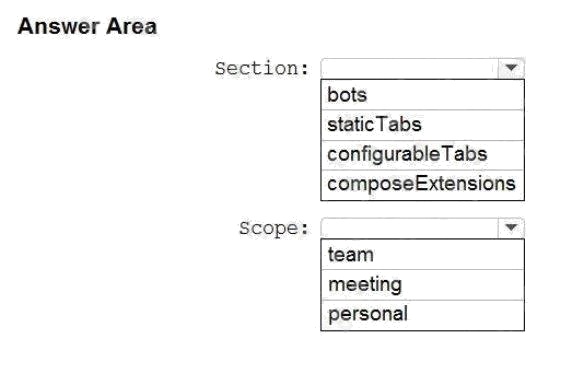
Answer:
Explanation:
Reference: https://docs.microsoft.com/en-us/microsoftteams/platform/resources/schema/manifest-
schema#composeextensions
Comments
Question 3 Topic 5, Case Study 5Case Study Question View Case
HOTSPOT
You need to recommend the development environment and tools for the development of SalesApp.
What should you recommend? To answer, select the appropriate options in the answer area.
NOTE: Each correct selection is worth one point.
Hot Area: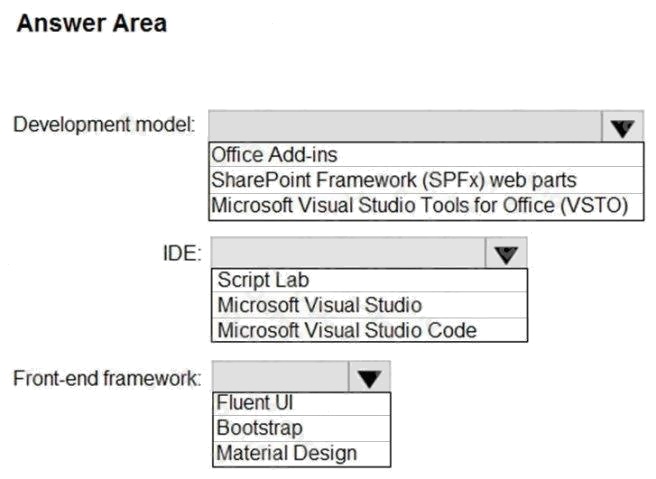
Answer:
Explanation:
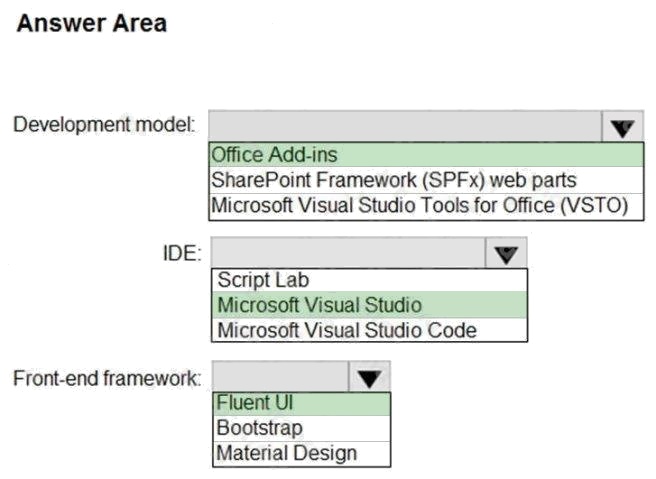
Box 1: Office Add-ins
Scenario: SalesApp must be integrated with Microsoft Word and must combine images and text from multiple sources to
create a quotation as a DOCX file.
You can use the Office Add-ins platform to build solutions that extend Office applications and interact with content in Office
documents.
Box 2: Microsoft Visual Studio
Visual Studio can be used to create Office Add-ins for Excel, Outlook, Word, and PowerPoint. An Office Add-in project gets
created as part of a Visual Studio solution and uses HTML, CSS, and JavaScript.
Box 3: Fluent UI
Fluent UI is the upcoming and continually evolving design system for Microsoft 365. Currently, there is an ongoing merge in
the process to have one consistent UI Framework across the Microsoft ecosystem.
Reference:
https://docs.microsoft.com/en-us/office/dev/add-ins/overview/office-add-ins https://n8d.at/5-reasons-or-thoughts-on-fluent-ui-
web
Comments
Question 4 Topic 5, Case Study 5Case Study Question View Case
You need to provide users with access to SalesApp. The solution must meet the technical requirements.
What should you include in the solution?
- A. sideloading
- B. App Catalog in SharePoint Online
- C. Centralized Deployment
- D. Microsoft AppSource
Answer:
B
Explanation:
An app catalog is a dedicated site collection in a SharePoint web application or SharePoint Online tenancy that hosts
document libraries for Office and SharePoint Add-ins. To make Office Add-ins accessible to users within their organization,
administrators can upload Office Add-ins manifest files to the app catalog for their organization. When an administrator
registers an app catalog as a trusted catalog, users can insert the add-in from the insertion UI in an Office client application.
Scenario:
SalesApp must be integrated with Microsoft Word and must combine images and text from multiple sources to create a
quotation as a DOCX file. The distribution of SalesApp must be automatic and require minimal user interaction.
Reference: https://docs.microsoft.com/en-us/office/dev/add-ins/publish/publish-task-pane-and-content-add-ins-to-an-add-in-
catalog
Comments
Question 5 Topic 5, Case Study 5Case Study Question View Case
You need to recommend which type of Office Add-in must be used for SalesApp.
What should you recommend?
- A. module extension
- B. task pane
- C. custom function
- D. contextual
Answer:
B
Explanation:
Reference: https://docs.microsoft.com/en-us/office/dev/add-ins/word/word-add-ins-programming-overview
Comments
Question 6 Topic 6, Mixed Questions
HOTSPOT
You are developing an interactive invoicing application that will be used by end users. The application will have the following
features:
Save invoices generated by a user to the users Microsoft OneDrive. Email daily automated reminders.

You need to identify which permissions to grant for the application features. The solution must use the principle of least
privilege.
Which permission should you grant for each feature? To answer, select the appropriate options in the answer area.
NOTE: Each correct selection is worth one point.
Hot Area: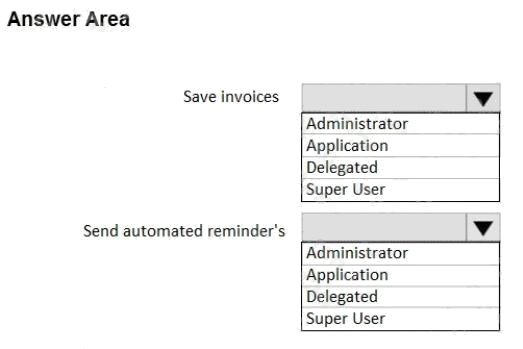
Answer:
Explanation:
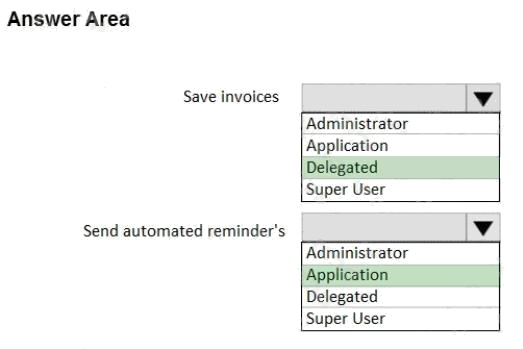
Microsoft identity platform supports two types of permissions: delegated permissions and application permissions.
Box 1: Delegated
Delegated permissions are used by apps that have a signed-in user present. For these apps, either the user or an
administrator consents to the permissions that the app requests, and the app is delegated permission to act as the signed-in
user when making calls to the target resource.
Box 2: Application
Application permissions are used by apps that run without a signed-in user present; for example, apps that run as
background services or daemons. Application permissions can only be consented by an administrator.
Reference: https://docs.microsoft.com/en-us/azure/active-directory/develop/v2-permissions-and-consent
Comments
Question 7 Topic 6, Mixed Questions
You need to develop a server-based web app that will be registered with the Microsoft identity platform. The solution must
ensure that the app can perform operations on behalf of the user.
Which type of authorization flow should you use?
- A. authorization code
- B. refresh token
- C. resource owner password
- D. device code
Answer:
A
Explanation:
In web server apps, the sign-in authentication flow takes these high-level steps: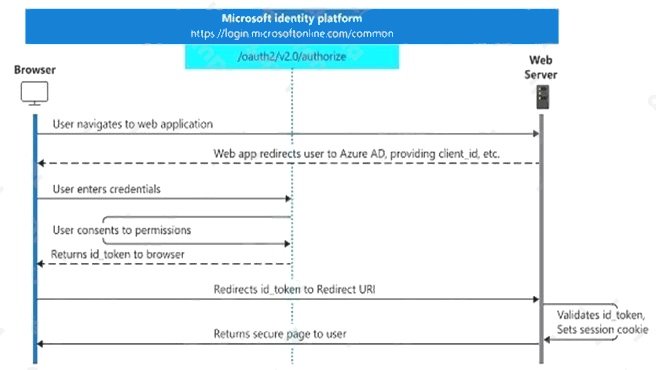
You can ensure the user's identity by validating the ID token with a public signing key that is received from the Microsoft
identity platform endpoint. A session cookie is set, which can be used to identify the user on subsequent page requests.
In addition to simple sign-in, a web server app might need to access another web service, such as a REST API. In this case,
the web server app engages in a combined OpenID Connect and OAuth 2.0 flow, by using the OAuth 2.0 authorization code
flow.
Reference: https://docs.microsoft.com/en-us/azure/active-directory/develop/v2-app-types
Comments
Question 8 Topic 6, Mixed Questions
You have a single-page application (SPA) named TodoListSPA and a server-based web app named TodoListService.
The permissions for the TodoList SPA API are configured as shown in the TodoList SPA exhibit. (Click the TodoListSPA
tab.)
The permissions for the TodoListService API are configured as shown in the TodoListService exhibit. (Click the
TodoListService tab.)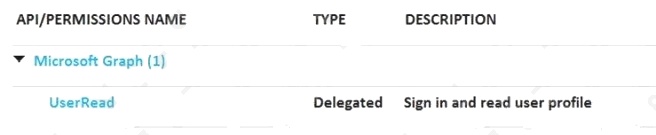
You need to ensure that TodoListService can access a Microsoft OneDrive file of the signed-in user. The solution must use
the principle of least privilege.
Which permission should to grant?
- A. the Sites.Read.All delegated permission for TodoListService
- B. the Sites.Read.All delegated permission for TodoListSpa
- C. the Sites.Read.All application permission for TodoListSPA
- D. the Sites.Read.All application permission for TodoListService
Answer:
A
Explanation:
A client application gains access to a resource server by declaring permission requests. Two types are available:
"Delegated" permissions, which specify scope-based access using delegated authorization from the signed-in resource
owner, are presented to the resource at run-time as "scp" claims in the client's access token.
"Application" permissions, which specify role-based access using the client application's credentials/identity, are presented
to the resource at run-time as "roles" claims in the client's access token.
Reference: https://docs.microsoft.com/en-us/azure/active-directory/develop/developer-glossary#permissions
Comments
Question 9 Topic 6, Mixed Questions
You are building a server-based web app that will use OAuth2 and will be registered with the Microsoft identity platform.
Which two values does the single-tenant app require to obtain tokens from the token endpoint for the Microsoft identity
platform? Each correct answer presents part of the solution.
NOTE: Each correct selection is worth one point.
- A. the tenant ID
- B. the context token
- C. the application ID
- D. the application secret
- E. the authorization code
Answer:
C E
Explanation:
C: The required client_id is the Application (client) ID that the Azure portal App registrations experience assigned to your
app.
E: The authorization code flow begins with the client directing the user to the /authorize endpoint.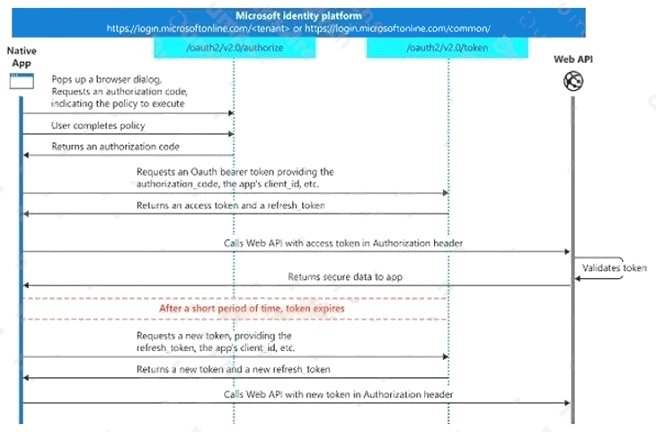
Reference: https://docs.microsoft.com/en-us/azure/active-directory/develop/v2-oauth2-auth-code-flow
Comments
Question 10 Topic 6, Mixed Questions
HOTSPOT
You are developing a single-page application (SPA).
You plan to access user data from Microsoft Graph by using an AJAX call.
You need to obtain an access token by the Microsoft Authentication Library (MSAL). The solution must minimize
authentication prompts.
How should you complete the code segment? To answer, select the appropriate options in the answer area.
NOTE: Each correct selection is worth one point.
Hot Area: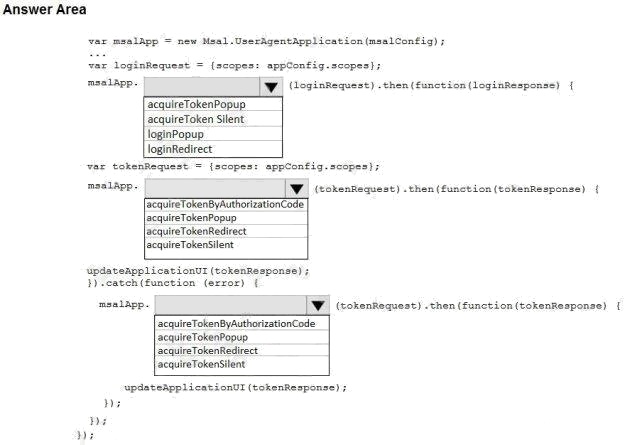
Answer:
Explanation:
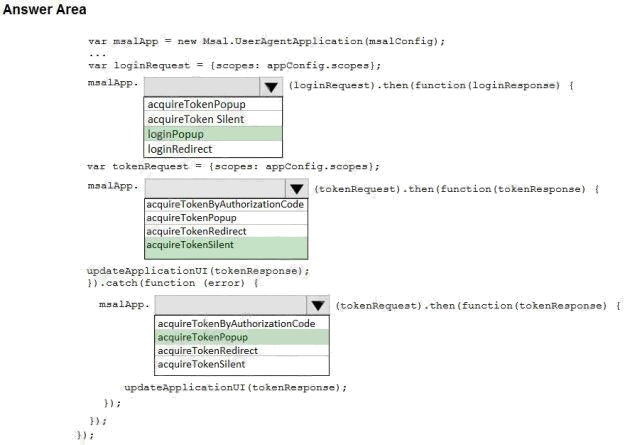
Box 1: loginPopup
Box 2: acquireTokenSilent
The pattern for acquiring tokens for APIs with MSAL.js is to first attempt a silent token request by using the
acquireTokenSilent method. When this method is called, the library first checks the cache in browser storage to see if a valid
token exists and returns it. When no valid token is in the cache, it sends a silent token request to Azure Active Directory
(Azure AD) from a hidden iframe. This method also allows the library to renew tokens.
Box 3: acquireTokenPopup
//AcquireToken Failure, send an interactive request.
Example:
userAgentApplication.loginPopup(applicationConfig.graphScopes).then(function (idToken) {
//Login Success
userAgentApplication.acquireTokenSilent(applicationConfig.graphScopes).then(function (accessToken) {
//AcquireToken Success updateUI();
}, function (error) {
//AcquireToken Failure, send an interactive request.
userAgentApplication.acquireTokenPopup(applicationConfig.graphScopes).then(function (accessToken) { updateUI(); },
function (error) {
console.log(error);
});
})
}, function (error) {
console.log(error);
});
Reference: https://github.com/AzureAD/microsoft-authentication-library-for-js/issues/339
Comments
Page 1 out of 15
Viewing questions 1-10 out of 155
page 2