En la documentación dice que es 20 no 50.
https://learn.microsoft.com/es-es/azure/cosmos-db/concepts-limits
You have an Azure Cosmos DB Core (SQL) API account.
You run the following query against a container in the account.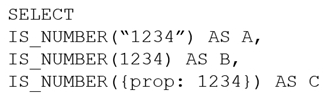
What is the output of the query?
a
IS_NUMBER returns a Boolean value indicating if the type of the specified expression is a number.
1234 is a string, not a number.
Reference:
https://docs.microsoft.com/en-us/azure/cosmos-db/sql/sql-query-is-number
HOTSPOT
You are designing a data model for an Azure Cosmos DB Core (SQL) API account.
What are the partition limits for request units per second (RU/s) and storage? To answer, select the appropriate options in the answer area.
NOTE: Each correct selection is worth one point.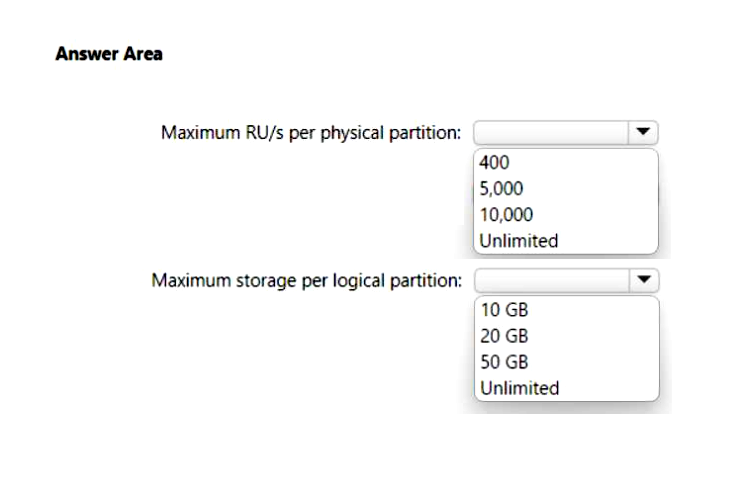
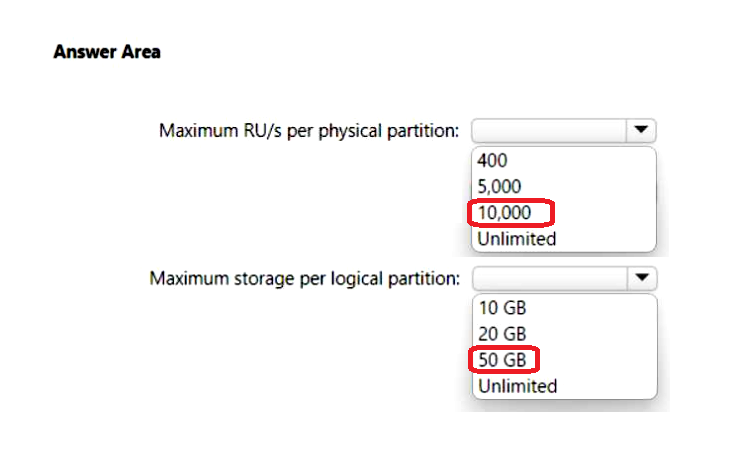
En la documentación dice que es 20 no 50.
https://learn.microsoft.com/es-es/azure/cosmos-db/concepts-limits
You have an Azure Cosmos DB account named account1.
You need to access account1 from an on-premises environment by using a Site-to-Site VPN.
What should you use?
a
Note: This question is part of a series of questions that present the same scenario. Each question in the series contains a unique solution that might meet the stated goals. Some question sets might have more than one correct solution, while others might not have a correct solution.
After you answer a question in this section, you will NOT be able to return to it. As a result, these questions will not appear in the review screen.
You have a database in an Azure Cosmos DB Core (SQL) API account that is configured for multi-region writes.
You need to use the Azure Cosmos DB SDK to implement the conflict resolution policy for a container. The solution must ensure that any conflicts are sent to the conflicts feed.
Solution: You set ConflictResolutionMode to LastWriterWins and you use the default settings for the policy.
Does this meet the goal?
a
You can create a last-writer-wins conflict resolution policy.
These samples show how to set up a container with a last-writer-wins conflict resolution policy. The default path for last-writer-wins is the timestamp field or the _ts property. For SQL API, this may also be set to a user-defined path with a numeric type. In a conflict, the highest value wins. If the path isn't set or it's invalid, it defaults to _ts. Conflicts resolved with this policy do not show up in the conflict feed. This policy can be used by all APIs.
.NET SDK
DocumentCollection lwwCollection = await createClient.CreateDocumentCollectionIfNotExistsAsync(
UriFactory.CreateDatabaseUri(this.databaseName), new DocumentCollection
{
Id = this.lwwCollectionName,
ConflictResolutionPolicy = new ConflictResolutionPolicy
{
Mode = ConflictResolutionMode.LastWriterWins,
ConflictResolutionPath = myCustomId,
},
});
Reference:
https://docs.microsoft.com/en-us/azure/cosmos-db/sql/how-to-manage-conflicts
Note: This question is part of a series of questions that present the same scenario. Each question in the series contains a unique solution that might meet the stated goals. Some question sets might have more than one correct solution, while others might not have a correct solution.
After you answer a question in this section, you will NOT be able to return to it. As a result, these questions will not appear in the review screen.
You have a database in an Azure Cosmos DB Core (SQL) API account that is configured for multi-region writes.
You need to use the Azure Cosmos DB SDK to implement the conflict resolution policy for a container. The solution must ensure that any conflicts are sent to the conflicts feed.
Solution: You set ConflictResolutionMode to Custom and you use the default settings for the policy.
Does this meet the goal?
b
You can create a custom conflict resolution policy but you need a stored procedure as well.
The stored procedure should use the conflictingItems parameter. conflictingItems: Array of the committed version of all items in the container that are conflicting with incomingItem on ID or any other unique index properties.
Reference:
https://docs.microsoft.com/en-us/azure/cosmos-db/sql/how-to-manage-conflicts
Note: This question is part of a series of questions that present the same scenario. Each question in the series contains a unique solution that might meet the stated goals. Some question sets might have more than one correct solution, while others might not have a correct solution.
After you answer a question in this section, you will NOT be able to return to it. As a result, these questions will not appear in the review screen.
You have a container named container1 in an Azure Cosmos DB Core (SQL) API account.
You need to make the contents of container1 available as reference data for an Azure Stream Analytics job.
Solution: You create an Azure function that uses Azure Cosmos DB Core (SQL) API change feed as a trigger and Azure event hub as the output.
Does this meet the goal?
a
The Azure Cosmos DB change feed is a mechanism to get a continuous and incremental feed of records from an Azure Cosmos container as those records are being created or modified. Change feed support works by listening to container for any changes. It then outputs the sorted list of documents that were changed in the order in which they were modified.
The following diagram represents the data flow and components involved in the solution:
Reference:
https://docs.microsoft.com/en-us/azure/cosmos-db/sql/changefeed-ecommerce-solution
HOTSPOT You plan to deploy two Azure Cosmos DB Core (SQL) API accounts that will each contain a single database. The accounts will be configured as shown in the following table.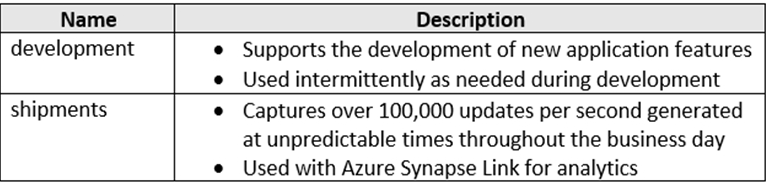
How should you provision the containers within each account to minimize costs? To answer, select the appropriate options in the answer area.
NOTE: Each correct selection is worth one point.
Hot Area: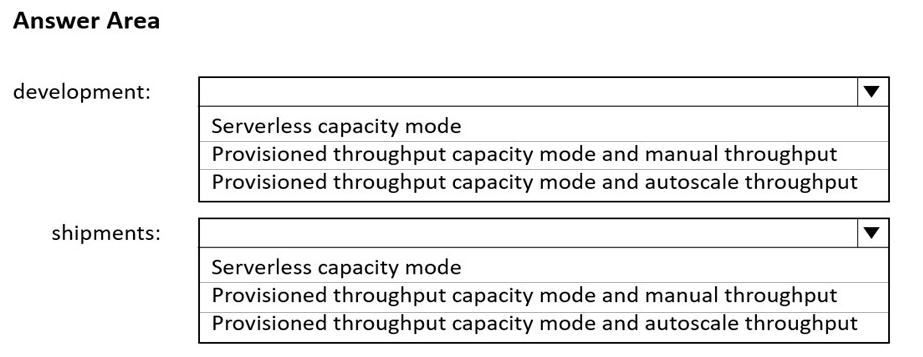
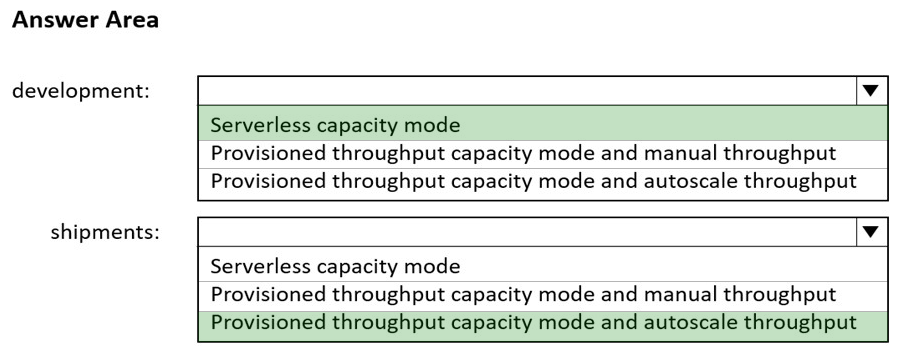
Box 1: Serverless capacity mode -
Azure Cosmos DB serverless best fits scenarios where you expect intermittent and unpredictable traffic with long idle times. Because provisioning capacity in such situations isn't required and may be cost-prohibitive, Azure Cosmos DB serverless should be considered in the following use-cases:
Getting started with Azure Cosmos DB
Running applications with bursty, intermittent traffic that is hard to forecast, or low (<10%) average-to-peak traffic ratio
Developing, testing, prototyping and running in production new applications where the traffic pattern is unknown
Integrating with serverless compute services like Azure Functions
Box 2: Provisioned throughput capacity mode and autoscale throughput
The use cases of autoscale include:
Variable or unpredictable workloads: When your workloads have variable or unpredictable spikes in usage, autoscale helps by automatically scaling up and down based on usage. Examples include retail websites that have different traffic patterns depending on seasonality; IOT workloads that have spikes at various times during the day; line of business applications that see peak usage a few times a month or year, and more. With autoscale, you no longer need to manually provision for peak or average capacity.
Reference:
https://docs.microsoft.com/en-us/azure/cosmos-db/serverless
https://docs.microsoft.com/en-us/azure/cosmos-db/provision-throughput-autoscale#use-cases-of-autoscale
The settings for a container in an Azure Cosmos DB Core (SQL) API account are configured as shown in the following exhibit.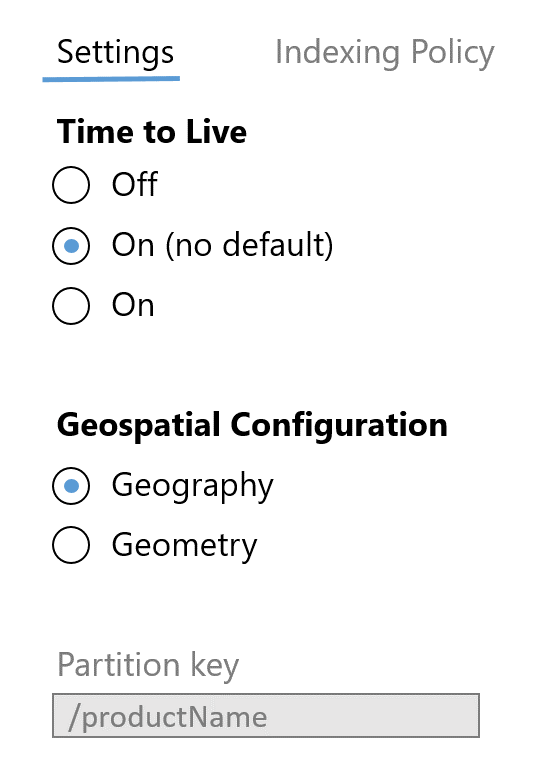
Which statement describes the configuration of the container?
c
When DefaultTimeToLive is -1 then your Time to Live setting is On (No default)
Time to Live on a container, if present and the value is set to -1, it is equal to infinity, and items don't expire by default.
Time to Live on an item:
This Property is applicable only if DefaultTimeToLive is present and it is not set to null for the parent container.
If present, it overrides the DefaultTimeToLive value of the parent container.
Reference:
https://docs.microsoft.com/en-us/azure/cosmos-db/sql/time-to-live
You have an Azure Cosmos DB Core (SQL) API account that has multiple write regions.
You need to receive an alert when requests that target the database exceed the available request units per second (RU/s).
Which Azure Monitor signal should you use?
b
Use an alert which is triggered when the container or a database has exceeded the provisioned throughput limit.
Note: Provisioned throughput is the maximum amount of capacity that an application can consume from a table or index. If your application exceeds your provisioned throughput capacity on a table or index, it is subject to request throttling. Throttling prevents your application from consuming too many capacity units.
Reference:
https://docs.microsoft.com/en-us/azure/cosmos-db/monitor-cosmos-db
HOTSPOT You have an Azure Cosmos DB Core (SQL) API account named storage1 that uses provisioned throughput capacity mode.
The storage1 account contains the databases shown in the following table.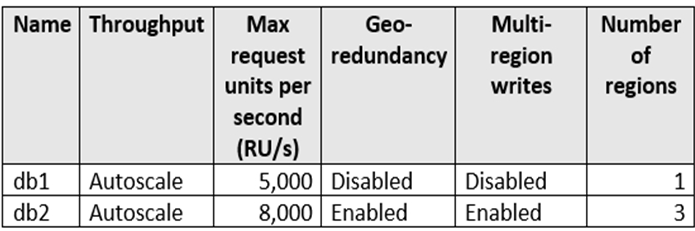
The databases contain the containers shown in the following table.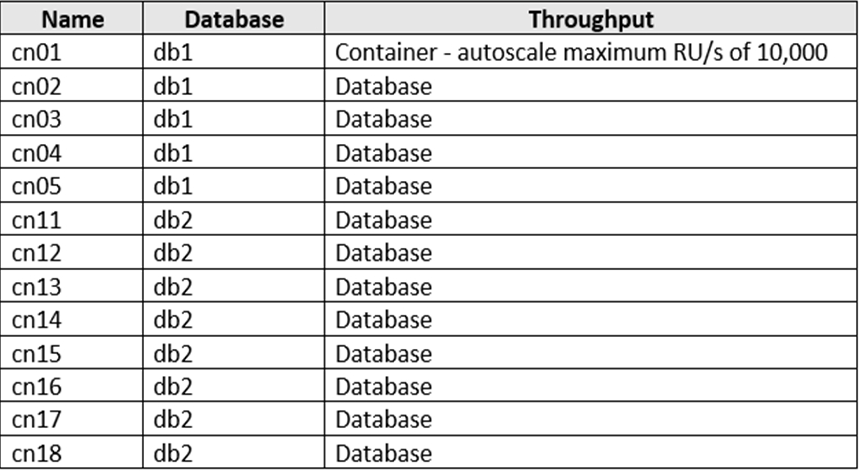
For each of the following statements, select Yes if the statement is true. Otherwise, select No.
NOTE: Each correct selection is worth one point.
Hot Area: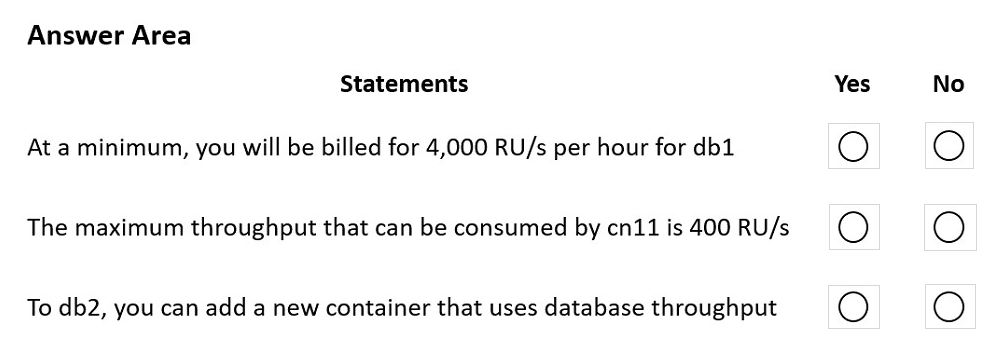
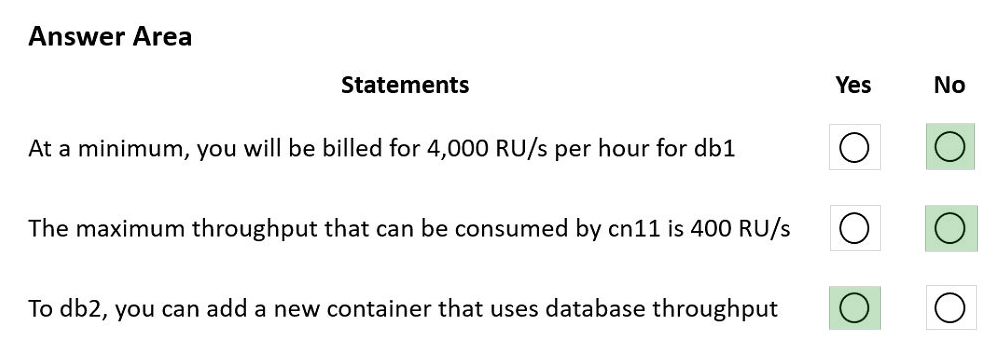
Box 1: No -
Four containers with 1000 RU/s each.
Box 2: No -
Max 8000 RU/s for db2. 8 containers, so 1000 RU/s for each container.
Box 3: Yes -
Max 8000 RU/s for db2. 8 containers, so 1000 RU/s for each container. Can very well add an additional container.
Reference:
https://docs.microsoft.com/en-us/azure/cosmos-db/plan-manage-costs https://azure.microsoft.com/en-us/pricing/details/cosmos-db/