Question 1
DRAG DROP Your on-premises network contains a server named Server1 that runs an ASP.NET application named App1.
You have a hybrid deployment of Azure Active Directory (Azure AD).
You need to recommend a solution to ensure that users sign in by using their Azure AD account and Azure Multi-Factor Authentication (MFA) when they connect to App1 from the internet.
Which three features should you recommend be deployed and configured in sequence? To answer, move the appropriate features from the list of features to the answer area and arrange them in the correct order.
Select and Place: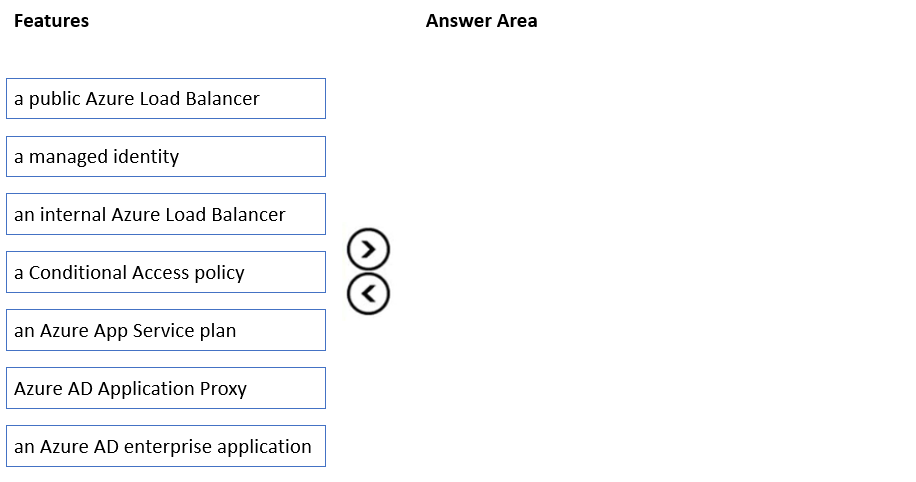
Answer:
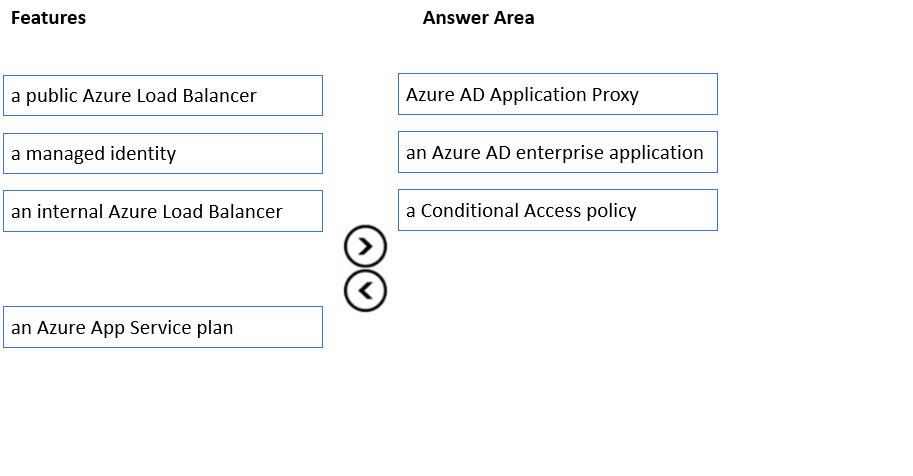
Step 1: Azure AD Application Proxy
Start by enabling communication to Azure data centers to prepare your environment for Azure AD Application Proxy.
Step 2: an Azure AD enterprise application
Add an on-premises app to Azure AD.
Now that you've prepared your environment and installed a connector, you're ready to add on-premises applications to Azure AD.
1. Sign in as an administrator in the Azure portal.
2. In the left navigation panel, select Azure Active Directory.
3. Select Enterprise applications, and then select New application.
4. Etc.
Reference:
https://docs.microsoft.com/en-us/azure/active-directory/app-proxy/application-proxy-add-on-premises-application
Comments
Question 2
Your company has the divisions shown in the following table.
Sub1 contains an Azure App Service web app named App1. App1 uses Azure AD for single-tenant user authentication. Users from contoso.com can authenticate to App1.
You need to recommend a solution to enable users in the fabrikam.com tenant to authenticate to App1.
What should you recommend?
- A. Configure Azure AD join.
- B. Configure Azure AD Identity Protection.
- C. Use Azure AD entitlement management to govern external users.
- D. Configure assignments for the fabrikam.com users by using Azure AD Privileged Identity Management (PIM).
Answer:
c
Comments
Question 3
What should you include in the identity management strategy to support the planned changes?
- A. Deploy domain controllers for corp.fabrikam.com to virtual networks in Azure.
- B. Move all the domain controllers from corp.fabrikam.com to virtual networks in Azure.
- C. Deploy a new Azure AD tenant for the authentication of new R&D projects.
- D. Deploy domain controllers for the rd.fabrikam.com forest to virtual networks in Azure.
Answer:
a
Directory synchronization between Azure Active Directory (Azure AD) and corp.fabrikam.com must not be affected by a link failure between Azure and the on- premises network. (This requires domain controllers in Azure).
Users on the on-premises network must be able to authenticate to corp.fabrikam.com if an Internet link fails. (This requires domain controllers on-premises).
Comments
Question 4
You plan to deploy an Azure Database for MySQL flexible server named Server1 to the East US Azure region.
You need to implement a business continuity solution for Server1. The solution must minimize downtime in the event of a failover to a paired region.
What should you do?
- A. Create a read replica.
- B. Store the database files in Azure premium file shares.
- C. Implement Geo-redundant backup.
- D. Configure native MySQL replication.
Answer:
c
Comments
Question 5
You are designing an Azure governance solution.
All Azure resources must be easily identifiable based on the following operational information: environment, owner, department and cost center.
You need to ensure that you can use the operational information when you generate reports for the Azure resources.
What should you include in the solution?
- A. an Azure data catalog that uses the Azure REST API as a data source
- B. an Azure management group that uses parent groups to create a hierarchy
- C. an Azure policy that enforces tagging rules
- D. Azure Active Directory (Azure AD) administrative units
Answer:
c
You apply tags to your Azure resources, resource groups, and subscriptions to logically organize them into a taxonomy. Each tag consists of a name and a value pair.
You use Azure Policy to enforce tagging rules and conventions. By creating a policy, you avoid the scenario of resources being deployed to your subscription that don't have the expected tags for your organization. Instead of manually applying tags or searching for resources that aren't compliant, you create a policy that automatically applies the needed tags during deployment.
Reference:
https://docs.microsoft.com/en-us/azure/azure-resource-manager/management/tag-policies
Comments
Question 6
HOTSPOT You are planning an Azure Storage solution for sensitive data. The data will be accessed daily. The dataset is less than 10 GB.
You need to recommend a storage solution that meets the following requirements:
All the data written to storage must be retained for five years.
Once the data is written, the data can only be read. Modifications and deletion must be prevented.
After five years, the data can be deleted, but never modified.
Data access charges must be minimized.
What should you recommend? To answer, select the appropriate options in the answer area.
NOTE: Each correct selection is worth one point.
Hot Area: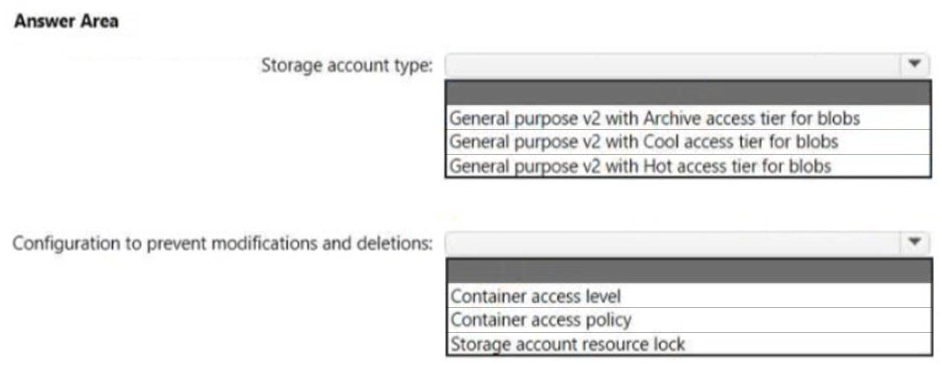
Answer:
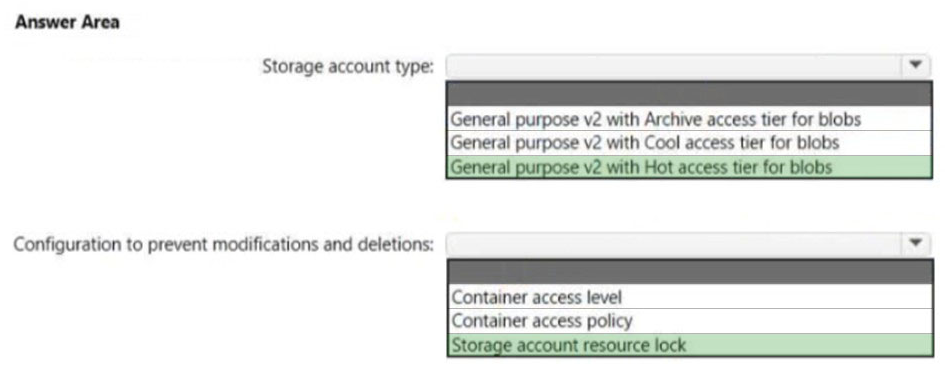
Box 1: General purpose v2 with Hot access tier for blobs
Note:
* All the data written to storage must be retained for five years.
* Data access charges must be minimized
Hot tier has higher storage costs, but lower access and transaction costs.
Incorrect:
Not Archive: Lowest storage costs, but highest access, and transaction costs.
Not Cool: Lower storage costs, but higher access and transaction costs.
Box 2: Storage account resource lock
As an administrator, you can lock a subscription, resource group, or resource to prevent other users in your organization from accidentally deleting or modifying critical resources. The lock overrides any permissions the user might have.
Reference:
https://docs.microsoft.com/en-us/azure/storage/blobs/access-tiers-overview https://docs.microsoft.com/en-us/azure/azure-resource-manager/management/lock-resources
Comments
Question 7
HOTSPOT You have an Azure subscription that contains 300 virtual machines that run Windows Server 2019.
You need to centrally monitor all warning events in the System logs of the virtual machines.
What should you include in the solution? To answer, select the appropriate options in the answer area.
NOTE: Each correct selection is worth one point.
Hot Area: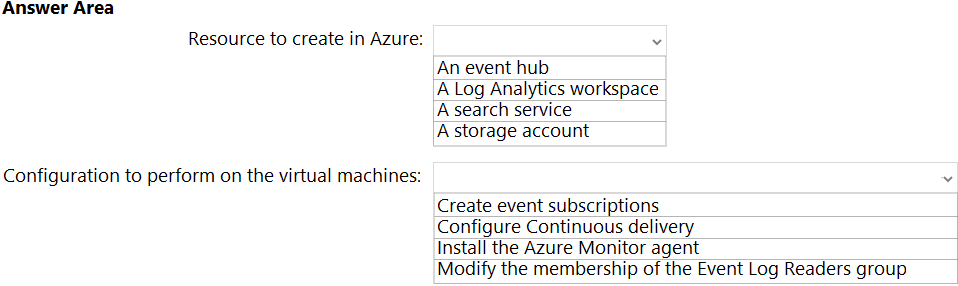
Answer:
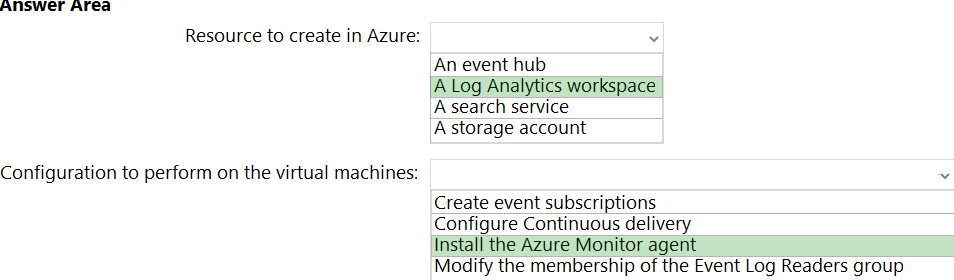
Box 1: A Log Analytics workspace
Send resource logs to a Log Analytics workspace to enable the features of Azure Monitor Logs.
You must create a diagnostic setting for each Azure resource to send its resource logs to a Log Analytics workspace to use with Azure Monitor Logs.
Box 2: Install the Azure Monitor agent
Use the Azure Monitor agent if you need to:
Collect guest logs and metrics from any machine in Azure, in other clouds, or on-premises.
Manage data collection configuration centrally
Reference:
https://docs.microsoft.com/en-us/azure/azure-monitor/essentials/resource-logs https://docs.microsoft.com/en-us/azure/azure-monitor/agents/agents-overview#azure-monitor-agent
Comments
Question 8
You are planning an Azure IoT Hub solution that will include 50,000 IoT devices.
Each device will stream data, including temperature, device ID, and time data. Approximately 50,000 records will be written every second. The data will be visualized in near real time.
You need to recommend a service to store and query the data.
Which two services can you recommend? Each correct answer presents a complete solution.
NOTE: Each correct selection is worth one point.
- A. Azure Table Storage
- B. Azure Event Grid
- C. Azure Cosmos DB SQL API
- D. Azure Time Series Insights
Answer:
cd
D: Time Series Insights is a fully managed service for time series data. In this architecture, Time Series Insights performs the roles of stream processing, data store, and analytics and reporting. It accepts streaming data from either IoT Hub or Event Hubs and stores, processes, analyzes, and displays the data in near real time.
C: The processed data is stored in an analytical data store, such as Azure Data Explorer, HBase, Azure Cosmos DB, Azure Data Lake, or Blob Storage.
Reference:
https://docs.microsoft.com/en-us/azure/architecture/data-guide/scenarios/time-series
Comments
Question 9
You need to recommend a solution to generate a monthly report of all the new Azure Resource Manager (ARM) resource deployments in your Azure subscription.
What should you include in the recommendation?
- A. Azure Log Analytics
- B. Azure Arc
- C. Azure Analysis Services
- D. Application Insights
Answer:
a
The Activity log is a platform log in Azure that provides insight into subscription-level events. Activity log includes such information as when a resource is modified or when a virtual machine is started.
Activity log events are retained in Azure for 90 days and then deleted.
For more functionality, you should create a diagnostic setting to send the Activity log to one or more of these locations for the following reasons: to Azure Monitor Logs for more complex querying and alerting, and longer retention (up to two years) to Azure Event Hubs to forward outside of Azure to Azure Storage for cheaper, long-term archiving
Note: Azure Monitor builds on top of Log Analytics, the platform service that gathers log and metrics data from all your resources. The easiest way to think about it is that Azure Monitor is the marketing name, whereas Log Analytics is the technology that powers it.
Reference:
https://docs.microsoft.com/en-us/azure/azure-monitor/essentials/activity-log
Comments
Question 10
You have an Azure subscription that contains a Basic Azure virtual WAN named VirtualWAN1 and the virtual hubs shown in the following table.
You have an ExpressRoute circuit in the US East Azure region.
You need to create an ExpressRoute association to VirtualWAN1.
What should you do first?
- A. Upgrade VirtualWAN1 to Standard.
- B. Create a gateway on Hub1.
- C. Enable the ExpressRoute premium add-on.
- D. Create a hub virtual network in US East.
Answer:
a
A basic Azure virtual WAN does not support express route. You have to upgrade to standard.
Reference:
https://docs.microsoft.com/en-us/azure/virtual-wan/virtual-wan-about
Comments
Page 1 out of 25
Viewing questions 1-10 out of 252
page 2