Question 1 Topic 4, Case Study 4Case Study Question View Case
You need to recommend a backup solution for the data store of the payment processing system.
What should you include in the recommendation?
- A. Microsoft System Center Data Protection Manager (DPM)
- B. Azure Backup Server
- C. Azure SQL long-term backup retention
- D. Azure Managed Disks
Answer:
C
Explanation:
Reference:
https://docs.microsoft.com/en-us/azure/sql-database/sql-database-long-term-backup-retention-configure
Comments
Question 2 Topic 4, Case Study 4Case Study Question View Case
You need to recommend a disaster recovery solution for the back-end tier of the payment processing system.
What should you include in the recommendation?
- A. Azure Site Recovery
- B. an auto-failover group
- C. Always On Failover Cluster Instances
- D. geo-redundant database backups
Answer:
B
Explanation:
Scenario:
The back-end data store is implemented as a Microsoft SQL Server 2014 database.
If a data center fails, ensure that the payment processing system remains available without any administrative
intervention.
Note: Auto-failover groups is a SQL Database feature that allows you to manage replication and failover of a group of
databases on a SQL Database server or all databases in a managed instance to another region. It is a declarative
abstraction on top of the existing active geo-replication feature, designed to simplify deployment and management of geo-
replicated databases at scale. Reference:
https://docs.microsoft.com/en-us/azure/sql-database/sql-database-auto-failover-group
Comments
Question 3 Topic 4, Case Study 4Case Study Question View Case
You need to recommend a high-availability solution for the middle tier of the payment processing system.
What should you include in the recommendation?
- A. the Premium App Service plan
- B. an availability set
- C. availability zones
- D. the Isolated App Service plan
Answer:
C
Comments
Question 4 Topic 5, Case Study 5Case Study Question View Case
You need to recommend a solution to meet the database retention requirement.
What should you recommend?
- A. Configure geo-replication of the database.
- B. Configure a long-term retention policy for the database.
- C. Configure Azure Site Recovery.
- D. Use automatic Azure SQL Database backups.
Answer:
B
Comments
Question 5 Topic 5, Case Study 5Case Study Question View Case
HOTSPOT
You design a solution for the web tier of WebApp1 as shown in the exhibit.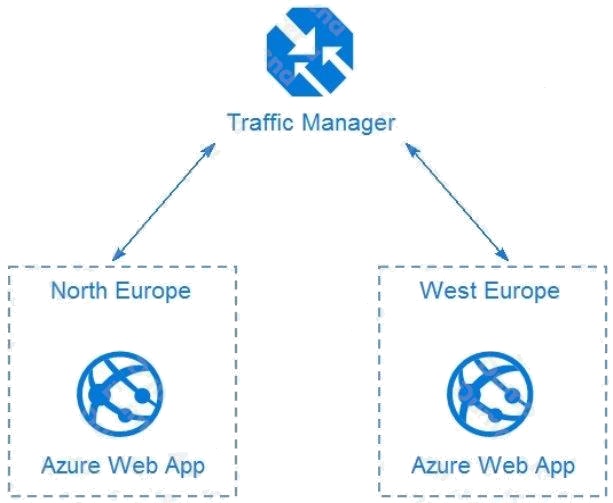
For each of the following statements, select Yes if the statement is true. Otherwise, select No.
NOTE: Each correct selection is worth one point.
Hot Area: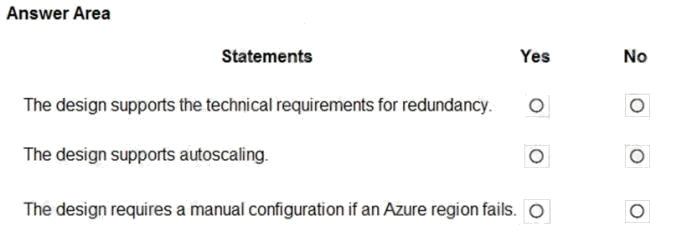
Answer:
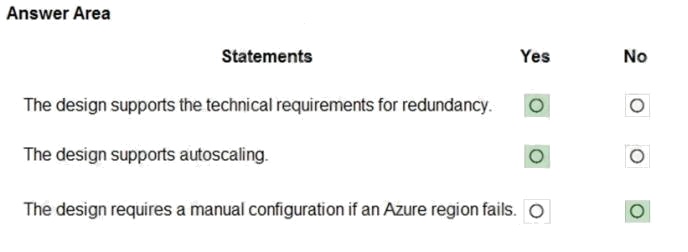
Explanation:
Box 1: Yes
Any new deployments to Azure must be redundant in case an Azure region fails.
Traffic Manager uses DNS to direct client requests to the most appropriate service endpoint based on a traffic-routing
method and the health of the endpoints. An endpoint is any Internet-facing service hosted inside or outside of Azure. Traffic
Manager provides a range of traffic-routing methods and endpoint monitoring options to suit different application needs and
automatic failover models. Traffic Manager is resilient to failure, including the failure of an entire Azure region.
Box 2: Yes
Recent changes in Azure brought some significant changes in autoscaling options for Azure Web Apps (i.e. Azure App
Service to be precise as scaling happens on App Service plan level and has effect on all Web Apps running in that App
Service plan).
Box 3: No
Traffic Manager provides a range of traffic-routing methods and endpoint monitoring options to suit different application
needs and automatic failover models. Traffic Manager is resilient to failure, including the failure of an entire Azure region.
Reference:
https://docs.microsoft.com/en-us/azure/traffic-manager/traffic-manager-overview
https://blogs.msdn.microsoft.com/hsirtl/2017/07/03/autoscaling-azure-web-apps/
Design Infrastructure
Comments
Question 6 Topic 5, Case Study 5Case Study Question View Case
You need to recommend a strategy for the web tier of WebApp1. The solution must minimize costs.
What should you recommend?
- A. Configure the Scale Up settings for a web app.
- B. Deploy a virtual machine scale set that scales out on a 75 percent CPU threshold.
- C. Create a runbook that resizes virtual machines automatically to a smaller size outside of business hours.
- D. Configure the Scale Out settings for a web app.
Answer:
C
Comments
Question 7 Topic 5, Case Study 5Case Study Question View Case
HOTSPOT
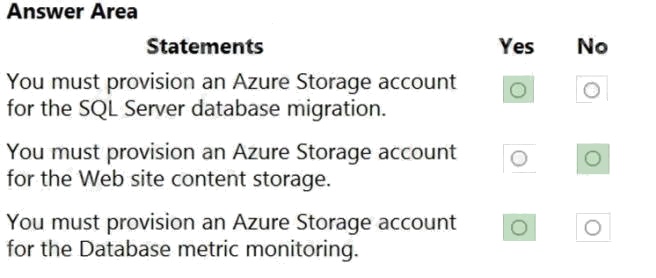
You are evaluating the components of the migration to Azure that require you to provision an Azure Storage account.
For each of the following statements, select Yes if the statement is true. Otherwise, select No.
NOTE: Each correct selection is worth one point.
Hot Area: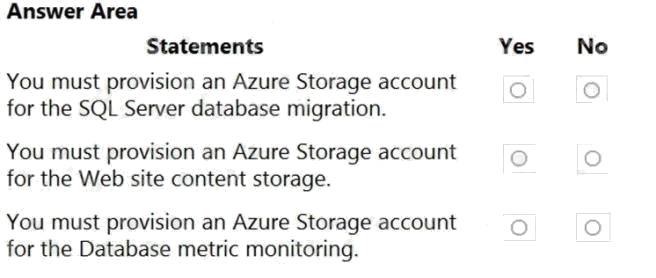
Answer:
Comments
Question 8 Topic 6, Case Study 6Case Study Question View Case
You need to recommend a strategy for migrating the database content of WebApp1 to Azure.
What should you include in the recommendation?
- A. Use Azure Site Recovery to replicate the SQL servers to Azure.
- B. Copy the BACPAC file that contains the Azure SQL database files to Azure Blob storage.
- C. Use SQL Server transactional replication.
- D. Copy the VHD that contains the Azure SQL database files to Azure Blob storage.
Answer:
D
Explanation:
Before you upload a Windows virtual machine (VM) from on-premises to Azure, you must prepare the virtual hard disk (VHD
or VHDX).
Scenario: WebApp1 has a web tier that uses Microsoft Internet Information Services (IIS) and a database tier that runs
Microsoft SQL Server 2016. The web tier and the database tier are deployed to virtual machines that run on Hyper-V.
Reference:
https://docs.microsoft.com/en-us/azure/virtual-machines/windows/prepare-for-upload-vhd-image
Comments
Question 9 Topic 6, Case Study 6Case Study Question View Case
You need to recommend a notification solution for the IT Support distribution group.
What should you include in the recommendation?
- A. a SendGrid account with advanced reporting
- B. Azure AD Connect Health
- C. Azure Network Watcher
- D. an action group
Answer:
B
Explanation:
Reference:
https://docs.microsoft.com/en-us/azure/active-directory/hybrid/how-to-connect-health-operations
Comments
Question 10 Topic 7, Mixed Questions
HOTSPOT
You plan to migrate App1 to Azure.
You need to estimate the compute costs for App1 in Azure. The solution must meet the security and compliance
requirements.
What should you use to estimate the costs, and what should you implement to minimize the costs? To answer, select the
appropriate options in the answer area.
NOTE: Each correct selection is worth one point.
Hot Area: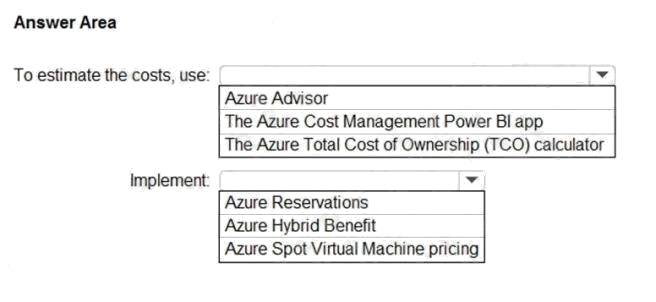
Answer:
Explanation:
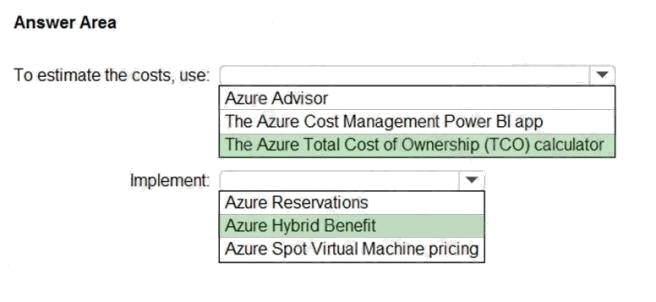
Box 1: The Azure Total Cost of Ownership (TCO) Calculator
The Total Cost of Ownership (TCO) Calculator estimates the cost savings you can realize by migrating your workloads to
Azure.
Note: The TCO Calculator recommends a set of equivalent services in Azure that will support your applications. Our analysis
will show each cost area with an estimate of your on-premises spend versus your spend in Azure. There are several cost
categories that either decrease or go away completely when you move workloads to the cloud.
Box 2: Azure Hybrid Benefit
Azure Hybrid Benefit is a licensing benefit that helps you to significantly reduce the costs of running your workloads in the
cloud. It works by letting you use your on-premises Software Assurance-enabled Windows Server and SQL Server licenses
on Azure. And now, this benefit applies to RedHat and SUSE Linux subscriptions, too.
Scenario:
Litware identifies the following security and compliance requirements:
Once App1 is migrated to Azure, you must ensure that new data can be written to the app, and the modification of new
and existing data is prevented for a period of three years.
On-premises users and services must be able to access the Azure Storage account that will host the data in App1.
Access to the public endpoint of the Azure Storage account that will host the App1 data must be prevented.
All Azure SQL databases in the production environment must have Transparent Data Encryption (TDE) enabled. App1

must not share physical hardware with other workloads.
Reference: https://azure.microsoft.com/en-us/pricing/tco/ https://azure.microsoft.com/en-us/pricing/hybrid-benefit/
Comments
Page 1 out of 24
Viewing questions 1-10 out of 247
page 2