Question 1
You are configuring a BGP signaled Layer 2 VPN across your MPLS enabled core network.
In this scenario, which statement is correct?
- A. You must ensure that all interfaces within the site's configuration are explicitly defined with their remote site identifier values.
- B. This type of VPN requires the support of the I2vpn signaling NLRI on all route reflectors and participating PE devices.
- C. You must use a unique route distinguisher value on all PE devices in your environment.
- D. This type of VPN is only supported over LSPs that are using traffic-engineering.
Answer:
B
Comments
Question 2
Exhibit:
Which two statements regarding the output shown in the exhibit are correct? (Choose two.)
- A. The type of connection is remote.
- B. The type of connection is local.
- C. The PEs have matching control word values.
- D. The label associated with this virtual circuit is out of range.
Answer:
AC
Comments
Question 3
Exhibit:
Referring to the exhibit, you need to implement VPLS between CE-A1 and CE-A2 You must ensure
that no loops are created due to the multihoming of the connection from CE-A2 to PE2 and PE3.
Based on the type of VPLS, which two solutions will satisfy this requirement? (Choose two.)
- A. In a BGP VPLS, configure a primary and backup neighbor.
- B. In an LDP VPLS. configure multihoming and local preference on PE-2 and PE-3
- C. In an LDP VPLS, configure a primary and backup neighbor.
- D. In a BGP VPLS, configure multihoming and local preference on PE-2 and PE-3.
Answer:
C, D
Comments
Question 4
Exhibit:
R1 assigns incoming voice traffic to the ef forwarding class. All other traffic is assigned to the best-
effort forwarding class You have configured a CoS re-write rule on R1 to include the correct CoS bit
values in packets sent towards R2 You want R2 to classify traffic using the CoS markings created by
R1.
Which two configuration steps are necessary to accomplish this task? (Choose two.)
- A. Configure a CoS re-write rule on R2 and assign matching CoS values.
- B. Assign the CoS re-write rule to the ge-0/0/1.0 interface on R2.
- C. Assign the behavior aggregate classifier to the ge-0/0/1.0 interface on R2.
- D. Configure a behavior aggregate classifier on R2.
Answer:
B, C
Comments
Question 5
You must deploy an interprovider VPN option that ensures that the ASBRs do not need to store any
VPN routes.
In this scenario, which interprovider VPN option should you choose?
- A. option B
- B. option A
- C. option C
- D. option D
Answer:
C
Comments
Question 6
Exhibit: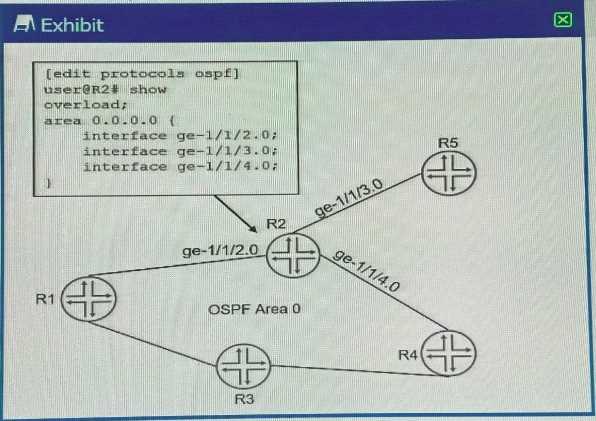
Referring to the exhibit, which two statements are correct? (Choose two.)
- A. R1 will never forward transit traffic through R2.
- B. Transit traffic from R1 to R4 will traverse R3.
- C. The OSPF interface metrics on R2 are all set to 65535.
- D. R2 stops sending LSAs into the network.
Answer:
B, C
Comments
Question 7
Exhibit: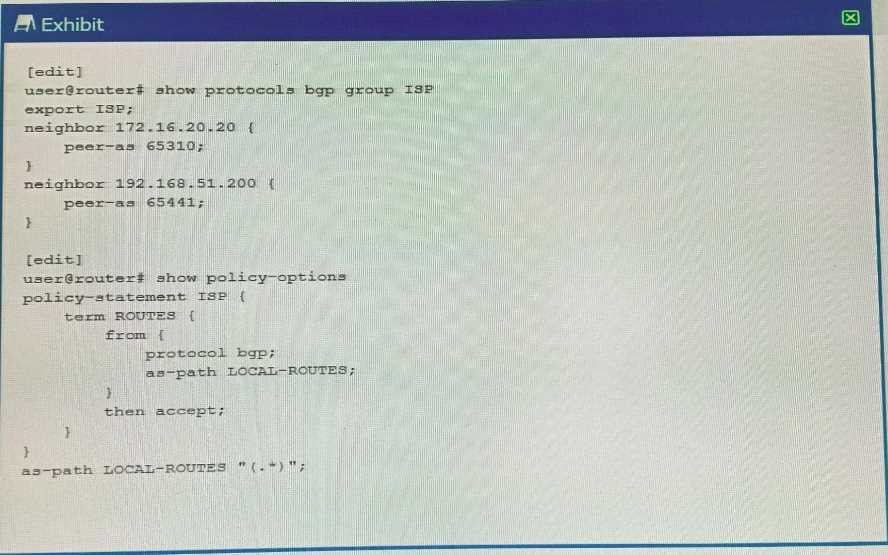
Your network is connected to two different ISPs and you notice that they are using your network for
transit traffic.
In this scenario, which two configuration statements will solve this problem? (Choose two.)
- A. set policy-options policy-statement ISP term ROUTES then reject
- B. set policy-options as-path LOCAL-ROUTES "()"
- C. set policy-options policy-statement ISP term REST then reject
- D. set policy-options as-path LOCAL-ROUTES " (65310 I 65441) +"
Answer:
B, C
Comments
Question 8
Which two statements are true about what a route reflector does by default when distributing routes
it has received from reflector clients? (Choose two.)
- A. It changes the default BGP attributes to inform peers that it is a route reflector.
- B. It adds its cluster ID to the client-received routes.
- C. It sets the next hop of all routes to "self' to prevent routing loops.
- D. It does not change any received BGP attributes.
Answer:
B, D
Comments
Question 9
Which two statements about virtual links are correct? (Choose two.)
- A. Virtual links are used for control plane traffic.
- B. Virtual links are point-to-point.
- C. Virtual links are excluded from SPF calculations.
- D. Virtual links are bidirectional.
Answer:
A, B
Comments
Question 10
Which two statements about IS-IS are correct? (Choose two.)
- A. Level 1 intermediate systems exchange routing information with Level 1 intermediate systems in other IS-IS areas.
- B. An IS-IS router sets the attached bit in the PDUs it sends to a Level 1 area to indicate that it is a backbone router.
- C. A Level 1 router can only form adjacencies with other Level 1 routers.
- D. Level 2 routers can form adjacencies with either Level 1 or Level 2 routers.
Answer:
B, C
Comments
Page 1 out of 9
Viewing questions 1-10 out of 94
page 2