Question 1
You are implementing the route summarization feature of OSPF.
Which two results do you achieve in this scenario? (Choose two.)
- A. It helps in migrating to future multi-area OSPF network designs.
- B. It reduced the routing table size, enabling devices to store and process less information.
- C. It reduces the impact of topology changes on a device.
- D. It provides optimal routing in the network.
Answer:
B, C
Explanation:
OSPF inter-area route summarization reduces the routing information exchanged between areas and
the size of routing tables, and improves routing performance. OSPF inter-area route summarization
enables an ABR to summarize contiguous networks into a single network and advertise the network
to other areas.
Comments
Question 2
Your organization has recently acquired another company. You must carry all of the company’s
existing VLANs across the corporate backbone to the existing branch locations without changing
addressing and with minimal configuration.
Which technology will accomplish this task?
- A. Q-in-Q all-in-one bundling
- B. PVLAN isolated VLAN
- C. MVRP registration normal
- D. EVPN-VXLAN anycast gateway
Answer:
A
Comments
Question 3
Your enterprise network uses routing instances to support multitenancy. Your Junos devices use BGP
to peer to multiple BGP devices. You must ensure that load balancing is achieved within the routing
instance.
Which two statements would accomplish this task? (Choose two.)
- A. Configure the multipath option at the [edit protocols bgp group <group-name> neighbor] hierarchy.
- B. Configure the multipath option at the [edit protocols bgp group] hierarchy.
- C. Configure a load-balance per-packet policy and apply it at the [edit routing-options forwarding- table] hierarchy.
- D. Configure the multipath option at the [edit routing-instances <instance-name> routing-options] hierarchy.
Answer:
B, C
Explanation:
Fortunately, the Juniper Networks BGP implementation supports the notion of a bandwidth
community. This extended community encodes the bandwidth of a given next hop, and when
combined with multipath, the load-balancing algorithm distributes flows across the set of next hops
proportional to their relative bandwidths. Put another way, if you have a 10-Mbps and a 1-Mbps next
hop, on average nine flows will map to the high-speed next hop for every one that uses the low
speed.
Use of BGP bandwidth community is supported only with per-packet load balancing.
The configuration task has two parts:
Configure the external BGP (EBGP) peering sessions, enable multipath, and define an import policy
to tag routes with a bandwidth community that reflects link speed.
Enable per-packet (really per-flow) load balancing for optimal distribution of traffic.
https://www.juniper.net/documentation/us/en/software/junos/bgp/topics/topic-map/load-balancing-bgp-session.html
Comments
Question 4
You are asked to enforce user authentication using a captive portal before users access the corporate
network.
Which statement is correct in this scenario?
- A. HTTPS is the default protocol for a captive portal.
- B. A captive portal can be bypassed using an allowlist command containing a device’s IP address.
- C. When enabled, a captive portal must be applied to each individual interface.
- D. All Web browser requests are redirected to the captive portal until authentication is successful.
Answer:
D
Explanation:
You can set up captive portal authentication on your switch to redirect all Web browser requests to a
login page that requires users to input a username and password before they are allowed access.
Upon successful authentication, users are allowed access to the network and redirected to the
original page requested. Junos OS provides a customizable template for the captive portal window
that allows you to easily design and modify the look of the captive portal login page. You can modify
the design elements of the template to change the look of your captive portal login page and to add
instructions or information to the page. You can also modify any of the design elements of a captive
portal login page. The first screen displayed before the captive login page requires the user to read
the terms and conditions of use. By clicking the Agree button, the user can access the captive portal
login page.
https://www.juniper.net/documentation/us/en/software/junos/user-access/topics/topic-map/user-authentication-captive-portal.html
Comments
Question 5
Referring to the exhibit, ServerA sends a single IP packet destined to 10.0.0.127.
Which two statements correctly describe the behavior of the resulting outbound VXLAN packets that
contain the original packet destined to 10.0.0.127? (Choose two.)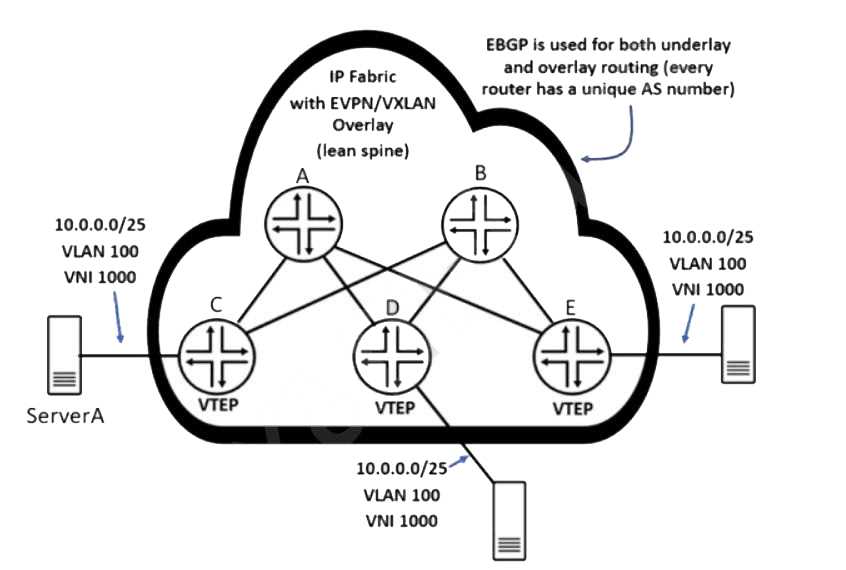
- A. Router E will replicate and send a copy of the received VXLAN packet to router D.
- B. Router C will send a VXLAN packet destined only to router D and router E.
- C. Router D will not replicate and send a copy of the received VXLAN packet to router E.
- D. Router C will send a single VXLAN packet to one remote VTEP.
Answer:
A, D
Comments
Question 6
A BGP network has been designed to provide resiliency and redundancy to a multihomed customer
network.
Which two statements are correct in this scenario? (Choose two.)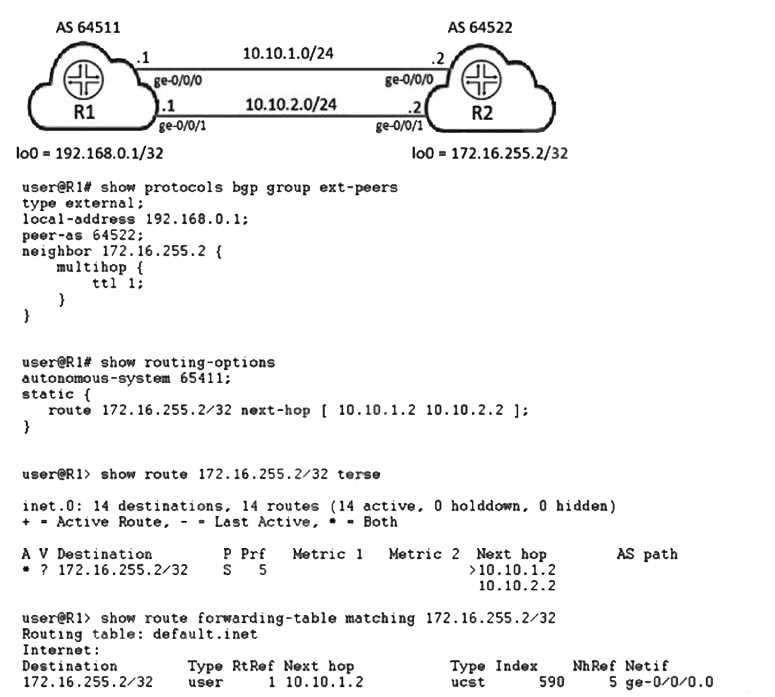
- A. Both the next hops will be used to forward traffic to R2.
- B. A routing policy will be required to forward traffic to both next hops.
- C. The TTL value of 1 is set to limit the scope of the EBGP session.
- D. The ttl statement must be configured to accommodate peering to a loopback address of a directly connected peer.
Answer:
B, D
Comments
Question 7
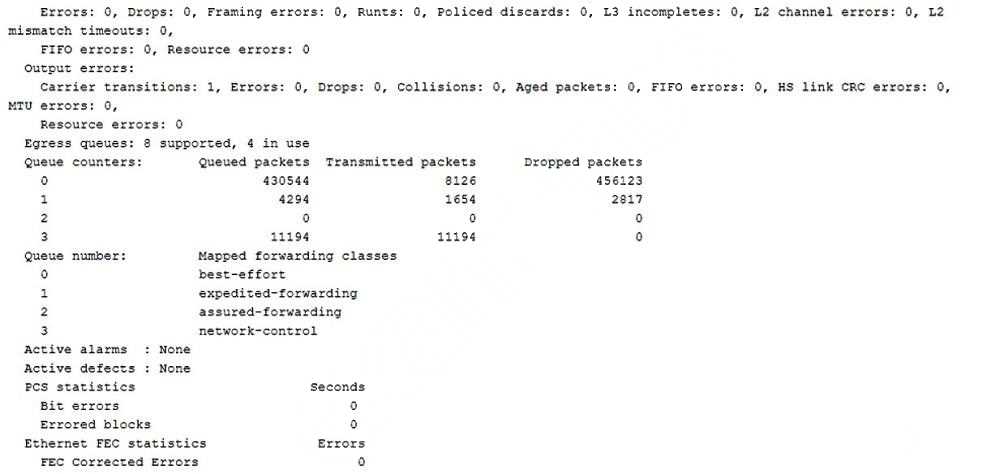
You are asked to troubleshoot voice quality issues on your newly implement VoIP network. You
notice that the voice packets are being dropped. You have verified that the packets are correctly
marked for expedited forwarding queue.
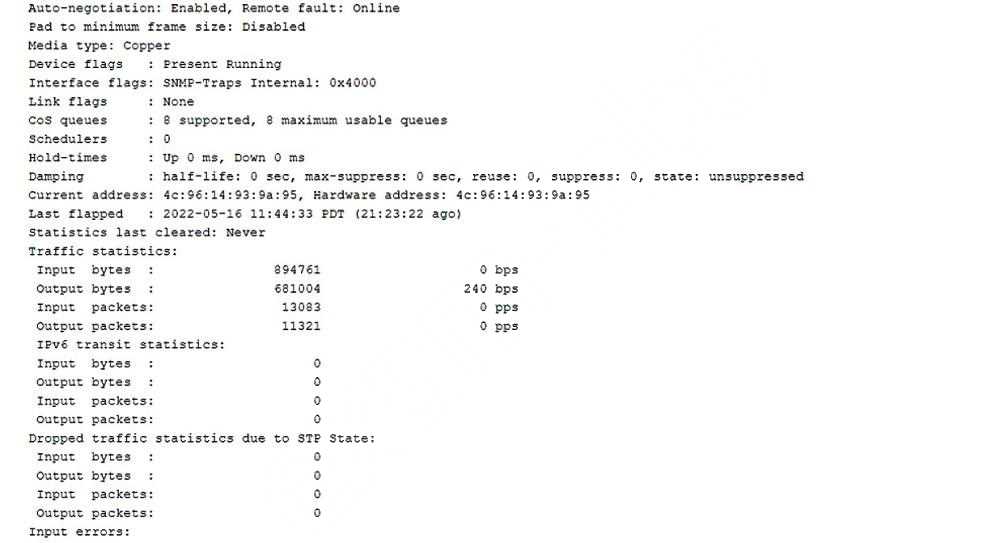
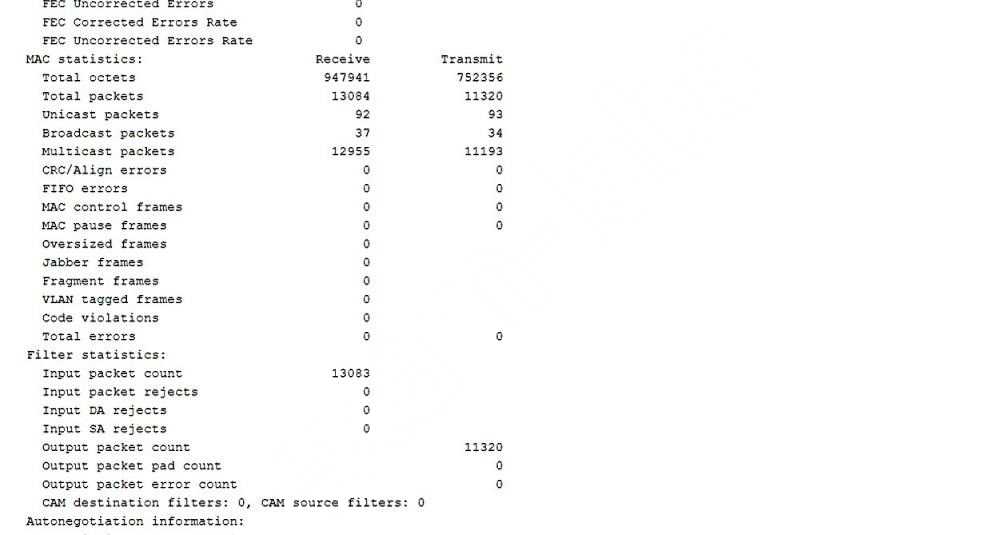
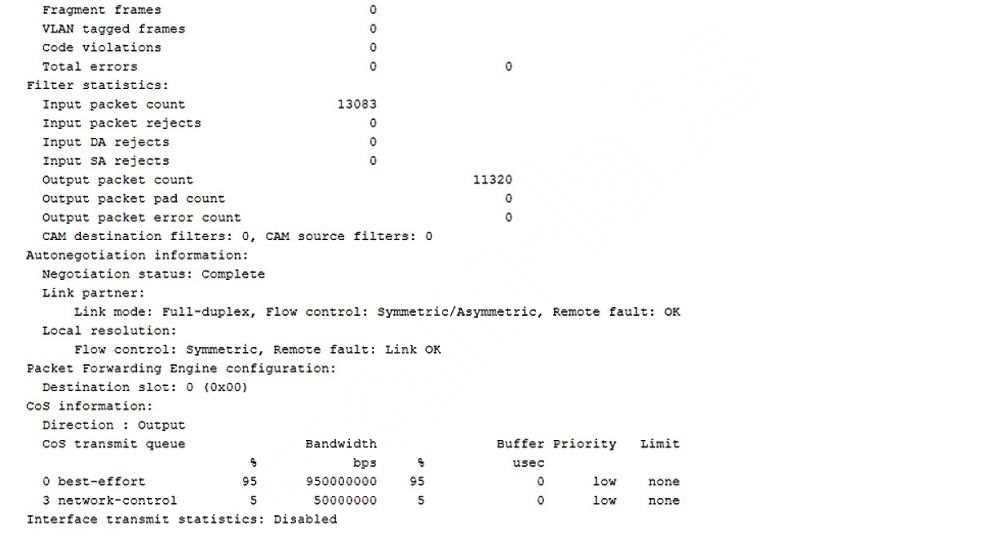
Referring to the exhibit, what must you configure to solve the problem?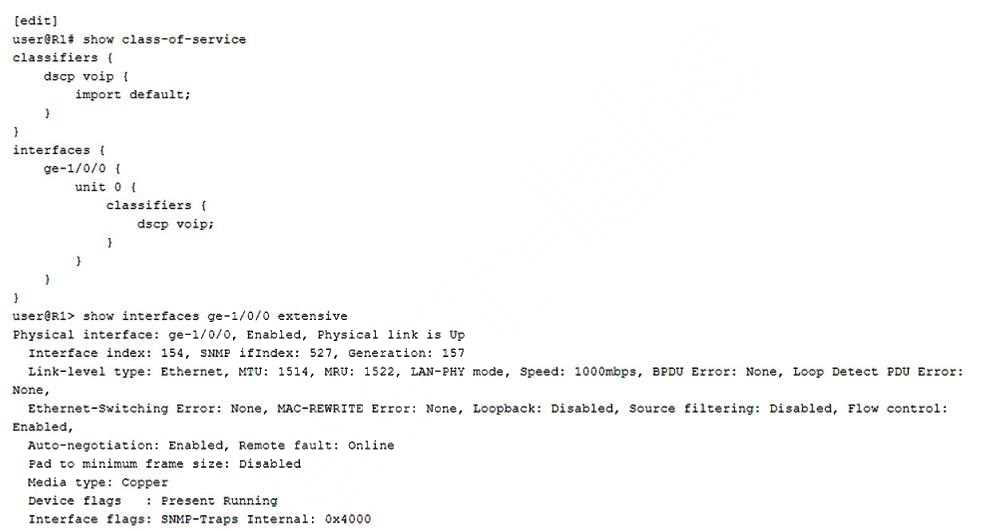
- A. You must configure a multifield classifier to put the VoIP traffic in the correct queue.
- B. You must configure a rewrite rule to ensure that the traffic is scheduled properly in the device.
- C. You must configure a scheduler to allocate bandwidth to the expedited forwarding queue.
- D. You must configure a policer to ensure that the queue is not being starved.
Answer:
C
Comments
Question 8
Remote branches connect to the corporate WAN through access switches. The access switches
connect to access ports on the WAN distribution switch, as shown in the exhibit. L2PT has previously
been configured on the tunnel Layer 2 traffic across the WAN. You decide to move the L2PT tunnel
endpoints to the access switches. When you apply the L2PT configuration to the access switches, the
ports that connect the access switches to the distribution switch shut down.
Which action would solve this problem?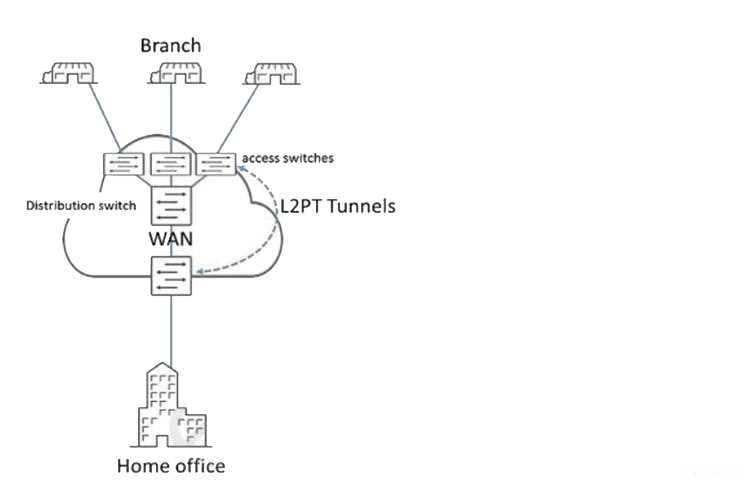
- A. Configure the links between the access switches and the distribution switch as a trunk port.
- B. Disable the BPDU block function on the access switches.
- C. Disable the BPDU block function on the distribution switch.
- D. Configure a GRE tunnel to encapsulate the L2PT traffic across the WAN.
Answer:
A
Explanation:
Access interfaces in an L2PT-enabled VLAN should not receive L2PT-tunneled PDUs. If an access
interface does receive L2PT-tunneled PDUs, there might be a loop in the network, and the device will
shut down the interface.
https://www.juniper.net/documentation/us/en/software/junos/multicast-l2/topics/topic-map/layer-2-protocol-tunneling.html
Comments
Question 9
You want to provide Layer 2 connectivity between campus sites using Ethernet switches through a
metro Ethernet service provider who is using Q-in-Q tagging on their network.
Referring to the exhibit, what are two design considerations in this environment? (Choose two.)
- A. VXLAN could be implemented on your network across this service provider network.
- B. Each campus switch shown must have a C-Tag 300 configured.
- C. L2PT is required on the SP network to support the spanning tree protocol.
- D. Each campus switch shown must have S-Tag 300 configured.
Answer:
C, D
Explanation:
https://www.juniper.net/documentation/us/en/software/junos/multicast-l2/topics/ref/statement/layer2-protocol-tunneling-edit-vlans-l2pt-ex-series.html
Comments
Question 10
You must ensure that all routes in the 10.0.0/8 address range are not advertised outside of your AS.
Which well-known BGP community should be assigned to these addresses to accomplish this task?
- A. no-export
- B. no-peer
- C. internet
- D. no-advertise
Answer:
A
Explanation:
For specifying the BGP community attribute only, you also can specify community-ids as one of the
following well-known community names defined in RFC 1997:
no-advertise—Routes containing this community name are not advertised to other BGP peers.
no-export—Routes containing this community name are not advertised outside a BGP confederation
boundary.
no-export-subconfed—Routes containing this community are advertised to IBGP peers with the same
AS number, but not to members of other confederations.
llgr-stale—Adds a community to a long-lived stale route when it is readvertised.
no-llgr—Marks routes which a BGP speaker does not want to be retained by LLGR. The Notification
message feature does not have any associated configuration parameters.
https://www.juniper.net/documentation/us/en/software/junos/bgp/topics/ref/statement/community-edit-routing-options.html
Comments
Page 1 out of 6
Viewing questions 1-10 out of 65
page 2