Question 1
You are bringing a new network online with three MX Series devices enabled for STP. No root bridge
priority has been configured. Which statement is true in this scenario?
- A. The device with the lowest MAC address will be elected as the root bridge.
- B. The device with the highest MAC address will be elected as the root bridge.
- C. The device with the lowest numerical lo0 IP address will be elected as the root bridge.
- D. The device with the highest numerical lo0 IP address will be elected as The bridge.
Answer:
A
Explanation:
https://supportportal.juniper.net/s/article/EX-Identify-the-Root-Bridge-in-a-Spanning-Tree-STP-
network?language=en_US The root bridge in a spanning-tree network is the bridge with the smallest
or the lowest bridge ID.
In the absence of a manually configured priority, the Spanning Tree Protocol (STP) elects the root
bridge based on the lowest bridge ID, which is a combination of the priority and the MAC address.
The device with the lowest MAC address will have the lowest bridge ID and thus be elected as the
root bridge.
Reference:
Juniper Networks Technical Documentation on STP
Comments
Question 2
What Is a key differentiator of generate routes from aggregate routes?
- A. Generate routes use a forwarding next hop.
- B. Generate routes have a default next-hop value of reject.
- C. Generate routes have a default preference value of 210.
- D. Generate routes cannot be used as a gateway of last resort.
Answer:
A
Explanation:
https://www.networkfuntimes.com/junos-aggregate-routes-vs-generate-routes-how-to-summarise-
on-juniper-routers/
Generated routes are a type of route that can be created to summarize and generate more specific
routes within the routing table. Unlike aggregate routes, which summarize existing routes and inherit
a next-hop, generated routes do not necessarily have to match an existing route and will have a next-
hop of reject by default unless specified otherwise.
Reference:
Juniper Networks Technical Documentation on Routing Policies and Route Generation
Comments
Question 3
Which statement is correct about the FE80;:/10 prefix?
- A. This prefix range is used for the link local address.
- B. This prefix range is used on the loopback interface.
- C. This prefix range is reserved for multicast applications
- D. This prefix range is not reserved.
Answer:
A
Explanation:
The FE80::/10 prefix is reserved for IPv6 link-local addresses. These addresses are auto-configured on
all IPv6-enabled interfaces and can be used for communication within the local link (subnet) only.
Reference:
Juniper Networks Technical Documentation on IPv6 Addressing
Comments
Question 4
You are asked to create connections between routing instances on the same Junos device and route
between the connected Instances. What are two ways to accomplish this task? (Choose two.)
- A. Use physical interfaces.
- B. Use an IRB interface.
- C. Use logical tunnel interfaces.
- D. Use loopback interfaces.
Answer:
CD
Explanation:
To create connections between routing instances on the same Junos device and route between them,
you can use logical tunnel interfaces, which are virtual interfaces that can be used to route traffic
between instances without the need for physical connectivity. Additionally, loopback interfaces,
which represent the device itself, can be used to route traffic between routing instances as they are
always up and can be reached within the device.
Reference:
Juniper Networks Technical Documentation on Routing Instances
Juniper Networks Technical Documentation on Logical Tunnel Interfaces
Comments
Question 5
Which configuration selling prohibits a static route from being redistributed by a dynamic routing
protocol?
- A. route-filter
- B. no-readvertise
- C. qualified-next-hop
- D. passive
Answer:
B
Explanation:
The no-readvertise policy statement is used to prevent a static route from being redistributed into a
dynamic routing protocol. This setting ensures that routes that are configured statically are not
advertised out via dynamic routing protocols such as OSPF or BGP.
Reference:
Juniper Networks Technical Documentation on Routing Policy
Comments
Question 6
What is the correct order of BGP attributes for active route selection?
- A. next hop -> local preference -> AS path -> MED -> origin
- B. next hop -> AS path -> local preference -> origin -> MED
- C. next hop -> local preference -> AS path -> origin -> MED
- D. next hop -> origin -> local preference -> AS path -> MED
Answer:
C
Explanation:
BGP selects the active route based on an ordered list of attributes. The correct order is:
Weight (Cisco proprietary, not listed in the options)
Local Preference
Network (route) originated from the BGP router itself
Shortest AS Path
Lowest Origin Type
Lowest MED
eBGP over iBGP paths
Closest IGP Neighbor
Lowest Router ID
The next hop is checked for reachability but is not part of the BGP decision process for selecting the
best path.
Reference:
Juniper Networks Technical Documentation on BGP
Comments
Question 7
What are three well-known mandatory BGP attributes? (Choose three.)
- A. next hop
- B. origin
- C. community
- D. MED
- E. AS path
Answer:
A, B, E
Explanation:
https://www.catchpoint.com/bgp-monitoring/bgp-attributes
BGP Attribute Categories
There are four categories of BGP attributes:
Well-known mandatory:Recognized by all BGP peers, passed to all peers, and present in all Update
messages. Well-known mandatory attributes include:- Next-hop- Origin- AS PATH
Well-known discretionary:Recognized by all routers, passed to all peers, and optionally included in
the Update message. Well-known discretionary attributes include:- Local Preference- Atomic
Aggregate
Optional transitive:Possibly recognized by BGP routers and passed to BGP peers. Optional transitive
attributes are marked as partial when not recognized. Optional transitive attributes include:-
Aggregator- Community
Optional non-transitive:Possibly recognized by BGP routers but not passed to peers. Optional non-
transitive attributes include:- Multi-exit discriminator (MED)- Originator ID- Cluster-ID
The three well-known mandatory BGP attributes that must be present in every BGP update message
are:
Next Hop: Indicates the next hop IP address to reach the advertising BGP peer.
Origin: Indicates how the route was originated, whether it was via IGP, EGP, or incomplete.
AS Path: Lists the autonomous systems that the update has traversed.
Reference:
Juniper Networks Technical Documentation on BGP Attributes
Comments
Question 8
Exhibit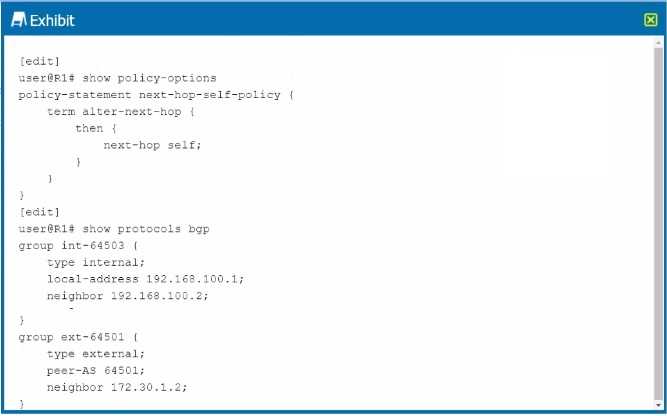
Referring to the exhibit, where should next-hop-self-policy be applied to alter the next-hop value?
- A. The policy is applied as an export policy for the group int-64503.
- B. The policy is applied as an export policy for the group ext-64501.
- C. The policy is applied as an import policy for the group int- 64 503.
- D. The policy is applied as an Import policy for the group ext-64501.
Answer:
B
Explanation:
The next-hop-self-policy policy is used to alter the next-hop attribute of BGP routes. When you apply
it as an export policy to an external BGP (eBGP) group, it changes the next-hop attribute of the routes
being advertised to eBGP neighbors so that the next-hop IP address is the IP address of the router
itself. This ensures that the eBGP neighbors use the local router as the next hop to reach these
routes.
Reference:
Juniper Networks Technical Documentation on BGP Policies
Comments
Question 9
Exhibit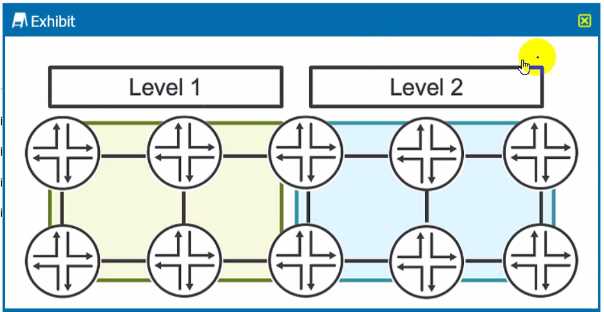
Referring to the exhibit, which two statements are correct? (Choose two.)
- A. Prefixes in Level 1 will be redistributed to Level 2.
- B. Prefixes in Level 2 will be not redistributed to Level 1.
- C. Prefixes in Level 1 will not be redistributed to Level 2.
- D. Prefixes in Level 2 will be redistributed to Level 1.
Answer:
AD
Explanation:
In IS-IS, Level 1 routes are usually contained within the same area and Level 2 routes are used to
interconnect different areas. By default, routes from Level 1 are redistributed into Level 2, and vice
versa, to ensure reachability between areas.
Reference:
Juniper Networks Technical Documentation on IS-IS
By default, IS-IS protocol leaks routing information from a Level 1 area to a Level 2 area. However, to
leak routing information from a Level 2 area to a Level 1 area, an export policy must be explicitly
configured.
Comments
Question 10
You are deploying link aggregation groups.
- A. By default, what are two considerations in this scenario? (Choose two.)
- B. There should only be four member links per LAG.
- C. All the ports must have the same speed.
- D. Member links are required to be contiguous ports.
- E. Member links can reside on different members within an MC-LAG.
Answer:
CE
Explanation:
When deploying Link Aggregation Groups (LAGs), it is necessary for all ports in the LAG to operate at
the same speed to ensure consistent performance and avoid issues with load balancing. Multi-
Chassis LAG (MC-LAG) allows for the use of member links that span multiple physical devices,
offering redundancy and higher bandwidth by combining the links from two separate devices into a
single logical LAG.
Reference:
Juniper Networks Technical Documentation on Link Aggregation Groups
Juniper Networks Technical Documentation on MC-LAG
Comments
Page 1 out of 8
Viewing questions 1-10 out of 86
page 2