Question 1
On an OSPF network, routers learn routing information on the entire network by exchanging LSAs.
Which of the following values is the LS Age in the LSA header when an LSA is deleted?
- A. 1800s
- B. 3600s
- C. 1200s
- D. 600s
Answer:
B
Explanation:
LSA Lifetime and Deletion
The LS Age field in the LSA header tracks the age of an LSA. When the LS Age reaches its maximum
value (3600 seconds), the LSA is marked for deletion. This ensures old or stale LSAs are removed from
the network to maintain accurate routing information.
HCIP-Datacom-Core Reference
Detailed explanation of LS Age behavior and LSA deletion processes can be found in the OSPF LSDB
and LSA sections.
Comments
Question 2
DRAG DROP
OSPF networks are classified into four types of networks by link layer protocol. Drag the following
link layer protocols to the corresponding network types.(Token is reusable)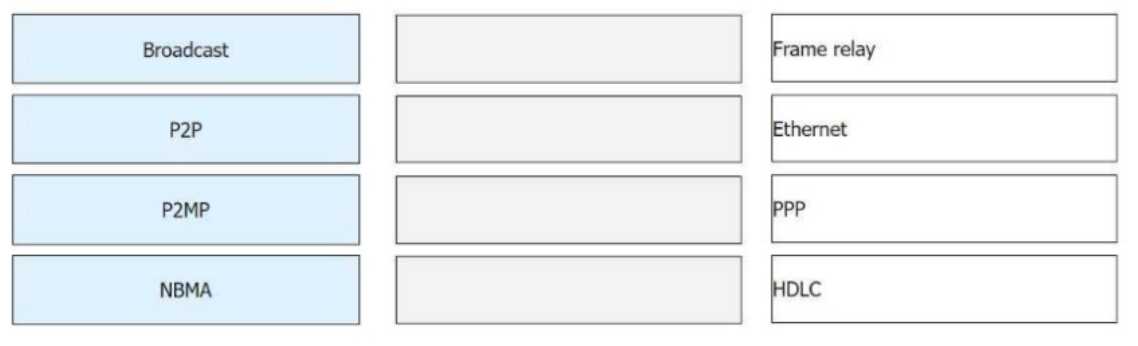
Answer:
None
Explanation:
Network Types and Corresponding Link Layer Protocols
Broadcast: Ethernet
Point-to-Point (P2P): PPP, HDLC
Point-to-Multipoint (P2MP): PPP
Non-Broadcast Multi-Access (NBMA): Frame Relay
OSPF Network Types:
OSPF classifies networks based on link layer protocols into the following types:
Broadcast: This type assumes that all routers on the network can communicate directly with one
another using multicast or broadcast frames. Ethernet networks are typical examples.
Point-to-Point (P2P): This type is used for links that connect two routers directly. Common protocols
include PPP (Point-to-Point Protocol) and HDLC.
Point-to-Multipoint (P2MP): This type simulates multiple point-to-point connections over a single
physical network, often used in WAN scenarios where PPP is employed.
Non-Broadcast Multi-Access (NBMA): These networks connect multiple devices but lack native
broadcast capability, such as Frame Relay.
Reference: HCIP-Datacom-Core Technology Training Material (OSPF Network Types).
Explanation of Matches:
Broadcast - Ethernet: Ethernet supports broadcast and multicast communication, making it a suitable
example of a broadcast OSPF network.
P2P - PPP, HDLC: Both PPP and HDLC are designed for direct communication between two nodes,
fitting the P2P category.
P2MP - PPP: In WANs, PPP often operates in a point-to-multipoint configuration, simulating separate
connections for each endpoint.
NBMA - Frame Relay: Frame Relay is a classic NBMA technology where direct communication
between devices requires manual configuration, as there is no inherent broadcast capability.
Conclusion:
This classification ensures that OSPF operates efficiently over different network types by adapting
neighbor discovery and LSA propagation mechanisms to the underlying link layer technology.
Comments
Question 3
On an IS-IS network, each router can generate LSPs. Which of the following events trigger the
generation of a new LSP?
- A. Related IS-IS interfaces go up or down.
- B. Periodic updates occur.
- C. Inter-area IP routes change.
- D. The IS-IS interface cost is increased.
Answer:
A, B, D
Explanation:
LSP Generation in IS-IS
IS-IS routers generate new Link State Packets (LSPs) under the following conditions:
Interface Status Changes: When IS-IS interfaces go up or down, the link state changes, triggering LSP
updates.
Periodic Updates: IS-IS periodically regenerates LSPs to ensure link-state information remains
synchronized across the network.
Interface Metric Changes: Any modification to interface costs results in a new LSP to reflect the
updated cost in the network.
Incorrect Option
C . Inter-area IP routes change is incorrect because IS-IS does not inherently differentiate between
areas for LSP generation.
HCIP-Datacom-Core Reference
IS-IS LSP generation rules are detailed in the IS-IS configuration and implementation chapters.
Comments
Question 4
Similar to the OSPF DR, the IS-IS DIS needs to be elected on a broadcast network. However, the OSPF
DR is preemptive by default, whereas the IS-IS DIS is not preemptive by default.
- A. TRUE
- B. FALSE
Answer:
A
Explanation:
DIS and DR Election
The IS-IS Designated Intermediate System (DIS) is responsible for generating and updating
pseudonode LSPs on a broadcast network.
Unlike OSPF DR, the IS-IS DIS does not preempt by default. This behavior avoids unnecessary flapping
in the network due to frequent DIS re-elections.
HCIP-Datacom-Core Reference
The characteristics of DIS and DR behavior are explained in IS-IS network operation chapters.
Comments
Question 5
On an IS-IS network, routers send LSPs to exchange link state information. LSPs are classified into
Level-1 LSPs and Level-2 LSPs and have the same format. Which of the following parts constitute the
LSP ID in an LSP?
- A. LSP Number
- B. Pseudonode ID
- C. System ID
- D. IS Type
Answer:
A, B, C
Explanation:
IS-IS Overview: Intermediate System to Intermediate System (IS-IS) is a link-state routing protocol.
Routers exchange Link State Packets (LSPs) to maintain a synchronized link-state database. These LSPs
are categorized into Level-1 LSPs (intra-area routing) and Level-2 LSPs (inter-area routing). Both types
share the same packet format.
Reference: HCIP-Datacom-Core Technology Training Material (IS-IS LSPs and Packet Structure).
LSP ID Format: The LSP ID uniquely identifies each LSP and ensures accurate routing information. It
comprises the following components:
System ID (C): A 6-byte identifier assigned to each router, derived from the router's NET (Network
Entity Title). This identifier ensures unique identification of routers within the IS-IS domain.
Pseudonode ID (B): Assigned when a router acts as a Designated Intermediate System (DIS) on a
broadcast network. It differentiates LSPs generated by the DIS from other routers.
LSP Number (A): A 1-byte field indicating the sequence number of the LSP. It helps distinguish
multiple LSPs generated by the same router for the same level.
Reference: HCIP-Datacom Advanced Routing & Switching Technology (IS-IS LSP Format).
IS Type Exclusion:
IS Type (D) is not part of the LSP ID itself. It is a field within the IS-IS PDU that indicates the type of
Intermediate System (Level-1, Level-2, or both) but does not contribute to the composition of the
LSP ID.
Reference: HCIE-Datacom V1.0 Training Material (IS-IS Basics and Levels).
Conclusion: The LSP ID in IS-IS consists of System ID, Pseudonode ID, and LSP Number. These
components uniquely identify each LSP within the IS-IS domain.
Comments
Question 6
On an OSPF network, interfaces are classified into four types based on link layer protocols. Which of
the following types can interfaces on an IS-IS network be classified into based on physical links?
- A. P2P
- B. Broadcast
- C. P2MP
- D. NBMA
Answer:
A, B
Explanation:
IS-IS Interface Types
IS-IS interfaces are categorized based on physical link characteristics:
Point-to-Point (P2P): Direct connections between two routers.
Broadcast: Shared medium networks where multiple routers communicate.
Incorrect Options
C . P2MP and D. NBMA are not standard interface classifications in IS-IS.
HCIP-Datacom-Core Reference
IS-IS physical link classifications are elaborated in IS-IS link configuration sections.
Comments
Question 7
Which of the following attributes must be carried when BGP sends route update messages?
- A. MED
- B. Next_Hop
- C. AS_Path
- D. Local_Preference
Answer:
B, C
Explanation:
Mandatory BGP Attributes
Next_Hop: Specifies the next hop to reach the destination.
AS_Path: Lists the autonomous systems traversed, crucial for loop prevention and route selection.
Optional Attributes
MED (Multi-Exit Discriminator) and Local_Preference are optional attributes that aid in route
preference but are not mandatory.
HCIP-Datacom-Core Reference
BGP attribute behavior and classifications are detailed in BGP path selection principles.
Comments
Question 8
A non-client is an IBGP peer that functions as neither an RR nor a client. A non-client must establish
fully meshed connections with the RR and all the other non-clients.
- A. TRUE
- B. FALSE
Answer:
A
Explanation:
Non-Client Definition in IBGP
In an IBGP setup with a Route Reflector (RR), a non-client is an IBGP peer that is neither the RR itself
nor its client.
Non-clients must establish fully meshed IBGP connections with all other non-clients and the RR
because IBGP rules prohibit route propagation between non-clients without a direct connection.
HCIP-Datacom-Core Reference
The behavior of non-clients in an RR topology is clearly outlined in the BGP implementation chapters.
Comments
Question 9
In BGP, Keepalive messages are used to maintain BGP peer relationships. When a BGP router
receives a Keepalive message from a peer, the BGP router sets the state of the peer to Established
and periodically sends Keepalive messages to maintain the connection. By default, the device sends
Keepalive messages every seconds.
Answer:
60
Explanation:
BGP Keepalive Message Behavior
Keepalive messages are used to maintain the Established state of a BGP peer relationship.
The Keepalive timer determines the frequency of these messages and defaults to 60 seconds, as per
the BGP specification.
HCIP-Datacom-Core Reference
The Keepalive timer default value is covered in the BGP configuration and operational principles.
Comments
Question 10
Which of the following statements is true about BGP?
- A. If the export routing policy applied to a BGP peer changes, manual intervention is required so that the device resends Update messages to the peer.
- B. IGP routes can be converted into BGP routes only through the network command.
- C. A router cannot be configured with multiple BGP processes.
- D. Open messages carry only the BGP header.
Answer:
A
Explanation:
Export Routing Policy Changes
When an export routing policy is modified, BGP does not automatically resend affected routes.
Manual intervention, such as a clear ip bgp command, is required to resend Update messages
reflecting the new policy.
Incorrect Options
B . IGP routes can also be advertised into BGP using redistribution, not just the network command.
C . A router can be configured with multiple BGP processes using different AS numbers (multi-
instance BGP).
D . Open messages carry additional parameters such as AS number, Hold Time, and Router ID, not
just the header.
HCIP-Datacom-Core Reference
BGP policy and update behavior are detailed in the route control and redistribution chapters.
Comments
Page 1 out of 21
Viewing questions 1-10 out of 219
page 2