Question 1
In Huawei's smart roaming solution, which of the following methods can be used by a WAC to
discover and maintain neighboring AP entries of STAs? (Select All that Apply)
- A. The WAC obtains such entries using 802. 11v.
- B. The AP listens to the Probe frames sent by STAs.
- C. The AP periodically and proactively scans neighboring APs of STAs.
- D. STAs proactively report neighboring AP information.
Answer:
BC
Explanation:
In Huawei’s smart roaming solution, the WAC can discover and maintain neighboring AP entries of
STAs by using two methods: passive listening and active scanning. Passive listening means that the
AP listens to the Probe frames sent by STAs and reports them to the WAC. Active scanning means
that the AP periodically and proactively scans neighboring APs of STAs and reports them to the WAC.
Reference:
https://support.huawei.com/enterprise/en/doc/EDOC1100058940/8a8f1c9b/smart-
roaming
Comments
Question 2
Which of the following statements about the home agent are true? (Select All that Apply)
- A. The home agent communicates with the gateway on the STAs1 home network at Layer 2.
- B. The home agent communicates with the gateway on the STAs' home network at Layer 3.
- C. A home AP can function as a home agent of STAs.
- D. A home WAC can function as a home agent of STAs.
Answer:
BD
Explanation:
The home agent is a device that communicates with the gateway on the STAs’ home network at Layer
3 and maintains the binding entries of STAs’ home addresses and care-of addresses. A home WAC
can function as a home agent of STAs, while a home AP cannot.
Reference: https://support.huawei.com/enterprise/en/doc/EDOC1100058940/8a8f1c9b/mobile-ip
Comments
Question 3
Which of the following types of non-Wi-R devices can be identified by Huawei APs? (Select All that
Apply)
- A. Bluetooth device
- B. ZigBee device
- C. Game controller
- D. 2.4 GHz wireless video and audio transmitter
Answer:
ABD
Explanation:
Huawei APs can identify non-Wi-Fi devices that operate in the 2.4 GHz frequency band, such as
Bluetooth devices, ZigBee devices, game controllers, wireless video and audio transmitters,
microwave ovens, cordless phones, and baby monitors.
Reference: https://support.huawei.com/enterprise/en/doc/EDOC1100058940/8a8f1c9b/non-wi-fi-
device-identification
Comments
Question 4
Which of the following advantages does BSS coloring provide in Wi-Fi 6? (Select All that Apply)
- A. Higher packet rate on the air interface
- B. Enhanced encryption on the air interface
- C. More efficient channel use
- D. Higher concurrency in high-density scenarios
Answer:
ACD
Explanation:
BSS coloring is a feature introduced in Wi-Fi 6 that assigns different colors to different BSSs to reduce
co-channel interference. BSS coloring provides the following advantages:
Higher packet rate on the air interface: BSS coloring reduces collisions between packets from
different BSSs on the same channel, improving packet transmission efficiency.
More efficient channel use: BSS coloring allows spatial reuse of channels by different BSSs, increasing
channel utilization.
Higher concurrency in high-density scenarios: BSS coloring reduces interference among neighboring
APs and improves network performance in high-density scenarios.
Reference:
https://support.huawei.com/enterprise/en/doc/EDOC1100058940/8a8f1c9b/bss-
coloring
Comments
Question 5
An AP may preferentially use the BTM mode to steer some STAs. With which of the following
protocols are such STAs compliant?
- A. 802.11k
- B. 802.11i
- C. 802.11r
- D. 802.11v
Answer:
D
Explanation:
An AP may preferentially use the BTM mode to steer some STAs that are compliant with 802.11v
protocol. BTM stands for BSS Transition Management, which is a feature defined in 802.11v protocol
that allows an AP to send a request to a STA to switch to another BSS.
Reference: https://support.huawei.com/enterprise/en/doc/EDOC1100058940/8a8f1c9b/btm
Comments
Question 6
As shown in the figure, STA_1 through STA_4 are associated with AP_1, and STA_5 is associated with
AP_2. Assuming that the load balancing threshold is 2, the load difference threshold is 25%, and API
and AP2 support a maximum of 10 STAs, which of the following statements are true? (Select All that
Apply)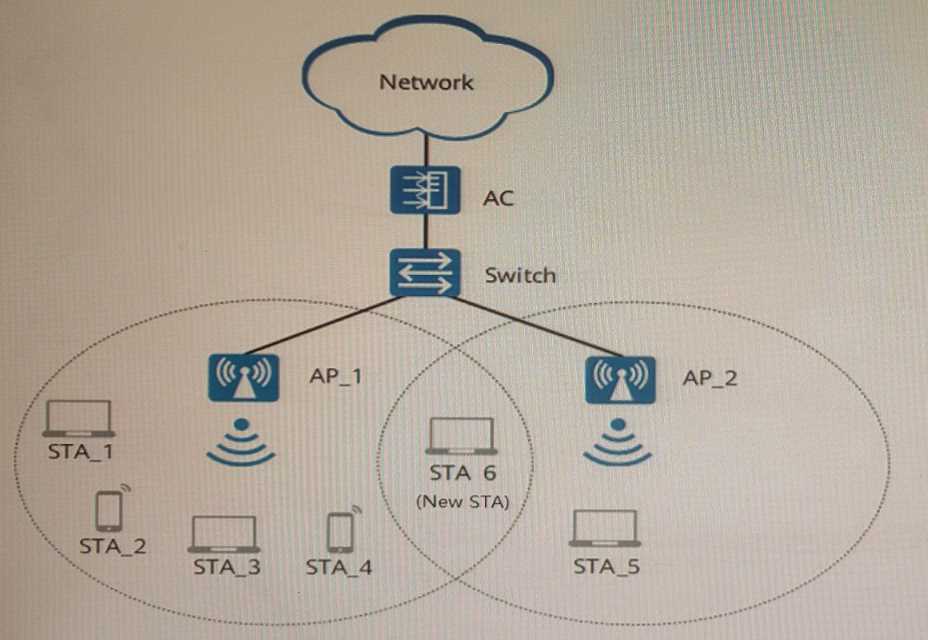
- A. The load percentage of AP_1 is 40%, and that of AP_2 is 10%.
- B. The load balancing mechanism needs to be enabled. Then some STAs are steered from AP_1 to AP__2.
- C. If load balancing is performed, the load percentage of AP_1 changes to 30%.
- D. The minimum load percentage is 10%, which is greater than the load difference threshold. Therefore, load balancing needs to be enabled.
Answer:
AB
Explanation:
The load percentage of an AP is calculated by dividing the number of associated STAs by the
maximum number of STAs supported by the AP. In this case, the load percentage of AP_1 is 4/10 =
40%, and that of AP_2 is 1/10 = 10%. The load balancing mechanism needs to be enabled to balance
the load between AP_1 and AP_2. Then some STAs are steered from AP_1 to AP_2 based on the load
balancing threshold and the load difference threshold.
Reference:
https://support.huawei.com/enterprise/en/doc/EDOC1100058940/8a8f1c9b/load-
balancing
Comments
Question 7
In a multicast solution, there must be reachable unlcast routes between multicast sources and
receivers.
- A. True
- B. False
Answer:
A
Explanation:
In a multicast solution, there must be reachable unicast routes between multicast sources and
receivers, because multicast routing protocols use unicast routing information to build multicast
forwarding trees.
Reference: https://support.huawei.com/enterprise/en/doc/EDOC1100058940/8a8f1c9b/multicast
Comments
Question 8
After multicast-to-unicast conversion is enabled on an AP's air interface, which of the followings is
the destination MAC address of multicast packets sent over the air interface?
- A. Multicast MAC address
- B. MAC address of the multicast source
- C. Broadcast MAC address
- D. MAC address of a STA
Answer:
D
Explanation:
After multicast-to-unicast conversion is enabled on an AP’s air interface, the destination MAC
address of multicast packets sent over the air interface is changed to the MAC address of a STA that
has joined the multicast group. This improves the transmission efficiency and reliability of multicast
packets.
Reference: https://support.huawei.com/enterprise/en/doc/EDOC1100058940/8a8f1c9b/multicast-
to-unicast-conversion
Comments
Question 9
To enable WPA3-incapable ST As to access a WPA3-conflgured network, the WI-FI Alliance defines
the WPA3 transition mode in which WPA3 and WPA2 can coexist for a period of time in the future.
This mode applies only to WPA3-Enterprise, not to WPA3-Personal.
- A. True
- B. False
Answer:
B
Explanation:
The WPA3 transition mode applies to both WPA3-Enterprise and WPA3-Personal. In this mode, WPA3
and WPA2 can coexist for a period of time in the future to enable WPA3-incapable STAs to access a
WPA3-configured network.
Reference:
https://support.huawei.com/enterprise/en/doc/EDOC1100058940/8a8f1c9b/wpa3-
transition-mode
Comments
Question 10
Which of the following statements correctly arranges matching modes used by URL filtering in
descending order of priority?
- A. Exact matching > Prefix matching > Suffix matching > Keyword matching
- B. Exact matching > Suffix matching > Keyword matching > Suffix matching
- C. Exact matching > Suffix matching > Prefix matching > Keyword matching
- D. Exact matching > Keyword matching > Suffix matching > Prefix matching
Answer:
C
Explanation:
URL filtering supports four matching modes: exact matching, suffix matching, prefix matching, and
keyword matching. The priority order of these modes is as follows:
Exact matching: The highest priority. An exact match means that a URL entered by a user is exactly
the same as a URL in a blacklist or whitelist.
Suffix matching: The second highest priority. A suffix match means that a URL entered by a user ends
with a suffix in a blacklist or whitelist.
Prefix matching: The third highest priority. A prefix match means that a URL entered by a user starts
with a prefix in a blacklist or whitelist.
Keyword matching: The lowest priority. A keyword match means that a URL entered by a user
contains a keyword in a blacklist or whitelist.
Reference: https://support.huawei.com/enterprise/en/doc/EDOC1100058940/8a8f1c9b/url-filtering
Comments
Page 1 out of 5
Viewing questions 1-10 out of 60
page 2