Question 1
Refer to the exhibit.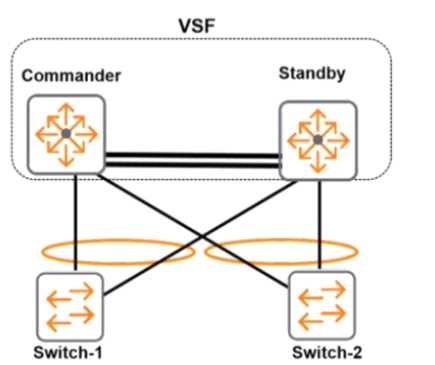
A known unicast packet is received from Switch-1 on the standby and must be forwarded to Switch-2.
How does the VSF fabric decide which port in the aggregated (ink should forward the packet?
- A. The standby uses its own port in the link aggregation to forward the fabric.
- B. The standby sends the packet to the commander over a VSF link, and the commander decides the correct port.
- C. The standby uses the typical load sharing algorithm, and it might select either its port or the commanders port.
- D. The standby selects the port on the designated forwarder for the aggregation.
Answer:
A
Comments
Question 2
A network administrator wants to use Aruba AirWave to audit an AOS-Switch configuration. What rs
one requirement?
- A. The switch defines the AirWave IP address in its zero touch provisioning (ZTP) profile.
- B. The switch specifies the AirWave IP address for the RADIUS server used for Telnet and SSH authentication.
- C. The switch is authorized in AirWave, which has the correct credentials to log in as a CLI manager.
- D. The switch is set to Manage Read-Write mode in AirWave but is not set to Monitor Only + Firmware Updates.
Answer:
B
Comments
Question 3
What is a primary use case for RPVST+ on AOS-Switches?
- A. more granular load balancing than MSTP when access switches connect to two core switches
- B. enhanced loop protection in an MSTP network
- C. integration of AOS-Switches in a heterogeneous vendor network that uses the Cisco protocol
- D. seamless integration with RSTP
Answer:
C
Comments
Question 4
Refer to the exhibit.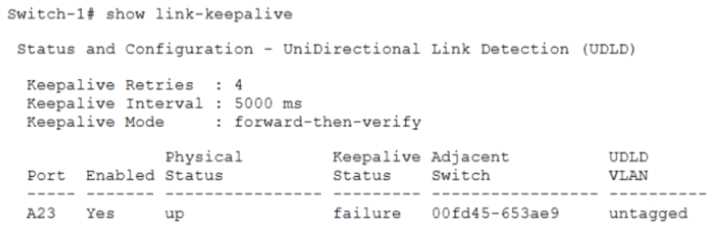
Switch-1 and Switch-2 connect on interface A23. The switches experience a connectivity issue. The
network administrator sees that both switches show this interface as up. The administrator sees the
output shown in the exhibit on Switch-1.
What is a typical issue that could cause this output?
- A. a hardware issue, such as a broken cable
- B. asymmetric routing introduced by a routing configuration error
- C. an issue with queuing, caused by mismatched QoS settings
- D. mismatched IP addresses on the VLAN for the link
Answer:
A
Comments
Question 5
A company has AOS-Switches, Aruba ClearPass, and Aruba Airwave. A network administrator needs
to set up a new switch with the same settings found on other switches in the company. Which action
rs likely to be the most useful to perform the task?
- A. Access the Network Device view on ClearPass.
- B. Use the configuration audit tool on AirWave.
- C. View the current running config on each switch.
- D. View usage patterns on the switches on AirWave.
Answer:
A
Comments
Question 6
Refer to the exhibit.
The network administrator wants to reduce failover time If a switch link m VIAN 100 goes down.
What should the administrator do?
- A. Configure echo mode BFD on VLAN 100 on all OSPF routing devices on VLAN 100.
- B. Lower the dead timer on the BDR of VLAN 100.
- C. Lower the hello timer only on the BDR of VLAN 100.
- D. Configure graceful restart on all of the OSPF routing devices on VLAN 100.
Answer:
A
Comments
Question 7
A company requires AOS-Switches at the campus core. The switches:
Will act as the default gateways for several campus VLANs
Must provide redundancy for their services and tolerate the loss of a link or an entire switch
Must recover from the failure of one of the switches within a second or less
VRRP and MSTP are proposed to meet these requirements. What is an issue with this proposal?
- A. VRRP provides redundancy against lost links but not a failed switch.
- B. VRRP provides routing redundancy but not default gateway redundancy.
- C. VRRP does not interoperate with MSTP.
- D. VRRP takes longer than a second to fail over.
Answer:
D
Comments
Question 8
Which technologies can prevent split brain in a VSF fabric that includes Aruba 2930F switches?
- A. ARP MAD or OOBM MAD
- B. VLAN MAD or ARP MAD
- C. OOBM MAD or LLDP MAD
- D. LLDP MAD or VLAN MAD
Answer:
D
Comments
Question 9
A network administrator can set the OSPF metric-type on an AOS-Switch to Type 1 or Type 2. What is
the difference?
- A. A Type 2 metric marks external routes that can be advertised in NSSAs, while a Type 1 metric marks external routes that can only be advertised in normal areas.
- B. A Type 2 metric assigns cost 1 to a 100 Gbps link, while a Type 1 metric assigns cost 1 to all links of 100 Mbps or higher.
- C. A Type 2 metric is assigned to multiple external routes that are aggregated together, while a Type 1 metric does not permit external route aggregation.
- D. A Type 2 metric stays the same as the external route is advertised, while a Type 1 metric increments with internal OSPF link costs.
Answer:
D
Comments
Question 10
What must an OSPF router do when it receives a link state update?
- A. It must participate in a new election for the Designated Router and Backup DR.
- B. It must initiate a graceful restart timer.
- C. It must re-establish adjacency with its Designated Router and Backup DR.
- D. It must run the shortest path first algorithm.
Answer:
D
Comments
Page 1 out of 5
Viewing questions 1-10 out of 60
page 2