Question 1
An architect needs to plan an 802.11ac wireless upgrade for a university building. What is one reason
that it is
important for the architect to identify auditoriums?
- A. Auditoriums typically require a high-density AP design for RF coverage.
- B. Users in Auditoriums often have Bluetooth devices, which can be a source of interface in the 5 GHz band.
- C. Auditoriums typically require the use of 80 MHz channels to meet bandwidth requirements.
- D. Auditoriums often require the use of DFS channels for sufficient 20 MHz channels.
Answer:
D
Comments
Question 2
An architect needs to deliver an upgrade to an 802.11ac-based solution for a customer. The customer
requires
an active site survey for the new deployment. Which deliverable should the architect provide to the
customer?
- A. a heat map with proposed AP locations and actual tested coverage
- B. a heat map with existing AP locations and actual tested coverage
- C. a heat map with sources of RF interface, both 802.11 and non-802.11
- D. the heat map with proposed AP locations and predictive coverage
Answer:
C
Comments
Question 3
Refer to the exhibit.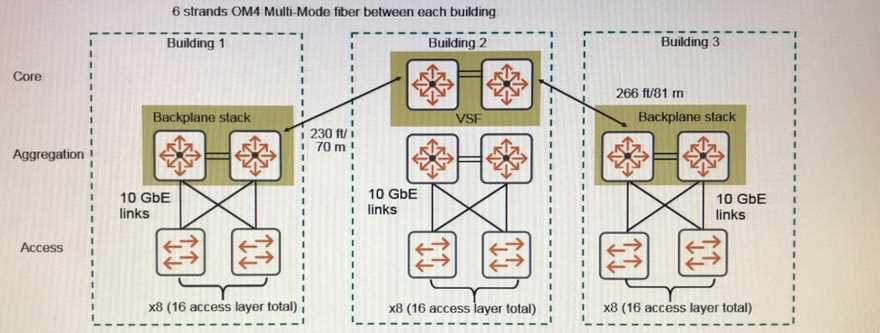
An architect determines that 80 Gbps bandwidth is required for the link aggregation between the
Building
1aggregation layer and Building 2. Which transceivers should the architect recommend for each pair
of
switches?
- A. two QSPF+ BiDi
- B. two QSPF+ MPO
- C. eight SPF+ LR
- D. eight SFP+ SR
Answer:
B
Comments
Question 4
An enterprise needs an upgrade to 802.11ac. Users run applications such as Web, email, voice, and
video.
The architect needs to conduct an active site survey to plan 802.11ac AP locations. The noise floor is
about -
90 dBm across the site.
Based on Aruba best practices, what is the minimum acceptable signal that the architect should look
for to
determine the test AP range?
- A. a signal of -65 dBm in the 2.4 GHz band
- B. a signal of -75 dBm in the 5 GHz band
- C. a signal of -65 dBm in the 5 GHz band
- D. a signal of -75 dBm in the 2.4 GHz band
Answer:
C
Comments
Question 5
An RF plan specifies wide sector directional antennas.
Refer to the antenna specifications.
H-plane refers to the Azimuth or Horizontal plane and E-plane refers to Elevation or Vertical plane.
Antenna 1: H-plane = 360; E-plane = 120
Antenna 2: H-plane = 360; E-plane = 60
Antenna 3: H-plane = 100; E-plane = 90
Antenna 4: H-plane = 60; E-plane = 60
Which antenna specifications indicate that the antenna is a good choice for the plan?
- A. Antenna 1
- B. Antenna 2
- C. Antenna 3
- D. Antenna 4
Answer:
B
Comments
Question 6
An architect needs to plan a very high density (VHD) wireless network at a large events venue, at
which
thousands of attendees are expected. The architect plans to deploy a cluster of Mobility Controllers
(MCs) to
control the APs. It is important to support seamless roaming for wireless devise across the venue.
What should the architect ensure for the network services?
- A. DHCP servers can support a high number of scopes with a /24 size.
- B. A third-party firewall integrates with ClearPass to filter the guest user traffic.
- C. A domain CA is set up to deploy certificates to a high volume of guest devices.
- D. DHCP and DNS servers are carrier-grade and support a low transaction time.
Answer:
B
Comments
Question 7
Refer to the exhibit.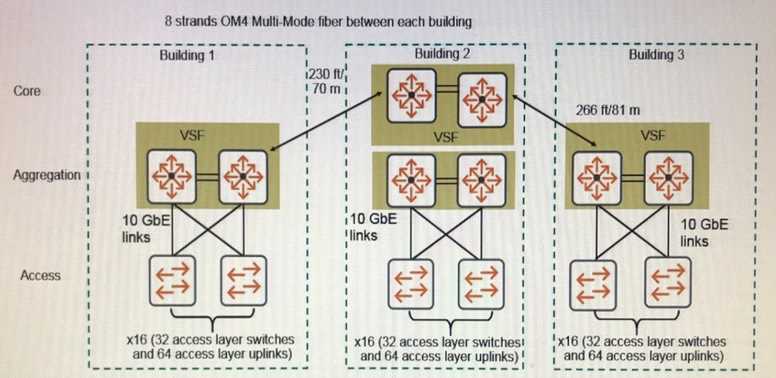
An architect selects 5406R switches for the aggregation layer. What is an appropriate amount of
bandwidth for
the link aggregation between each aggregation layer VSF fabric and the campus core?
- A. 60 Gbps
- B. 160 Gbps
- C. 200 Gbps
- D. 320 Gbps
Answer:
C
Comments
Question 8
A plan includes these security settings for the employee WLAN:
1. WPA2-Enterprise with AES encryption
2. 802.1X with PEAP-MSCHAPv2
However, the customer wants to use certificates to authenticate user devices. Which change brings
the plan in
alignment with the customer requirements?
- A. Use EAP-TLS instead of PEAP-MSCHAPv2
- B. The TKIP encryption instead of AES.
- C. Add WPA2-PSK as an alternative to WPA2-Enterprise.
- D. Add Tunneled TLS (TTLS) as an alternative to PEAP-MSCHAPv2.
Answer:
D
Comments
Question 9
A customer needs an 802.11ac upgrade for an office with cubicles. The customer states that, because
they
planned locations for the existing 802.11n APs so that there are no coverage holes, they will simply
deploy the
new 802.11ac APs in the same location as the existing APs. The customer plans to support mobile
devices in
addition to laptops.
What should the architect explain about shy a site survey is desirable to determine the optimal
locations for the
new APs?
- A. An 802ac deployment typically works better with side-mounted, rather than ceiling-mounted, APs, and a site survey will help determine the new mounting locations.
- B. The new 802.11ac deployment should have a capacity-based design for the best performance, but the existing deployment sounds like a coverage-based design.
- C. 802.11ac AP radios tend to be more sensitive to 2.4 GHz interference than 802.11n APs, so the architect needs to search for all potential sources of such interference.
- D. 802.11ac APs can support a higher density of clients, so they can be deployed farther apart than the APs in most existing 802.11n deployments.
Answer:
A
Comments
Question 10
An architect has an Instant AP (IAP) cluster at a mid-sized branch office. The IAP cluster now needs to
tunnel
corporate traffic to a Mobility Controller (MC) at the main office. However, the branch office should
remain
functional even if the link to the main office fails. Users at the branch office require access to main
office
resources, but do not require multicast services.
What is the recommended DHCP mode?
- A. Local
- B. Centralized L2
- C. Distributed L2
- D. Distributed L3
Answer:
D
Comments
Page 1 out of 5
Viewing questions 1-10 out of 60
page 2