Question 1
The pharmacy must have the results of a currentANC (Absolute Neutrophil Count) and WBC (White
Blood Cell) blood testprior to dispensing which medication?
- A. Aripiprazole
- B. Fluoxetine
- C. Amitriptyline
- D. Clozapine
Answer:
D
Explanation:
Comprehensive and Detailed Step-by-Step Explanation:
Clozapine (Clozaril)is anatypical antipsychoticused to treatschizophrenia. However, it has a severe
side effect calledagranulocytosis, which causesa dangerous drop in white blood cells (WBCs) and
neutrophils (ANCs), increasing the risk of infections.
✅
Explanation of Answer Choices:
D. Clozapine→Correct.Patients must be enrolled in theClozapine
❌
REMS program, and pharmacies must verifyANC and WBC resultsbefore dispensing.
A.
❌
Aripiprazole→ Incorrect.Aripiprazole (Abilify) does not require ANC monitoring.
B. Fluoxetine→
❌
Incorrect.Fluoxetine (Prozac) is an SSRI and does not require blood monitoring.
C. Amitriptyline→
Incorrect.Amitriptyline is a tricyclic antidepressant and does not require ANC monitoring.
Reference:
FDA Clozapine REMS Program
PTCB Exam: Medication Safety & Risk Evaluation
Comments
Question 2
Two stock bottles ofAtenololhave the following NDC numbers:
00781-1506-10and00781-1506-01. What is the difference between the bottles?
- A. Package size
- B. Dosage
- C. Manufacturer
- D. Strength
Answer:
A
Explanation:
Comprehensive and Detailed Step-by-Step Explanation:
TheNational Drug Code (NDC)is a10- or 11-digit numberidentifying a drug'smanufacturer, product,
and package size.
NDC Format:
XXXXX−YYYY−ZZ\text{XXXXX} - \text{YYYY} - \text{ZZ}XXXXX−YYYY−ZZ
First 5 digits= Manufacturer
Middle 4 digits= Drug, strength, and formulation
Last 2 digits=Package size
✅
A. Package size→Correct.Since the first two segments(00781-1506)are identical, the difference is
❌
in thelast segment, which representspackage size.
B. Dosage→ Incorrect. Thedosage (mg strength)
❌
remains the same.
C. Manufacturer→ Incorrect. Themanufacturer is the same (first 5 digits are
❌
identical).
D. Strength→ Incorrect. Thestrength is unchanged.
Reference:
FDA NDC Directory
PTCB Inventory Management Guidelines
Comments
Question 3
Desvenlafaxineis indicated to treat:
- A. Hypertension
- B. Major depressive disorder
- C. Benign prostatic hypertrophy
- D. Atrial fibrillation
Answer:
B
Explanation:
Comprehensive and Detailed Step-by-Step Explanation:
Desvenlafaxine (Pristiq)is anSNRI (Serotonin-Norepinephrine Reuptake Inhibitor)used to treatmajor
depressive disorder (MDD).
✅
Explanation of Answer Choices:
B. Major depressive disorder→Correct.Desvenlafaxine is FDA-
❌
❌
approved fordepression.
A. Hypertension→ Incorrect.Not an antihypertensive.
C. Benign
❌
prostatic hypertrophy→ Incorrect.Alpha-blockers like Tamsulosin treat BPH.
D. Atrial fibrillation→
Incorrect.Beta-blockers, not SNRIs, manage atrial fibrillation.
Reference:
FDA Drug Database: Desvenlafaxine
PTCB Exam: Pharmacology for Technicians
Comments
Question 4
According to theFDA,heparin strength per total volumeshould be the primary and prominent
expression on the manufacturer’s label, followed by the:
- A. Percentage weight per volume
- B. Volume per total strength
- C. Strength per mL enclosed in parentheses
- D. mL per dose enclosed in parentheses
Answer:
C
Explanation:
Comprehensive and Detailed Step-by-Step Explanation:
To preventheparin dosing errors, theFDA requires labeling to display:
Strength per total volume (e.g., 10,000 units/10 mL)
Strength per mL in parentheses (e.g., 1,000 units/mL)
✅
❌
Explanation of Answer Choices:
C. Strength per mL enclosed in parentheses→Correct.
A.
❌
Percentage weight per volume→ Incorrect.Heparin is not measured this way.
B. Volume per total
❌
strength→ Incorrect.Reverse order of required labeling.
D. mL per dose enclosed in parentheses→
Incorrect.Dosing varies by prescription.
Reference:
FDA Heparin Labeling Guidelines
Comments
Question 5
A prescriber orders1000 mgof a medication. If the stock bottle label stateseach tablet contains 0.1 g,
how many tablets should the patient receive?
- A. 1
- B. 10
- C. 100
- D. 1000
Answer:
B
Explanation:
Comprehensive and Detailed Step-by-Step Explanation: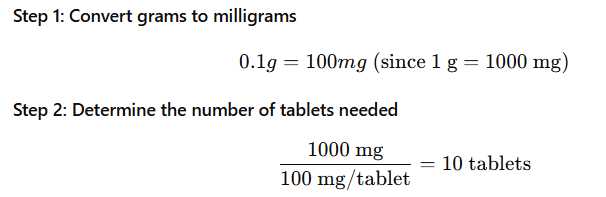
A white background with black text Description automatically generated
✅
❌
Explanation of Answer Choices:
B. 10→Correct.
A. 1→ Incorrect.1 tablet contains 100 mg, not
❌
❌
1000 mg.
C. 100→ Incorrect.Overdose.
D. 1000→ Incorrect.Severe overdose.
Reference:
USP <795> Pharmaceutical Calculations
PTCB Dosage Conversions
Comments
Question 6
Handling hazardous substances should be done:
- A. In a chemical safety cabinet.
- B. Wearing personal protective equipment.
- C. Using disposable gloves washed between each use.
- D. In a positive-pressure clean room.
Answer:
B
Explanation:
Comprehensive and Detailed Step-by-Step Explanation:
Hazardous drugs (HDs)must be handled withpersonal protective equipment (PPE), including:
Gloves (chemotherapy-rated)
Gown (disposable, impermeable material)
Eye protection (if splashing risk exists)
Respirator (if airborne exposure is possible)
✅
Explanation of Answer Choices:
B. Wearing personal protective equipment→Correct.USP <800>
❌
mandatesPPEfor handling hazardous drugs.
A. In a chemical safety cabinet→ Incorrect.Only sterile
❌
hazardous drugs require a biological safety cabinet.
C. Using disposable gloves washed between
❌
each use→ Incorrect.Disposable gloves should be discarded, not washed.
D. In a positive-pressure
clean room→ Incorrect.Hazardous drugs require negative pressure rooms, not positive pressure.
Reference:
USP <800>: Hazardous Drug Handling
NIOSH Guidelines on PPE for Hazardous Drugs
Comments
Question 7
Which of the following medications is indicated to treatdiabetes?
- A. Galantamine
- B. Gemfibrozil
- C. Glimepiride
- D. Granisetron
Answer:
C
Explanation:
Comprehensive and Detailed Step-by-Step Explanation:
Glimepiride (Amaryl)is asulfonylureaused tolower blood sugar in type 2diabetesby increasinginsulin
secretion from the pancreas.
✅
Explanation of Answer Choices:
C. Glimepiride→Correct.Atype 2 diabetes
❌
❌
medication(sulfonylurea).
A. Galantamine→ Incorrect.Used for Alzheimer’s disease.
B.
❌
Gemfibrozil→ Incorrect.Used to lower cholesterol (fibrate).
D. Granisetron→ Incorrect.Used for
nausea and vomiting (antiemetic).
Reference:
FDA Drug Database: Glimepiride
PTCB Pharmacology Section: Diabetes Medications
Comments
Question 8
Which of the following should be a characteristic of a successfulroot-cause analysis (RCA)used to
investigate a significant medication error?
- A. Termination of employment for the individuals involved in the medication error.
- B. Focusing primarily on systems and processes rather than individual performance.
- C. Immediate reporting of the error to the state board of pharmacy for a third-party investigation.
- D. Criminal charges against the responsible pharmacist if a patient experienced serious injury or death.
Answer:
B
Explanation:
Comprehensive and Detailed Step-by-Step Explanation:
Root-Cause Analysis (RCA)is asystematic approachused toidentify the underlying causes of
medication errors. RCA focuses onsystems and processes, not individual blame.
✅
Explanation of Answer Choices:
B. Focusing primarily on systems and processes rather than
❌
individual performance→Correct.RCA aims toprevent future errors by improving systems.
A.
❌
Termination of employment→ Incorrect.Blaming individuals does not address system failures.
C.
❌
Immediate reporting to the state board→ Incorrect.RCA is an internal investigation process.
D.
Criminal charges→ Incorrect.RCA focuses on improvement, not legal punishment.
Reference:
ISMP Guidelines on Root-Cause Analysis
PTCB Medication Safety Principles
Comments
Question 9
Which of the following statements regardingspecific patient medication returns in the hospital
settingis correct?
- A. Unlabeled medications may be dispensed by the nurse at discharge.
- B. Unopened units-of-use returned from outpatients may be redispensed.
- C. Unopened units-of-use returned from inpatients may be redispensed.
- D. Crediting of unused doses is not feasible.
Answer:
C
Explanation:
Comprehensive and Detailed Step-by-Step Explanation:
Hospitals mayredispenseunopened, sealed, unit-dose medicationsreturned frominpatients, as long
as they areproperly storedand not tampered with.
✅
Explanation of Answer Choices:
C. Unopened units-of-use returned from inpatients may be
redispensed→Correct.Hospital pharmacies canredispense sealed unit-dose medications from
❌
inpatients.
A. Unlabeled medications may be dispensed by the nurse at discharge→
❌
Incorrect.Unlabeled meds cannot be dispensed due to safety concerns.
B. Unopened units-of-use
returned from outpatients may be redispensed→ Incorrect.Medications dispensed to outpatients
❌
cannot be returned to stock.
D. Crediting of unused doses is not feasible→ Incorrect.Many
hospitals have systems for crediting unused doses.
Reference:
USP <795> and <797>: Hospital Medication Storage
PTCB Medication Safety Regulations
Comments
Question 10
A physician prescribes5 mg/kgof a drugtwice dailyfor a patient weighing110 lbs. How many0.5 g
tabletsof the drug are required for a10-day duration?
- A. 5
- B. 10
- C. 20
- D. 40
Answer:
C
Explanation:
Comprehensive and Detailed Step-by-Step Explanation: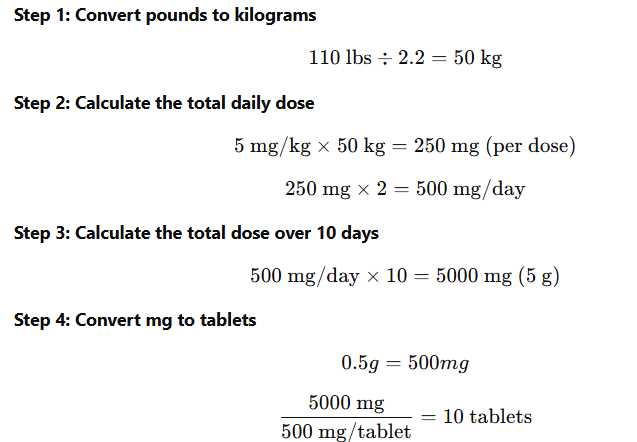
A math formula on a white background Description automatically generated
✅
❌
Explanation of Answer Choices:
C. 20→Correct.2 tablets per day × 10 days = 20 tablets.
A. 5→
❌
❌
Incorrect. Under-dose.
B. 10→ Incorrect. Under-dose.
D. 40→ Incorrect. Over-dose.
Reference:
USP <795> Pharmaceutical Calculations
PTCB Exam: Dosing Conversions
Comments
Page 1 out of 22
Viewing questions 1-10 out of 223
page 2