Question 1
The Control Limits width varies if the sample size varies for which type of chart?
- A. P Charts
- B. NP Charts
- C. Xbar-R Charts
- D. Time Series Charts
Answer:
A
Comments
Question 2
Which of these elements are not included in Implementation plans?
- A. Work breakdown structure
- B. Risk management plans
- C. Cost/Benefit ratios
- D. Planned audits of work completion
Answer:
C
Comments
Question 3
Upon completion and validation of an improvement to a process a Belt and the Project Team create a
Control Plan that contains which of these?
- A. Standard operating work description of the process change
- B. Description of the monitoring system in place to assure continued compliance
- C. Summary of the targeted critical metrics for process performance measurement
- D. All of the above
Answer:
D
Comments
Question 4
What conclusion is most correct about the Experimental Design shown here with the response in the
far right column?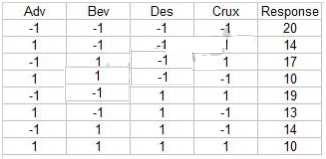
- A. No factor has enough statistical confidence greater than 95% to have an impact on the response rate
- B. Constant, Adv and Bev are the only factors statistically affecting the response rate with 95% confidence or more
- C. If the Adv is increased from the low level to the high level, the response rate increases
- D. The response level is statistically concluded to only need the Adv and Bev factors set at the low level to get the largest response rate
- E. This design does not have enough experimental runs to conclude anything as evidenced by the lack of P-values in the MINITABTM output
Answer:
D
Comments
Question 5
Which statement(s) are correct about the Factorial Plot shown here? (Note: There are 3 correct
answers).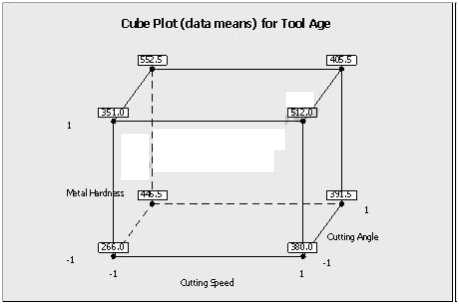
- A. When the cutting speed increased from low to high level, the tool age increases
- B. The coefficient of the metal hardness is positively related to the output of tool age
- C. The coded coefficient is lower for cutting speed than the cutting angle related to the output of tool age
- D. These plots prove a statistically significance factor with 95% confidence
- E. These plots are an example of interaction plots
Answer:
A,B,C
Comments
Question 6
How many experimental runs exist in a Full Factorial and fully randomized design for 4 factors with 2
replicates for the Corner Points and no Center Points? The factors in the experiment are only at 2-
levels.
- A. 10
- B. 32
- C. 256
- D. 64
Answer:
B
Comments
Question 7
If an experiment has 5 factors and no replicates for a 2-level Experimental Design with 16
experimental runs which statement is incorrect?
- A. The Experimental Design is half-fractional
- B. The Main Effects are confounded with only 4-way interactions
- C. The Main Effects for the 5 factors are not aliased or confounded but the 2-way interactions are confounded with the 3-way interactions
- D. The experiment has 8 experimental runs with the first factor at the high level
Answer:
C
Comments
Question 8
Which statement(s) are correct about the Pareto Chart shown here for the DOE analysis? (Note:
There are 2 correct answers).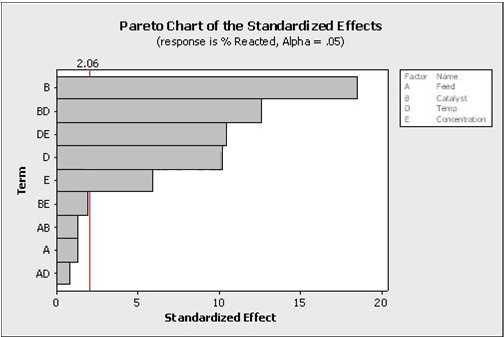
- A. It is unknown from this graph how many factors were in the Experimental Design
- B. The factors to keep in the mathematical model are E, D, DE, BD and B with an alpha risk equal to 2.06
- C. The effects to keep in the mathematical model are E, D, DE, BD and B with an alpha risk equal to 0.05
- D. The factors to keep in the mathematical model with a 5% alpha risk are BE, AB, A and AD
Answer:
A,C
Comments
Question 9
Fractional Factorial, ____________and Response Surface Method are types of planned experiments.
- A. Multi-Vari Analysis
- B. Baldridge Channels
- C. One Factor at a Time or OFAT
- D. Factorial Design
Answer:
D
Comments
Question 10
Relative to a Design of Experiments the term ________________ refers to variables being a linear
combination of each other.
- A. Mirror Image
- B. Directly Parallel
- C. Collinear
- D. None of the above
Answer:
C
Comments
Page 1 out of 29
Viewing questions 1-10 out of 300
page 2