Question 1
A database administrator manages a database server that is running low on disk space. A lot of
backup files are stored on the server's disks.
Which of the following is the best action for the administrator to take?
- A. Move all the backup files to external disks.
- B. Delete all the backup files containing data that is rated as classified.
- C. Delete all the backup files that are not required by the backup retention policy.
- D. Delete all the backup files except for the most recent one.
Answer:
C
Explanation:
The best action for the administrator to take is to delete all the backup files that are not required by
the backup retention policy. This will free up disk space on the server and also comply with the best
practices for data backup and recovery. The backup retention policy defines how long the backup files
should be kept and when they should be deleted or archived. The other options are either risky,
inefficient, or impractical. For example, moving all the backup files to external disks would require
additional hardware and time, deleting all the backup files containing data that is rated as classified
would compromise data security and compliance, and deleting all the backup files except for the
most recent one would limit the recovery options in case of a disaster. Reference:
CompTIA DataSys+
Course Outline
, Domain 5.0 Business Continuity, Objective 5.2 Given a scenario, implement backup
and restoration of database management systems.
Comments
Question 2
A business analyst is using a client table and an invoice table to create a database view that shows
clients who have not made purchases yet. Which of the following joins is most appropriate for the
analyst to use to create this database view?
- A. INNER JOIN ON Client.Key = Invoice.Key
- B. RIGHT JOIN ON Client.Key = Invoice.Key WHERE BY Client.Key IS NOLL
- C. LEFT JOIN ON Client.Key = Invoice.Key
- D. LEFT JOIN ON Client.Key = Invoice.Key WHERE BY Invoice.Key IS NOLL
Answer:
D
Explanation:
The join that is most appropriate for the analyst to use to create this database view is option D. This
join uses the LEFT JOIN clause to combine the client table and the invoice table based on the
matching values in the Key column. The WHERE clause filters out the rows where
the Invoice.Key column is not null, meaning that the client has made a purchase. The result is a view
that shows only the clients who have not made any purchases yet. The other options either do not
produce the desired result or have syntax errors. For example, option A would show only the clients
who have made purchases, option B would show only the invoices that do not have a matching
client, and option C would show all the clients regardless of their purchase
status. Reference:
CompTIA DataSys+ Course Outline
, Domain 1.0 Database Fundamentals, Objective
1.2 Given a scenario, execute database tasks using scripting and programming languages.
Comments
Question 3
A database administrator would like to create a table named XYZ. Which of the following queries
should the database administrator use to create the table?
A)
B)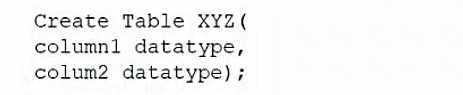
C)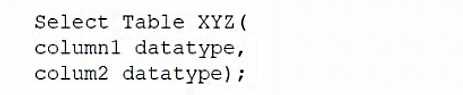
D)
- A. Option A
- B. Option B
- C. Option C
- D. Option D
Answer:
B
Explanation:
The query that the administrator should use to create the table is option B. This query uses
the CREATE TABLE statement to define a new table named XYZ with three columns: ID, Name,
and Age. Each column has a data type and a constraint, such as NOT NULL, PRIMARY KEY, or CHECK.
The other options either have syntax errors, use incorrect keywords, or do not specify the table name
or columns correctly. Reference:
CompTIA DataSys+ Course Outline
, Domain 1.0 Database
Fundamentals, Objective 1.1 Given a scenario, identify and apply database structure types.
Comments
Question 4
A database administrator needs to provide access to data from two different tables to multiple group
users in order to facilitate ongoing reporting. However, some columns in each table are restricted,
and users should not be able to see the values in these columns.
Which of the following is the best action for the administrator to take?
- A. Create a stored procedure.
- B. Create a view.
- C. Create a csv export.
- D. Create a trigger.
Answer:
B
Explanation:
The best action for the administrator to take is to create a view. A view is a virtual table that shows a
subset of data from one or more tables. The administrator can use a view to provide access to data
from two different tables to multiple group users without exposing the restricted columns. The view
can also simplify the queries and improve the performance of the reporting process. The other
options are either not suitable for this scenario or do not address the requirement of hiding some
columns from users. For example, creating a stored procedure would require additional coding and
execution, creating a csv export would create a static file that may not reflect the latest data changes,
and creating a trigger would perform an action in response to an event rather than provide access to
data. Reference:
CompTIA DataSys+ Course Outline
, Domain 2.0 Database Deployment, Objective 2.2
Given a scenario, create database objects using scripting and programming languages.
Comments
Question 5
Which of the following describes a scenario in which a database administrator would use a relational
database rather than a non-relational database?
- A. An organization wants to maintain consistency among the data in the database.
- B. An organization requires data encryption.
- C. An organization wants to process complex data sets.
- D. An organization wants to store a large number of videos, photos, and documents.
Answer:
A
Explanation:
A scenario in which a database administrator would use a relational database rather than a non-
relational database is when an organization wants to maintain consistency among the data in the
database. A relational database is a type of database that organizes data into tables with predefined
columns and rows, and enforces rules and constraints to ensure data integrity and accuracy. A
relational database also supports transactions, which are sets of operations that must be executed as
a whole or not at all, to prevent data corruption or inconsistency. The other options are either not
exclusive to relational databases or not relevant to the choice of database type. For example, data
encryption can be applied to both relational and non-relational databases, processing complex data
sets may require specialized tools or techniques that are not dependent on the database type, and
storing a large number of videos, photos, and documents may be better suited for a non-relational
database that can handle unstructured or semi-structured data. Reference:
CompTIA DataSys+
Course Outline
, Domain 1.0 Database Fundamentals, Objective 1.1 Given a scenario, identify and
apply database structure types.
Comments
Question 6
A database administrator set up a connection for a SQL Server instance for a new user, but the
administrator is unable to connect using the user's workstation. Which of the following is the most
likely cause of the issue?
- A. The SQL Server codes are performing badly.
- B. The SQL Server has not been tested properly.
- C. The SQL Server ports to the main machine are closed.
- D. The SQL Server has many concurrent users.
Answer:
C
Explanation:
The most likely cause of the issue is that the SQL Server ports to the main machine are closed. SQL
Server uses TCP/IP ports to communicate with clients and other servers. If these ports are blocked by
a firewall or other network device, the connection will fail. The administrator should check the port
configuration on both the server and the user’s workstation, and make sure that they are open and
match the expected values. The other options are either unlikely or unrelated to the issue. For
example, the SQL Server codes performing badly or having many concurrent users may affect the
performance or availability of the server, but not prevent the connection entirely; the SQL Server not
being tested properly may cause errors or bugs in the functionality or security of the server, but not
affect the connection unless there is a configuration problem. Reference:
CompTIA DataSys+ Course
Outline
, Domain 2.0 Database Deployment, Objective 2.3 Given a scenario, troubleshoot common
database deployment issues.
Comments
Question 7
A group of developers needs access to a database in a development environment, but the database
contains sensitive dat
a. Which of the following should the database administrator do before giving the developers access
to the environment?
- A. Audit access to tables with sensitive data.
- B. Remove sensitive data from tables
- C. Mask the sensitive data.
- D. Encrypt connections to the development environment.
Answer:
C
Explanation:
The database administrator should mask the sensitive data before giving the developers access to
the environment. Data masking is a technique that replaces sensitive data with fictitious but realistic
data, such as random numbers or characters, to protect it from unauthorized access or exposure.
Data masking preserves the format and structure of the original data, but does not reveal its actual
value. This allows developers to work with realistic data without compromising its confidentiality or
compliance. The other options are either insufficient or excessive for this scenario. For example,
auditing access to tables with sensitive data may help monitor and track who accesses the data, but
does not prevent it from being seen; removing sensitive data from tables may compromise the
quality or completeness of the data, and may not be feasible if there is a large amount of data;
encrypting connections to the development environment may protect the data in transit, but not at
rest or in use. Reference:
CompTIA DataSys+ Course Outline
, Domain 4.0 Data and Database Security,
Objective 4.2 Given a scenario, implement security controls for databases.
Comments
Question 8
A database administrator needs to aggregate data from multiple tables in a way that does not impact
the original tables, and then provide this information to a department. Which of the following is the
best way for the administrator to accomplish this task?
- A. Create a materialized view.
- B. Create indexes on those tables
- C. Create a new database.
- D. Create a function.
Answer:
A
Explanation:
The best way for the administrator to accomplish this task is to create a materialized view. A
materialized view is a type of view that stores the result of a query on one or more tables as a
separate table in the database. A materialized view can aggregate data from multiple tables in a way
that does not impact the original tables, and then provide this information to a department as a
single source of truth. A materialized view also improves query performance and efficiency by
reducing the need to recompute complex queries every time they are executed. The other options
are either not suitable or not optimal for this task. For example, creating indexes on those tables may
improve query performance on individual tables, but not on aggregated data; creating a new
database may require additional resources and maintenance, and may introduce inconsistency or
redundancy; creating a function may require additional coding and execution, and may not store the
result as a separate table. Reference:
CompTIA DataSys+ Course Outline
, Domain 2.0 Database
Deployment, Objective 2.2 Given a scenario, create database objects using scripting and
programming languages.
Comments
Question 9
A database administrator is migrating the information in a legacy table to a newer table. Both tables
contain the same columns, and some of the data may overlap.
Which of the following SQL commands should the administrator use to ensure that records from the
two tables are not duplicated?
- A. UNION
- B. JOIN
- C. IINTERSECT
- D. CROSS JOIN
Answer:
A
Explanation:
The SQL command that the administrator should use to ensure that records from the two tables are
not duplicated is option A. This command uses the UNION clause to combine the records from the
legacy table and the newer table into a single result set. The UNION clause also eliminates any
duplicate records that may exist in both tables, and sorts the result by default. The other options
either do not produce the desired result or have syntax errors. For example, option B would join the
records from the two tables based on a common column, but not remove any duplicates; option C
would return only the records that are common to both tables, but not the ones that are unique to
each table; option D would produce a Cartesian product of the records from the two tables, which
would increase the number of duplicates. Reference:
CompTIA DataSys+ Course Outline
, Domain 1.0
Database Fundamentals, Objective 1.2 Given a scenario, execute database tasks using scripting and
programming languages.
Comments
Question 10
A company is launching a proof-of-concept, cloud-based application. One of the requirements is to
select a database engine that will allow administrators to perform quick and simple queries on
unstructured dat
a. Which of the following would be best suited for this task?
- A. MonogoDB
- B. MS SQL
- C. Oracle
- D. Graph database
Answer:
A
Explanation:
The best suited database engine for this task is MongoDB. MongoDB is a type of non-relational
database that stores data as documents in JSON-like format. MongoDB allows administrators to
perform quick and simple queries on unstructured data, such as text, images, videos, or social media
posts, without requiring a predefined schema or complex joins. MongoDB also supports cloud-based
deployment, scalability, and high availability. The other options are either relational databases that
require a fixed schema and structure for data, or specialized databases that are designed for specific
purposes, such as graph databases for storing and analyzing network data. Reference:
CompTIA
DataSys+ Course Outline
, Domain 1.0 Database Fundamentals, Objective 1.1 Given a scenario,
identify and apply database structure types.
Comments
Page 1 out of 7
Viewing questions 1-10 out of 80
page 2