Question 1
What two actions should be taken to deploy a new Cisco ACI Multi-Pod setup? (Choose two.)
- A. Configure anycast RP for the underlying multicast protocol
- B. Configure the TEP pool of the new pod to be routable across the IPN
- C. Configure MP-BGP on IPN routers that face the Cisco ACI spines
- D. Increase interface MTU for all IPN routers to support VXLAN traffic
- E. Connect all spines to the IPN
Answer:
de
Comments
Question 2

Refer to the exhibit. Server S1 is connected to Cisco ACI using two NIC interfaces. NIC1 is an active interface and NIC2 is a standby interface. NIC2 uses its MAC address to send traffic to the Cisco ACI fabric when NIC1 is offline. The requirement is to update the IP address to use the MAC address of NIC2. Which action accomplishes this goal?
- A. Clear remote MAC entries.
- B. Set L2 Unknown Unicast to Proxy.
- C. Activate IP Data Plane Learning,
- D. Enable GARP EP Move Detection.
Answer:
d
Comments
Question 3
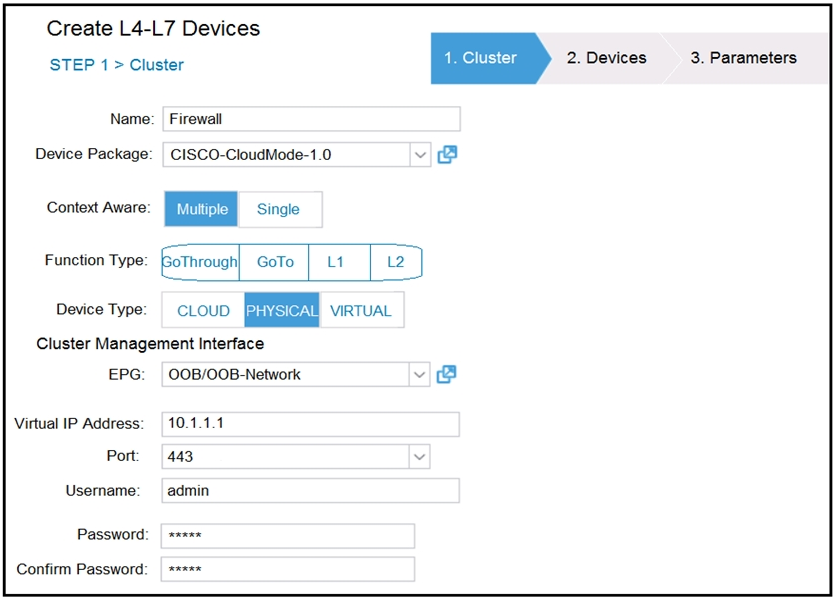
Refer to the exhibit. A network engineer configures a Layer 4 to Layer 7 device for an outside routed firewall that is connected to POD-1 inside a Cisco ACI fabric that consists of two pods. All traffic from POD-1 or POD-2 that uses the L3Out should pass through the routed firewall. Which Function Type must be implemented in the service graph for POD-2 to use L3Out?
- A. GoThrough
- B. L1
- C. GoTo
- D. L2
Answer:
d
Comments
Question 4

Refer to the exhibit. How is the ARP request from VM1 forwarded when VM2 is not learned in the Cisco ACI fabric?
- A. Leaf 101 forwards the ARP request to one of the proxy VTEP spines.
- B. POD1 spine responds to the ARP request after the POD1 COOP is updated with the VM2 location.
- C. Leaf 101 encapsulates the ARP request into a multicast packet that is destined to 225.0.37.192.
- D. Leaf 101 switch consumes the ARP reply of VM2 to update the local endpoint table.
Answer:
a
Comments
Question 5
How is the traffic directed to the firewall pair in a two-site Multi-Pod deployment with an active/standby firewall pair stretched across pods?
- A. to the pod with the active service node
- B. to a collector in the Inter-Pod Network
- C. to the pod designated as the primary pod
- D. to the local service node for processing
Answer:
d
Comments
Question 6
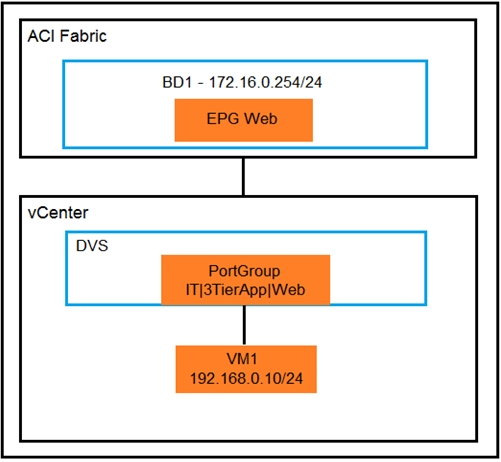
An organization migrates its virtualized servers from a legacy environment to Cisco ACI. VM1 is incorrectly attached to PortGroup IT|3TierApp|Web. Which action limits IP address learning in BD1?
- A. Enable Enforce Subnet Check
- B. Enable Rouge Endpoint Control
- C. Enable GARP-based EP Move Detection Mode
- D. Disable Remote EP Learn
Answer:
c
Comments
Question 7

Refer to the exhibit. What must be configured to allow the PBR node (LB-int) to monitor the availability of the endpoint that is in the EPG server?
- A. Endpoint Dataplane Learning
- B. Unicast Route disabled for client and server bridge domains
- C. PBR node tracking
- D. Direct Connect in the service graph template
Answer:
a
Comments
Question 8
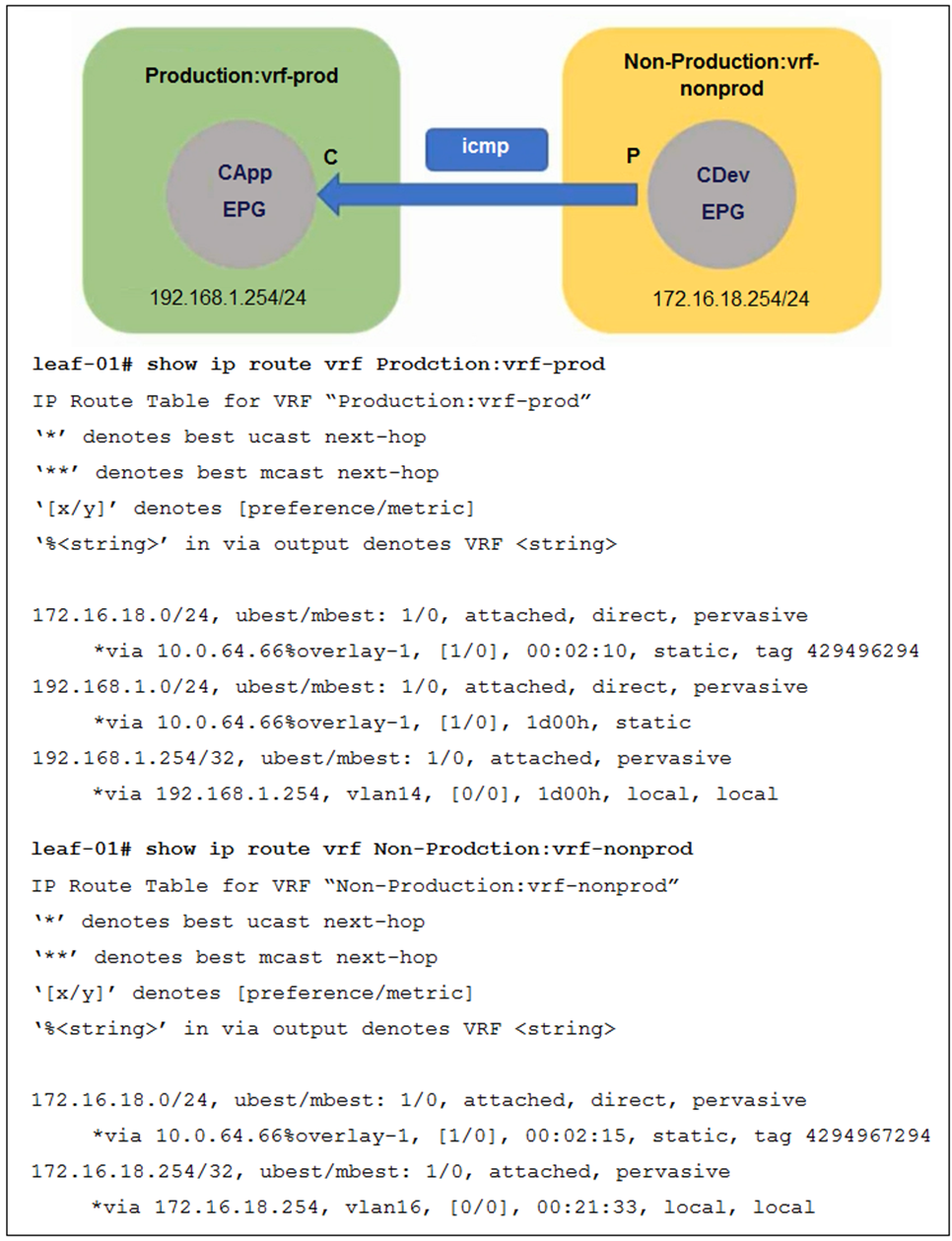
Refer to the exhibit. An administrator configures inter-VRF route leaking between Production:vrf-prod and Non-Production:vrf-nonprod. However, the route in the Non-Production:vrf-nonprod VRF to the production tenant is missing. Which action resolves the VRF route leaking issue?
- A. Enable the Shared between VRFs option for the BD subnet in the production VRF.
- B. Change the contract scope to Global.
- C. Enable the Shared between VRFs option for the EPG subnet in the non-production VRF.
- D. Export the contract from provider to consumer tenant.
Answer:
a
Comments
Question 9
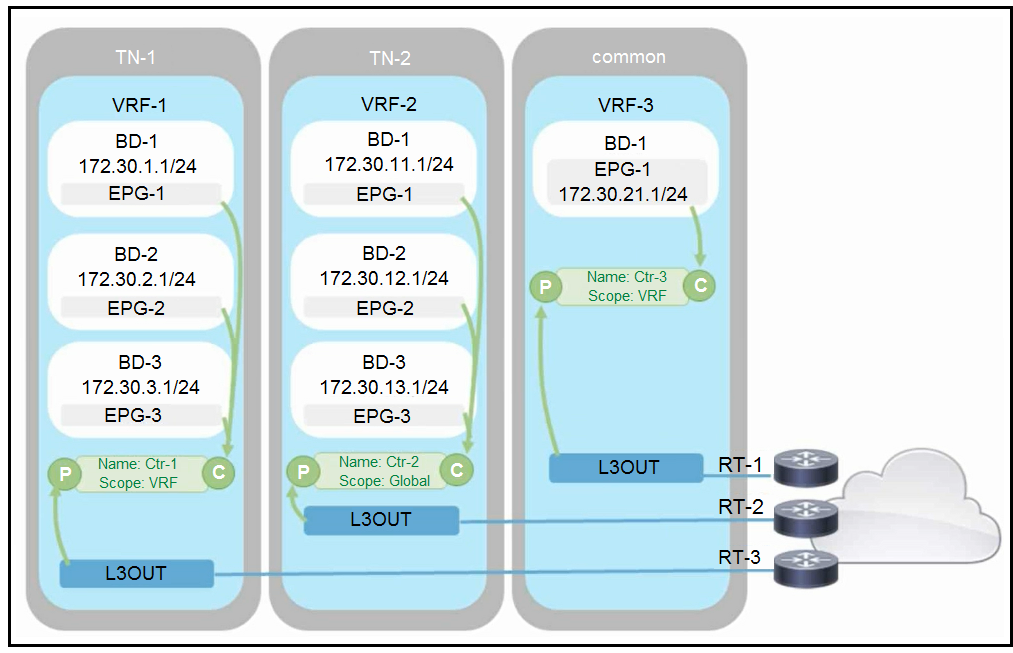
Refer to the exhibit. A company decided to decrease its routing footprint and remove RT-2 and RT-3 devices from its data center. Because of that, the exit point must be created from all the tenants by using the common tenant. Which two configuration tasks must be completed to meet these requirements? (Choose two.)
- A. Move subnets from all the bridge domains to the EPG level and mark them with flag Shared between VRFs.
- B. Change contract Ctr-3 scope to Global, consume it by all EPGs, and flag all subnets with flag Shared between VRFs.
- C. Update the L3Out ExtEPG subnet in the common tenant with flag Shared Route Control Subnet and Aggregate Shared Routes.
- D. Mark all subnets with flag Shared between VRFs and attach contract Ctr-3 as a provider to all the EPGs.
- E. Export contract Ctr-2 into the tenant TN-1 and attach it as a consumer to all the EPGs in the tenant TN-1.
Answer:
ac
Comments
Question 10
What is a use of the Overlay Multicast TEP in Cisco ACI Multi-Site communication?
- A. to perform headend replication
- B. to act as the source IP for BUM traffic
- C. to establish MP-BGP adjacencies with remote spines
- D. to send and receive unicast VXLAN data plane traffic
Answer:
b
Reference:
https://www.cisco.com/c/en/us/solutions/collateral/data-center-virtualization/application-centric-infrastructure/white-paper-c11-
739609.html#CiscoACIMultiSiteoverlaydataplane
Comments
Page 1 out of 10
Viewing questions 1-10 out of 106
page 2