Question 1
A project team is engaged in a risk assessment process prior to the execution of a major project. One
risk is assessed to be of low impact but medium likelihood (probability). In these circumstances the
appropriate response is:
- A. Accept the risk, but monitor closely
- B. Negotiate the transfer of the risk to a third party
- C. Accept (tolerate) the risk without further action
- D. Take immediate steps to terminate the risk
Answer:
A
Comments
Question 2
With respect to the management of quality on projects, which of the following statements is true?
- A. The only actions required are to inspect the final deliverables and reject items that do not meet specifications.
- B. A key responsibility of a project manager is to ensure that design specifications are met.
- C. The central theme of project quality is to exceed the expectations of the client by building to the highest standards.
- D. Most project processes produce outputs with no variation in quality characteristics.
Answer:
B
Comments
Question 3
The initial Balanced Scorecard design, defined by Kaplan and Norton, used four perspectives (or legs)
for management control and the implementation of strategy. What are the FOUR original
perspectives?
- A. Learning and growth
- B. Internal business
- C. External issues
- D. Competitors
- E. Financial
- F. Customer
Answer:
A,B,E,F
Comments
Question 4
Hersey and Blanchard developed a theory of situational leadership which suggested that successful
leaders should change their leadership style according to the maturity of the subordinates they are
leading. This includes an assessment of their professional ability and their readiness to undertake set
tasks.
Based on this theory, which leadership style would be best suited to a subordinate showing the
highest levels of maturity, readiness, ability and willingness to tackle the work available?
- A. Delegating
- B. Telling
- C. Selling
- D. Participating
Answer:
A
Comments
Question 5
Which of the following best describes generic competitors?
- A. Competitors which compete for the same income as the company.
- B. Competitors which compete with products which, although technically quite different, satisfy the same needs.
- C. Competitors which have similar goods but not necessarily the same size or structure organisation.
- D. Competitors which have similar size and structure and offer similar products to the same customers.
Answer:
A
Comments
Question 6
Identify ways in which an orgnisation can undertake qualitative research.
Select ALL that apply.
- A. Conducting a focus group
- B. Carrying out observations
- C. Calculating ratios on sales data
- D. Carrying out interviews
- E. Studying organisations operating statements
Answer:
A,B,D
Comments
Question 7
V is the owner of a small jewellery business which deals exclusively in pearls. The business has built
up an excellent network of suppliers which deliver a steady stream of high quality pearls
to its workshops, where a team of highly skilled craftsmen turn basic pearls into items of jewellery. V
feels that no other company has such a talented and valuable workforce and believes their skills are
rare and difficult if not impossible to imitate. They are the key to the company's sustainable
competitive advantage and success.
What is the approach to strategy which proposes that competitive advantage is achieved from the
organisation's unique assets or competences?
- A. Resource-based view
- B. Emergent strategy
- C. Rational strategy model
- D. Free-wheeling opportunism
Answer:
A
Comments
Question 8
Examine the network diagram shown and identify ALL of the statements below that are true.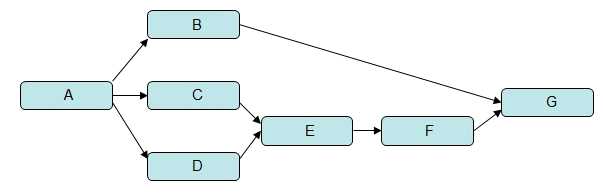
- A. Task C is a predecessor of E
- B. Task G may begin when either Task B or Task F have finished
- C. When Task A is complete, three tasks may begin
- D. Task D is a successor to F
Answer:
A,C
Comments
Question 9
X is a Project Manager who works in a matrix organisational structure with an authoritarian
leadership style. Team members are seconded on a part-time basis to teams led by X, who will then
contribute to their individual performance appraisals at the end of each year.
X requires all team members to follow exactly what he tells them without question because he has
the authority to provide negative feedback in their performance appraisals. According to the French
and Raven model, select the type of power that X is using in these circumstances.
- A. Coercive
- B. Reward
- C. Referent
- D. Feedback
Answer:
A
Comments
Question 10
Q is a manager planning to introduce new workflow technology into a busy office environment. Q
knows this will impact the work pattern of everyone in the office and is very concerned about the
potential reaction from staff and how best to manage the change process.
Q decides to document all possible factors and concerns. A list of all the positive factors in favour of
change is made in one column, and all the factors against the change in another column. This
analysis will enable Q to decide how best to reduce the strength of the factors opposing the change,
and/or increase the strength of the factors in favour.
Select the approach that Q is adopting.
- A. Force field analysis
- B. Incremental change
- C. Transformational development
- D. Stakeholder analysis
Answer:
A
Comments
Page 1 out of 20
Viewing questions 1-10 out of 210
page 2