Question 1
The principal budget factor can be defined as:
- A. The factor which has the highest value in the budget
- B. The factor which limits the activities of the organisation
- C. The factor which is most likely to result in an adverse variance
- D. The factor which is least likely to change in the future
Answer:
B
Comments
Question 2
Which of the following statements is correct?
i. sector bodies use budgetary planning and control systems
ii. costing cannot be used by public sector bodies because they have no measurable output
iii. in public sector bodies tend to focus on cost management therefore they have no need for non-
financial information
- A. (i) only
- B. (i) and (ii) only
- C. (ii) and (iii) only
- D. (i) and (iii) only
Answer:
A
Comments
Question 3
GB Limited operates a standard costing system. During the month 18,500 labour hours were worked
at a standard cost of $6 per hour. The labour efficiency variance was $8,700 favourable.
How many standard hours were produced?
- A. 1,450
- B. 19,950
- C. 17,050
- D. 18,500
Answer:
C
Comments
Question 4
Refer to the Exhibit.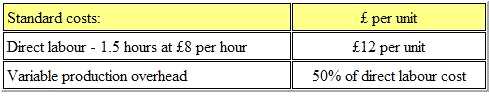
AM Ltd. makes and sells a single product for which the standard cost information is as follows:
Budgeted production for the period is 30000 units.
The actual results for the period were as follows: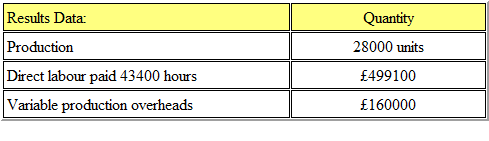
What is the variable overhead expenditure variance?
- A. 13,161 adverse
- B. 13,161 favourable
- C. 13,600 adverse
- D. 13,600 favourable
Answer:
D
Comments
Question 5
CORRECT TEXT
Refer to the Exhibit.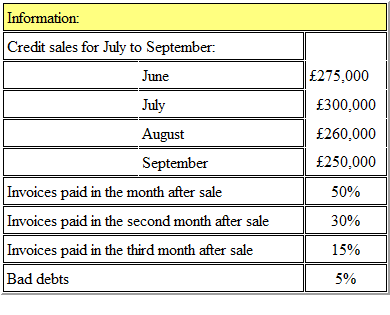
The following details have been extracted from the receivables collection records of SBC:
The amount budgeted to be received in September from credit sales is, to the nearest £000:
Answer:
£257000
Comments
Question 6
In a manufacturing company which produces a range of products, the production manager's salary
would be classified as A.
- A. Direct labour cost
- B. Direct expense
- C. Indirect labour cost
- D. Indirect expense
Answer:
C
Comments
Question 7
An increase in the selling price per unit, will cause the point at which the line plotted on a
profit/volume (PV) graph intersects the horizontal axis to:
- A. Move to the left
- B. Move to the right
- C. Double
- D. Stay where it is
Answer:
A
Comments
Question 8
Prime cost is:
- A. Total product cost minus overheads
- B. The material cost of the product
- C. The cost of operating a cost centre
- D. All costs incurred in making a product
Answer:
A
Comments
Question 9
The management accountant has completed the appraisal of an investment in new office equipment.
It has now been discovered that the cost of capital used in the appraisal should have been higher.
What will be the effect on the calculated net present value (NPV) and the payback period?
- A. NPV increase; payback period increase
- B. NPV decrease; payback period decrease
- C. NPV decrease; payback period stay the same
- D. NPV decrease; payback period increase
Answer:
C
Comments
Question 10
Which of the following best describes a step cost?
- A. A cost which remains constant until activity reaches a critical level; thereafter the cost increases to a higher level and the unit cost remains constant until the next critical activity level is reached.
- B. A cost which increases steadily until activity reaches a critical level; thereafter the cost increases to a higher level and the total cost remains constant until the next critical activity level is reached.
- C. A cost which remains constant until activity reaches a critical level; thereafter the cost increases to a higher level and the total cost remains constant until the next critical activity level is reached.
- D. A cost which increases per unit until activity reaches a critical level; thereafter the cost increases to a higher level and the unit cost remains constant until the next critical activity level is reached.
Answer:
C
Comments
Page 1 out of 39
Viewing questions 1-10 out of 392
page 2