Question 1
Assume that no additional product risks have been identified during the first week of test execution.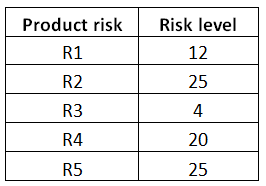
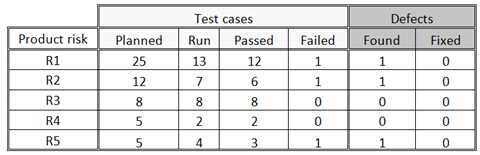
Which of the following answers would you expect to best describe the residual risks associated with
the identified product risks, at the end of the first week of test execution?
Number of correct responses: 1
- A. Since R3 is the only risk for which all test cases have passed, the risk has been reduced by 20%
- B. The test execution status table indicates that the risk has been reduced by 56%
- C. The residual risk level can’t be determined, because it requires that all the test cases have been executed
- D. The test execution table doesn’t give an indication of the risk level of the open defects and the test cases that failed or are not run yet
Answer:
D
Comments
Question 2
The following are the exit criteria described in the test plan of a software product:
EX1. The test suite for the product must ensure that at least each quality risk item is covered by at
least one test case (a quality risk item can be covered by more test cases).
EX2. All test cases in the test suite must be run during the execution phase.
EX3. Defects are classified into two categories: “C” (critical defect) and “NC” (non-critical defect). No
known C defects shall exist in the product at the end of the test execution phase.
Which of the following information is useless when the specified exit criteria is evaluated?
Number of correct responses: 1
- A. A traceability matrix showing the relationships between the product risk items and the test cases
- B. A list of all the open defects with the associated classification information extracted from the defect tracking system
- C. A chart, showing the trend in the lag time from defect reporting to resolution, extracted from the defect tracking system
- D. The execution status of all the test cases extracted from the test management tool
Answer:
C
Comments
Question 3
Which of the following is an example of the test closure activity indicated as "lessons learned"?
Number of correct responses: 1
- A. Archive all the test results of the acceptance testing phase
- B. Deliver a list of the open defects of a software product released into production to the service desk team
- C. Participate in a meeting at the end of a project aimed at better managing the events and problems of future projects
- D. Deliver an automated regression test suite, used during the system test phase of a software product released into production, to the team responsible for maintenance testing
Answer:
C
Comments
Question 4
A chart showing the trend in the lag time from defect reporting to resolution during system testing is
also available. The chart shows that the daily closure period is consistently and significantly above
the rolling closure period for a long period of the system testing phase.
Almost all defects found during system testing have been related to the system as a whole, not
related to single units or integrations issues. Almost all quality risks have been addressed during the
unit and integration testing phase and no residual quality risks were present in the integrated
system. This has been confirmed by exploratory testing sessions performed during system testing,
targeted at finding defects in these quality risk areas.
Based on the given information only, which one of the following areas would you expect to be
considered more in the retrospective meeting in order to be improved?
Number of correct responses: 1
- A. The requirements review
- B. The defect management process
- C. The quality risk analysis process
- D. The system design and architecture design reviews
Answer:
B
Comments
Question 5
You can count on well-written requirements, but you can’t count on an adequate contribution of the
stakeholders to the quality risk analysis. You have to mitigate the insufficient contribution of the
stakeholders because the risk-based testing approach shall minimize the product risks. Your test
team has one expert tester in security testing.
Which of the following test activities would you expect to be the less important in this context?
Number of correct responses: 1
- A. Extract from the defect tracking system of the previous project all the security defects and failures, and classify them to support design and execution of specific tests
- B. Automate all functional and non-functional system tests
- C. Apply systematic and exploratory testing for integration and system test
- D. Perform exploratory testing sessions with adequate charters covering security aspects
Answer:
B
Comments
Question 6
You are the Test Manager on a project following an iterative life-cycle model. The project should
consist of nine iterations of one month duration each. It is planned to develop the most important
features to have a stable core of the application in the first three iterations and to add the additional
features in the last six iterations.
At the beginning of the first iteration, only a draft version of the requirements specification
document for the core features is available. Assume that during each of the first three iterations, the
chosen features are fully completed and unit tested.
Which of the following statements is true in this context?
Number of correct responses: 1
- A. The system test phase should start when all the requirements are frozen
- B. You should allocate a large effort for system testing during the first three iterations
- C. You should allocate all the effort for the system test phase only in the last iteration
- D. You should apply the same test strategy as used in a sequential life cycle model
Answer:
B
Comments
Question 7
Which of the following statements, about the test reporting activities for a project adopting an
iterative lifecycle model with very short iterations (e.g. two weeks iterations), is correct?
Number of correct responses: 1
- A. Test reporting activities can’t be influenced by the use of an iterative lifecycle model with short iterations
- B. Test reporting activities are not important for projects adopting an iterative lifecycle model with short iterations
- C. Test reporting activities are less important for projects adopting an iterative life cycle model with short iterations. They should be performed at the end of the last iteration
- D. Test reporting activities are still important with an iterative lifecycle. The reports can be used to conduct post-iteration review sessions before starting with the next iteration
Answer:
D
Comments
Question 8
Consider an agile team adopting Extreme Programming (XP) with five developers and one tester
without any coding experience.
To which of the following activities would you expect the tester will contribute most?
Number of correct responses: 1
- A. Developing unit tests
- B. Executing unit tests
- C. Planning and executing tests during the integration test phase to detect interface defects
- D. Supporting the customer in the execution of acceptance testing
Answer:
D
Comments
Question 9
Which of the following statements best describes an appropriate approach for managing exploratory
testing?
Number of correct responses: 1
- A. Define very detailed mission statements, which allow testing work to be broken into sessions of up to 10 minutes duration in which testing is guided by these mission statements
- B. Break the testing work in 30 to 120 minutes sessions and use properly defined mission statements consisting of two or three sentences to guide testing during these sessions
- C. Define very generic charters to drive exploratory testing sessions of 2 days where testers are completely free to decide what to test
- D. Exploratory testing should not be managed because such testing is inherently unmanageable and not measurable
Answer:
B
Comments
Question 10
Assume you are managing the system testing phase of a project.
The system test execution period is scheduled to twenty weeks.
All tests are manual tests. You are following a risk-driven test approach.
During the last staff meeting the project manager tells you new deadlines that will not allow
completion of all the system tests.
Which of the following would you expect to be the best way to respond to this situation?
Number of correct responses: 1
- A. Prioritize executing the tests for the highest product risks and track these risks
- B. Remove testers from your test team, so that they can be assigned to other projects
- C. Automate all remaining tests
- D. No action is needed, test as much as possible in the remaining time period
Answer:
A
Comments
Page 1 out of 6
Viewing questions 1-10 out of 65
page 2