Question 1
You're developing a user input form for a government services application that includes a file upload
component.
If the uploaded file is a multimedia file (for example: .MP4, .MOV or .WAV), the customer wants
these uploaded to Microsoft SharePoint instead.
What is the best way to achieve this requirement?
- A. Use the out-of-the-box Appian Connected System, but since it does not have any pre-built connected systems, you will need to use either a HTTP or OpenAI Connected System to connect with SharePoint.
- B. Develop a connected system plug-in given SharePoint has an extensive API that cannot easily be resolved using the Appian out-of-the-box Connected System.
- C. Use the out-of-the-box Appian Connected System as it has a pre-built connected system to SharePoint to provide a guided experience for designers to send and receive data.
Answer:
C
Explanation:
Appian provides an out-of-the-box pre-built connected system for SharePoint, allowing you to
integrate file uploads to SharePoint with a guided experience for configuration—making this the best
way to fulfill the requirement.
Comments
Question 2
Your client reported that a form in the application is very slow to load.
You investigate and find a query entity which is nor performing well.
Which action should you perform to improve query performance for the query entity?
- A. Change the data source of the query entity to a view with a WHERE clause.
- B. Apply indices on all the fields referred in the query.
- C. Apply the appropriate filters and indices in both Appian and the database.
Answer:
C
Explanation:
Applying appropriate filters and indices in both Appian and the database ensures that only relevant
data is retrieved and the database query runs efficiently, improving overall query performance.
Comments
Question 3
You need to write an expression to retrieve a list of all account managers who don't currently have an
active customer account.
Which code snippet should you use?
A)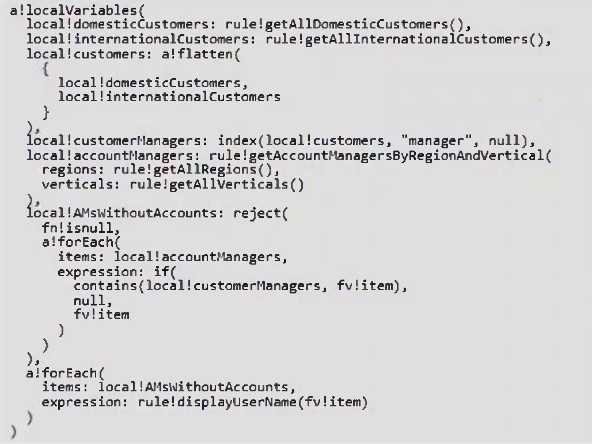
B)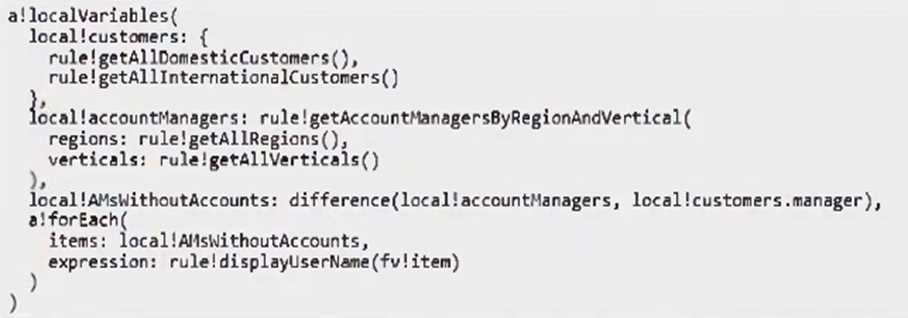
C)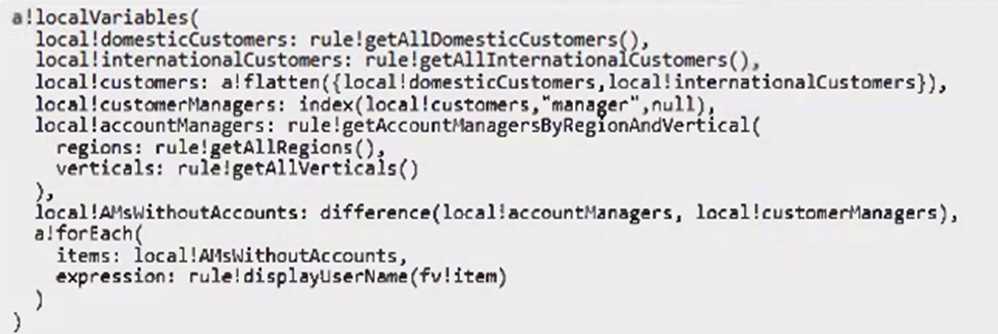
- A. Option A
- B. Option B
- C. Option C
Answer:
B
Explanation:
Chosen snippet uses the difference() function to efficiently get all account managers who are not
currently managers of any customer account. It directly compares local!accountManagers to
local!customers.manager, resulting in a concise and optimal solution for retrieving account managers
without an active customer account.
Comments
Question 4
You're creating a new record type with data sync enabled. Users in the "ACME Employees" group
must be able to access the record list and start the New Case action.
What are two valid steps that you should perform to grant users the appropriate access? (Choose
two.)
- A. Add the “ACME Employees" group as a Viewer on the record type.
- B. Add the "ACME Employees" group as a Viewer to the data store mapped to the record.
- C. Grant Viewer permissions to the underlying interface object for the record list.
- D. Grant Initiator permissions to the underlying process model for the New Case action.
Answer:
A, D
Explanation:
Adding the “ACME Employees” group as a Viewer on the record type allows them to access the
record list.
Granting Initiator permissions to the process model for the New Case action enables group members
to start that action.
Comments
Question 5
You have designed a three-step 'Wizard' form interaction using user input tasks in the process model.
The second step of the Wizard must utilize another process model which contains a user input task
inside.
Which two methods should be implemented for a seamless Wizard-like interaction for the user?
(Choose two.)
- A. Enable activity-chaining between all nodes on the main process model.
- B. Enable activity chaining between all nodes in the second process model, and activity chain between all user input tasks.
- C. Use a subprocess to call the second process model.
- D. Use the Start Process smart service to call the second process model.
Answer:
A, C
Explanation:
Enabling activity-chaining between all nodes on the main process model ensures the wizard steps
flow seamlessly for the user.
Using a subprocess to call the second process model allows the main process to incorporate its user
input task as part of the wizard flow with activity-chaining support.
Comments
Question 6
You need to implement a field-level audit functionality on the application data, and then display a log
of the changes made over time to the users.
What should you do?
- A. Create Audit table(s) and create stored procedures on each transaction table to compare and save the modified data.
- B. Create utility process model(s) to insert new version of the modified data for the same record into the transaction tables on modification.
- C. Create Audit table(s) and create triggers on each transaction table to record modifications into the Audit table.
Answer:
C
Explanation:
Creating audit tables and using triggers on each transaction table ensures that all field-level changes
are automatically recorded at the database level, providing a reliable and consistent audit log for
display to users.
Comments
Question 7
Which two options are correct regarding record relationships when using synced records in your
application? (Choose two.)
- A. Relationships can be established between any record types that have sync enabled, regardless of the source.
- B. Many-to-one relationships can be established using record relationships.
- C. Record type relationships enforce referential integrity.
- D. Up to 20 relationships can be added on a record type with data sync enabled.
Answer:
B, D
Explanation:
Many-to-one relationships can be established between record types using record relationships.
Up to 20 relationships can be added to a record type with data sync enabled, according to Appian
platform limits.
Comments
Question 8
You're creating a support case record type while working on a support case management system. You
want to track support case status changes.
You want to use record events to track this information.
Which record data source type is the most appropriate for you to use?
- A. Web service without data sync enabled
- B. Database source with data sync enabled
- C. Process Model source with data sync enabled
Answer:
B
Explanation:
A database source with data sync enabled is required to use record events for tracking support case
status changes, as Appian record events are only supported for synced record types with a database
as the data source.
Comments
Question 9
A local variable is reevaluated every time a form loads and you notice subsequent slow performance
of the form.
Which two steps could you perform to optimize this? (Choose two.)
- A. Create a local variable inside with () for faster reevaluation.
- B. Ensure the local variable is refreshed after a specified interval, and nor refreshed when referenced variable are changed.
- C. Avoid executing queries every time a form reevaluates.
- D. Ensure the local variable only updates when a referenced variable is modified or when it's being updated in the saveInto parameter of a component.
Answer:
C, D
Explanation:
Avoiding queries on every form reevaluation prevents unnecessary data retrieval and improves form
performance.
Ensuring the local variable only updates when necessary (e.g., on relevant variable changes or via
saveInto) reduces redundant recalculations and optimizes responsiveness.
Comments
Question 10
A process was recently pushed to the Prod environment. However, users are reporting that a task on
this process is experiencing slow response times when they try to input data.
What is the most likely reason for this issue?
- A. The process uses too many hidden variables.
- B. There are too many SAIL components on the task.
- C. Exception timers on tasks are set to values that are too low.
- D. The task is assigned to too many users.
Answer:
B
Explanation:
Having too many SAIL components on the task can cause slow response times for users, as the
interface may take longer to render and process inputs, impacting performance.
Comments
Page 1 out of 9
Viewing questions 1-10 out of 99
page 2