Question 1
An Adobe Commerce developer is writing an integration test. They checked some Integration Tests
for Magento core modules for reference and noticed that they use data fixtures initialized by adding
annotations to test classes. For example:
The developer wants to add their own fixture to test a MyVendor_MyModule they created. Which
steps will make this possible?
A.
1. Create a PHP file with the fixture data inside their own module in [module
dir]/Test/integration/_fiies/my_fixture.php.
2. Add the following annotation to the test method:
B.
1. Create a PHP file With the fixture data in [magento root
dir]/dev/tests/integration/testsuite/MyVendor/MyModule/_files/my_fixture.php.
2. Add the following annotation to the test method:
C.
1. Create a PHP file with the fixture data inside their own module in [module dir]/Test/integration/_f
iies/my_f ixture.php.
2. Add the following annotation to the test method:
- A. Option A
- B. Option B
- C. Option C
Answer:
B
Explanation:
To add a custom fixture to test a MyVendor_MyModule, the developer needs to do the following:
Create a PHP file with the fixture data in [magento root
dir]/dev/tests/integration/testsuite/MyVendor/MyModule/_files/my_fixture.php.
Add the following annotation to the test method:
@magentoDataFixture(
'testsuite/MyVendor/MyModule/_files/my_fixture.php'
)
This will tell Magento to load the fixture data from the my_fixture.php file before the test method is
executed.
Comments
Question 2
An Adobe Commerce developer has created a before plugin for the save() function within the
Magento\Framework\App\cache\Proxy class. The purpose of this plugin is to add a prefix on all
cache identifiers that fulfill certain criteria.
Why is the plugin not executing as expected?
- A. Another around plugin defined for the same function does not call the callable.
- B. Cache identifiers are immutable and cannot be changed.
- C. The target ClaSS implements Magento\Framework\ObjectManager\NoninterceptableInterface.
Answer:
C
Explanation:
According to the Plugins (Interceptors) guide for Magento 2 developers, plugins are class methods
that modify the behavior of public class methods by intercepting them and running code before,
after, or around them. However, some classes in Magento 2 implement the
NoninterceptableInterface interface, which prevents plugins from being generated for them. The
Magento\Framework\App\cache\Proxy class is one of them, as it extends from
Magento\Framework\ObjectManager\NoninterceptableInterface. Therefore, the plugin is not
executing as expected because the target class implements NoninterceptableInterface. Verified
Reference: https://devdocs.magento.com/guides/v2.3/extension-dev-guide/plugins.html
Comments
Question 3
An Adobe Commerce developer has installed a module from a third-party vendor. This module fires a
custom event named third_party_event_after and also defines an observer named
third_party_event_after_observer that listens to that event. The developer wants to listen to this
custom event in their own module but wants to execute their observer's logic after the
third_party_event_after_observer observer has finished executing.
What would the developer do to ensure their observer runs after the observer defined by the third-
party module?
- A. Ensure the third-party module is listed in the <sequence> node of the developer's module.xmi file.
- B. Set the sort order of the new observer to be less than that of the third-party vendor's observer.
- C. This is not possible as observers listening to the same event may be invoked in any order.
Answer:
B
Explanation:
To ensure that the developer's observer runs after the observer defined by the third-party module,
they need to set the sort order of the new observer to be less than that of the third-party vendor's
observer.
The sort order is a number that is assigned to each observer. The lower the number, the earlier the
observer will be executed.
For example, if the third-party vendor's observer has a sort order of 10, the developer's observer
would need to have a sort order of 9 or lower.
Comments
Question 4
An Adobe Commerce developer has been asked to modify the PageBuilder slider content type to
allow a new custom content type (other than slide) to be assigned as a child. The developer has
already created the new content type called improved_slide in their module. They now need to
create a new view/adminhtml/pagebuilder/content_type/slider. xml file in their module to allow the
new content type to be a child of slider content types.
What is the correct xml to accomplish this?
A)
B)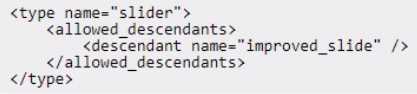
C)
- A. Option A
- B. Option B
- C. Option C
Answer:
B
Explanation:
The following XML will allow the new content type to be a child of slider content types:
<pagebuilder_content_type>
<type>slider</type>
<children>
<type>improved_slide</type>
</children>
</pagebuilder_content_type>
Use code with caution.
https://bard.google.com/faq#coding
This XML will tell Magento that the slider content type can have improved_slide content types as
children.
Comments
Question 5
An Adobe Commerce developer creates a new website using a data patch. Each website will have
unique pricing by website. The developer does not have visibility into the production and staging
environments so they do not know what the configuration currently is.
How would they ensure the configuration is deployed and consistent across all environments?
A)
B)
C)
- A. Option A
- B. Option B
- C. Option C
Answer:
B
Explanation:
To ensure that the configuration is deployed and consistent across all environments, the developer
can use the following steps:
Create a data patch that contains the configuration for the new website.
Deploy the data patch to all environments.
Use the magento deploy:status command to verify that the configuration has been deployed to all
environments.
Comments
Question 6
An Adobe Commerce developer was asked to provide additional information on a quote. When
getting several quotes, the extension attributes are returned, however, when getting a single quote it
fails to be returned.
What is one reason the extension attributes are missing?
- A. The developer neglected to add coiiection="trueM to their attribute in etc/extension_attributes.xmi file. O ottribute code="my_attributesM type="MyVendor\MyModule\Api\Data\^AttributeInterface[]M collection="true" />
- B. The developer neglected to provide a plugin On Hagento\Quote\Api\CartRepositoryInterface: :get.
- C. The developer neglected to implement an observer on the coiiection_ioad_after event.
Answer:
A
Explanation:
The extension attributes are missing because the collection="true" attribute is not set in the
etc/extension_attributes.xmi file. This attribute tells Magento that the extension attributes should be
returned when the quote is retrieved.
To fix this issue, the developer needs to add the collection="true" attribute to the my_attributes
extension attribute.
<attribute code="my_attributes" type="MyVendor\MyModule\Api\Data\AttributeInterface[]"
collection="true" />
Once the collection="true" attribute is set, the extension attributes will be returned when the quote
is retrieved.
Comments
Question 7
A logistics company with an Adobe Commerce extension sends a list of reviewed shipment fees to all
its clients every month in a CSV file. The merchant then uploads this CSV file to a "file upload" field in
admin configuration of Adobe Commerce.
What are the two requirements to display the "file upload" field and process the actual CSV import?
(Choose two.)
A)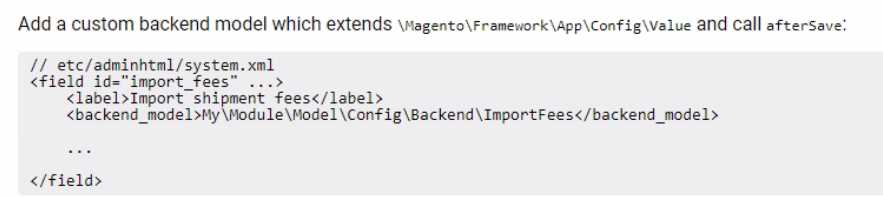
B)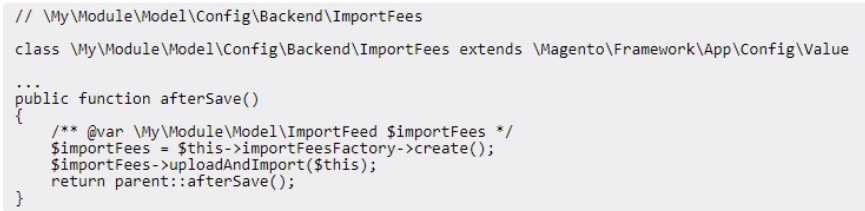
C)
D)
- A. Option A
- B. Option B
- C. Option C
- D. Option D
Answer:
AB
Explanation:
To display the "file upload" field and process the actual CSV import, the following two requirements
must be met:
The developer must create a new system configuration setting that specifies the path to the CSV file.
The developer must create a new controller action that handles the file upload and import process.
The system.xml file is used to define system configuration settings. The following XML snippet shows
how to define a new system configuration setting for the CSV file path:
XML
<config>
<system>
<config>
<shipment_fees_csv_path>/path/to/csv/file</shipment_fees_csv_path>
</config>
</system>
</config>
The Controller\Adminhtml\ShipmentFees controller class is used to handle the file upload and
import process. The following code shows how to create a new controller action that handles the file
upload and import process:
PHP
public function uploadAction()
{
$file = $this->getRequest()->getFile('shipment_fees_csv_file');
if ($file->isUploaded()) {
$importer = new ShipmentFeesImporter();
$importer->import($file);
}
return $this->redirect('adminhtml/system_config/edit/section/shipment_fees');
}
Comments
Question 8
An Adobe Commerce developer is tasked with adding custom data to orders fetched from the API.
While keeping best practices in mind, how would the developer achieve this?
- A. Create an extension attribute on Nagento\sales\Api\E)ata\orderinterface and an after plugin on Magento\Sales\Model\Order: :getExtensionAttributes() to add the custom data.
- B. Create an extension attribute On Magento\Sales\Api\Data\OrderInterface and an after plugin On Magento\Sales\Api\OrderRepositoryInterface On geto and getListo to add the custom data.
- C. Create a before plugin on Magento\sales\model\ResourceModel\order\collection: :load and alter the query to fetch the additional data. Data will then be automatically added to the items fetched from the API.
Answer:
B
Explanation:
The developer should create an extension attribute on the Magento\Sales\Api\Data\OrderInterface
interface and an after plugin on the Magento\Sales\Api\OrderRepositoryInterface::get() and
Magento\Sales\Api\OrderRepositoryInterface::getList() methods.
The extension attribute will store the custom data. The after plugin will be used to add the custom
data to the order object when it is fetched from the API.
Here is the code for the extension attribute and after plugin:
PHP
namespace MyVendor\MyModule\Api\Data;
interface OrderExtensionInterface extends \Magento\Sales\Api\Data\OrderInterface
{
/**
* Get custom data.
*
* @return string|null
*/
public function getCustomData();
/**
* Set custom data.
*
* @param string $customData
* @return $this
*/
public function setCustomData($customData);
}
namespace MyVendor\MyModule\Model;
class OrderRepository extends \Magento\Sales\Api\OrderRepositoryInterface
{
/**
* After get order.
*
* @param \Magento\Sales\Api\OrderRepositoryInterface $subject
* @param \Magento\Sales\Api\Data\OrderInterface $order
* @return \Magento\Sales\Api\Data\OrderInterface
*/
public function afterGetOrder($subject, $order)
{
if ($order instanceof OrderExtensionInterface) {
$order->setCustomData('This is custom data');
}
return $order;
}
/**
* After get list.
*
* @param \Magento\Sales\Api\OrderRepositoryInterface $subject
* @param \Magento\Sales\Api\Data\OrderInterface[] $orders
* @return \Magento\Sales\Api\Data\OrderInterface[]
*/
public function afterGetList($subject, $orders)
{
foreach ($orders as $order) {
if ($order instanceof OrderExtensionInterface) {
$order->setCustomData('This is custom data');
}
}
return $orders;
}
}
Once the extension attribute and after plugin are created, the custom data will be added to orders
fetched from the API.
Comments
Question 9
An Adobe Commerce developer has created a process that exports a given order to some external
accounting system. Launching this process using the Magento CLI with the command php
bin/magento my_module:order: process --order_id=<order_id> is required.
Example: php bin/magento my_module:order:process --order_id=1245.
What is the correct way to configure the command?
A)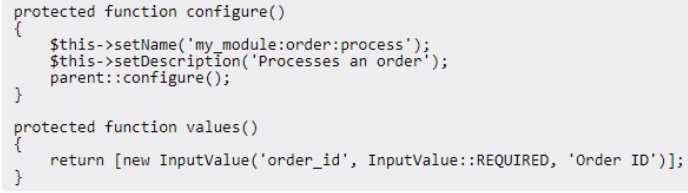
B)
C)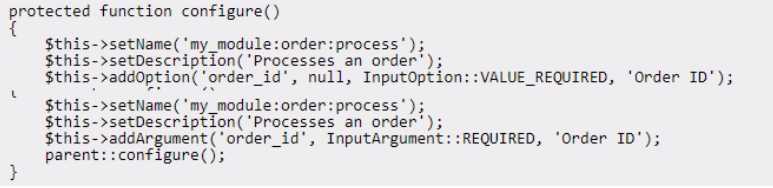
D)
- A. Option B
- C. Option C
- D. Option D
Answer:
C
Explanation:
According to the How to use the Magento command-line interface (CLI) guide, to configure and run
the Magento CLI, the developer needs to make the bin/magento file executable and then use it to
run commands. To create a custom command, the developer needs to create a class that implements
\Symfony\Component\Console\Command\Command and define its name, description, arguments,
options, and logic. The developer also needs to register the command in the di.xml file of their
module using the Magento\Framework\Console\CommandList argument. Therefore, option C is the
correct answer, as it shows the correct class and di.xml code to configure the custom command.
Verified Reference:
https://www.a2hosting.com/kb/installable-applications/optimization-and-
configuration/magento1/using-the-magento-command-line-interface-cli/
Comments
Question 10
An Adobe Commerce developer is working on a Magento 2 instance which contains a B2C and a B2B
website, each of which contains 3 different store views for English, Welsh, and French language
users. The developer is tasked with adding a link between the B2C and B2B websites using a generic
link template which is used throughout the sites, but wants these links to display in English
regardless of the store view.
The developer creates a custom block for use with this template, before rendering sets the translate
locale and begins environment emulation using the following code:
They find that the template text is still being translated into each stores language. Why does this
occur?
- A. startEnvironmffntEmulation() SetS and locks the locale by Using the setLocale() Optional Second $lock parameter, i.e. setLocale($newLocaleCode, true), to override and lock the locale of the emulated store. If this is set and locked initially then the environment emulation will not be able to override this.
- B. startEnvironmentEmuiation() resets the translation locale to the one of the emulated stores, which overrides the locale the developer has set when the order of setLocate and startEnvironmentEmulation is used as displayed above.
- C. setLocate() does not change translation locale after it has been initially set, the $this->_translate- >emulate($newLocaiecode) method exists to temporarily modify this by pushing the new locale to the top of the current emuiatedLocales stack.
Answer:
B
Explanation:
The startEnvironmentEmulation() method resets the translation locale to the one of the emulated
stores, which overrides the locale the developer has set when the order of setLocale() and
startEnvironmentEmulation() is used as displayed above.
The correct way to achieve the desired result is to use the emulate() method to temporarily modify
the translation locale. The following code shows how to do this:
PHP
$this->_translate->emulate('en_US');
// Render the template
$this->_translate->revert();
This code will set the translation locale to English before rendering the template, and then revert the
locale back to the default value after the template has been rendered.
The startEnvironmentEmulation() method is used to emulate a different store view or website. This
can be useful for testing purposes, or for developing features that need to work in different
environments.
The emulate() method is used to temporarily modify the translation locale. This can be useful for
rendering templates in a specific language, or for testing features that need to work in different
languages.
Comments
Page 1 out of 6
Viewing questions 1-10 out of 69
page 2